
Deep Hole Drill Guide: 30D–50D Through-Coolant Long Drill
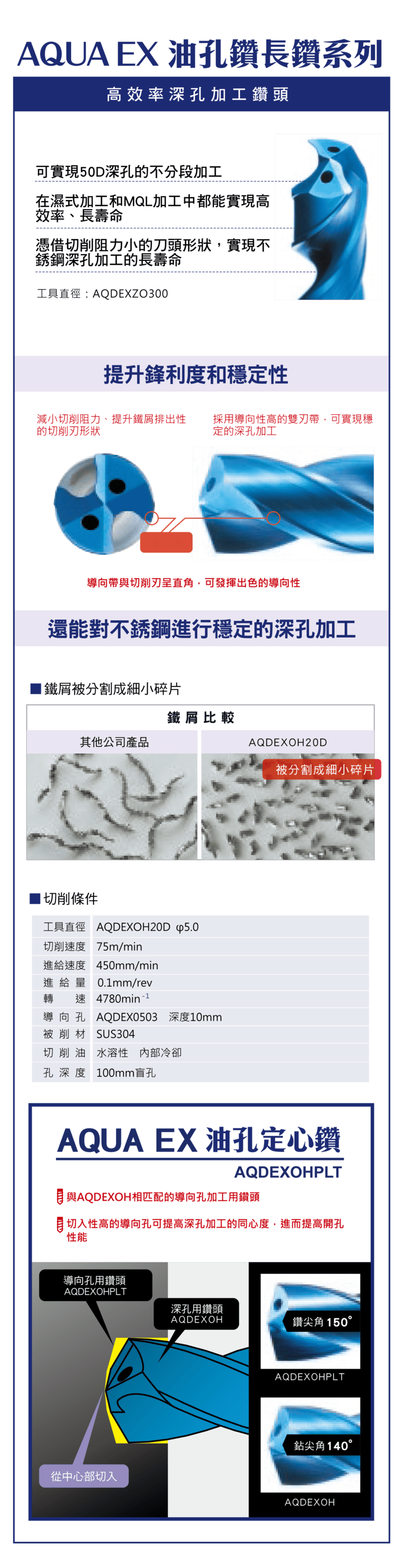
Oil-hole (through-coolant long) drills are built for deep holes: an internal coolant channel and low-resistance geometry enable 30D or even 50D drilling without pecking, sharply raising efficiency and stability. On S50C and SUS304, both wet and MQL machining hold stable life and strong evacuation, cutting wear and breakage risk. This guide covers the working principle, deep-hole capability, evacuation and guiding design as a reference for high-efficiency deep-hole drilling.
1. Working Principle
An oil-hole drill has an internal coolant channel that delivers coolant straight to the tip, improving evacuation and cooling, reducing thermal distortion and wear, and stabilizing deep-hole drilling. For cooling types and selection, see the Through-Coolant Drill Guide.
2. Deep-Hole Capability (30D–50D)
| Capability | Description |
|---|---|
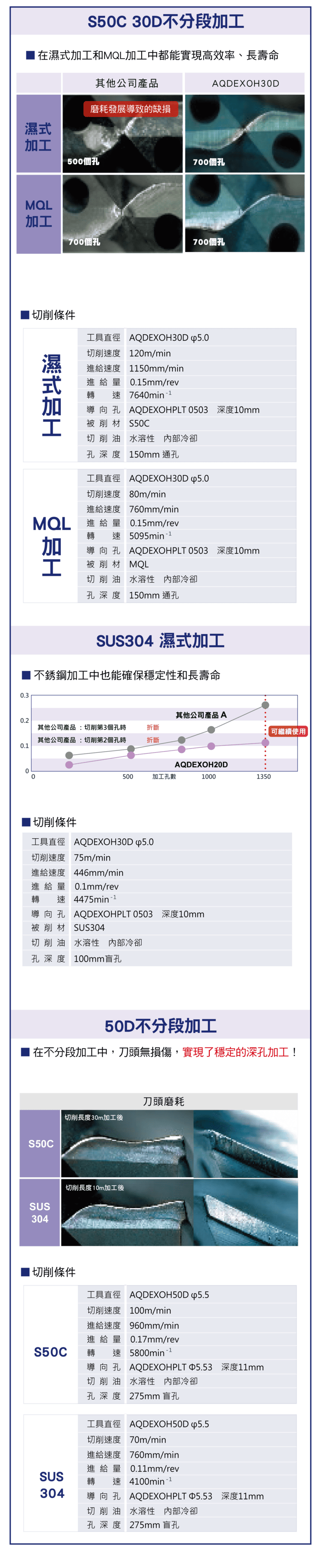
| 30D, no pecking | 30× diameter in one pass |
| 50D deep hole | 50× diameter drilling (mfr. example) |
| No retract | No repeated pecking — higher efficiency, less time |
3. Stability and Tool Life (Manufacturer Example)
| Material | Life (mfr. example) |
|---|---|
| S50C | 700+ holes |
| SUS304 | Over 1000 holes |
※ Manufacturer example data; actual results vary with tool, machine and conditions.
4. Wet vs MQL Machining
Wet machining cools strongly and suits high loads; MQL (minimum-quantity lubrication) uses little oil and is greener while still holding stable life. Both pair well with oil-hole drills — choose by your site's environmental and load needs.
5. Evacuation and Cutting Behavior
Oil-hole drills typically use low-resistance geometry and finer chips; with internal coolant, chips clear smoothly and clogging is avoided, improving wall quality and reducing defects. For chip reading, see the Drill Chip Formation Guide.
6. Inclined Faces, Accuracy and Guiding
Oil-hole drills can machine inclined-face holes (about 15°) with stable diameter, high roundness and low runout. A pilot drill improves location and reduces drift; geometry with the cutting edge perpendicular to the margin strengthens guidance, improving deep-hole straightness and stability.
7. Cutting Conditions (Reference)
| Material | Cutting speed (ref.) | Feed (ref.) |
|---|---|---|
| S50C | approx. 100–120 m/min | approx. 0.15–0.17 mm/rev |
| SUS304 | approx. 70–75 m/min | approx. 0.1–0.11 mm/rev |
※ Hole-depth range approx. 100–275 mm (mfr. example). Indicative values; base working parameters on the Drilling Parameters Guide or the maker's catalog rather than copying them.
8. Applications
Oil-hole drills suit high-L/D deep holes and molds, automotive and aerospace parts; pair them with a rigid machine such as a CNC machining center and ensure stable internal-coolant supply.
FAQ
Q: How is an oil-hole drill different from a normal drill?
It has an internal coolant channel that delivers coolant straight to the tip, so heat removal and evacuation are far better than a normal drill — ideal for deep holes and difficult materials.
Q: Do deep holes require internal coolant?
Deep holes evacuate poorly and trap heat; internal (oil-hole) coolant greatly improves evacuation and cooling and reduces breakage. It is strongly recommended for high-L/D deep holes.
Q: What do 30D and 50D mean?
D is the drill diameter, so 30D/50D means hole depth is 30/50 times the diameter. Higher multiples are deeper and harder to evacuate, needing internal coolant and low-resistance geometry to stay stable. See Drill Point Geometry Guide: Point Types, Thinning and Selection for details.
Q: Can MQL be used for deep holes?
Yes. With an oil-hole drill, MQL can hold stable life in deep holes and is greener; but for very high loads or very deep holes, wet high-pressure internal coolant is safer.
For the full reading guide on this topic, see Chip Control: A Complete Reading Guide.
This article is part of Drill Bits: The Complete Guide - Start From Depth-to-Diameter, Then Pick the Drill and Set the Conditions; that guide shows how the whole topic fits together.
Published: 2026-03-24 | Last updated: 2026-10-31









