
Measuring and Designating a Buttress Thread: Wire Sizes and the BUTT Callout
The standard three-wire formula assumes both flanks share one angle. A buttress thread has 7 degrees on one side and 45 on the other, so that assumption fails at the first step. It has its own wire-size formulas, and two ways to choose a wire. The other half of the problem is on the drawing: the fields left out of a BUTT callout are not unspecified - each one has a default, and misreading them turns a tension part into a compression part.
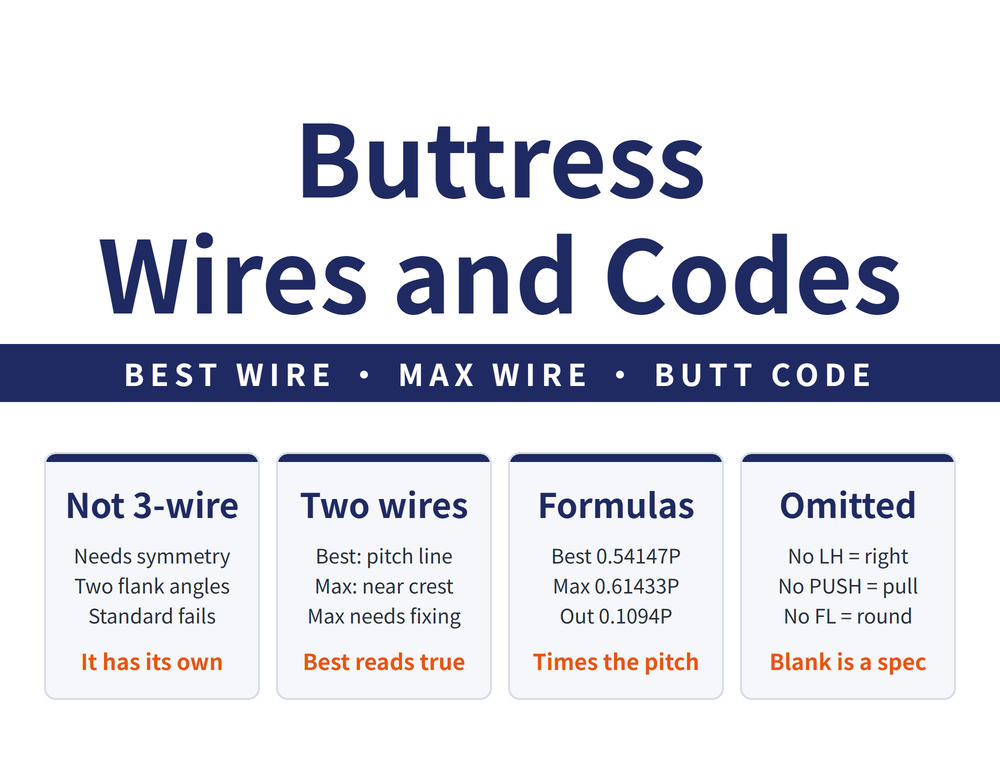
1. Why the standard three-wire formula does not apply
The standard three-wire formula for pitch diameter rests on one premise: both flanks have the same angle. When the wire drops into the groove the geometry is symmetrical on both sides, so the correction term can be written as a single general expression.
A buttress thread has 7 degrees on one flank and 45 on the other. The wire touches at a different position and depth on each side, and the symmetrical derivation fails at the first step. It therefore has its own set of wire-size formulas, held in its own measuring-wire data and not shared with other thread forms.
For the symmetrical case see Three-Wire Measurement of Thread Pitch Diameter: Formulas, Best Wire Size and Odd-Flute Taps; this article covers only the buttress form.
2. Two wire choices, differing in where they touch
| Choice | Contact position | What it means in use |
|---|---|---|
| Best wire | Touches both flanks on the pitch line | Reads the pitch diameter at its most accurate position |
| Maximum wire | Contact sits towards the crest | Needs a further correction before it converts to pitch diameter |
The rule is simple: if the purpose is pitch diameter, use the best wire. The maximum wire exists because a thicker wire is easier to place and hold, but it buys that with one more conversion step - and a conversion step is exactly where measurement error creeps in.
3. Four geometric formulas
All in units of the pitch p.
| Symbol | Meaning | Formula |
|---|---|---|
| wbest | Best wire diameter | 0.541 47 p |
| wmax | Maximum wire diameter | 0.614 33 p |
| j | Distance from the 45° contact point to the pitch line | 0.052 81 p |
| a | Best wire stand-out above the crest | 0.109 4 p |
| a′ | Maximum wire stand-out above the crest | 0.224 4 p |
Every one is a coefficient times the pitch, so knowing the pitch is enough - no table lookup required.
4. Checking against the two end points of the data table
| Threads per inch | Pitch p | Best wire w | a | Max wire w |
|---|---|---|---|---|
| 20 | 0.05000 | 0.02707 | 0.0055 | 0.03072 |
| 1 | 1.00000 | 0.54147 | 0.1094 | 0.61433 |
Substitute the pitch back into the coefficients of section 3: 0.541 47 × 0.05 = 0.027 07, and 0.109 4 × 1 = 0.109 4 - both end points agree. It is worth doing this once yourself, because it proves two things at the same time: the formulas were transcribed correctly, and so was the table.
⚠ The full threads-per-inch table is a hand-written lookup, and is not reproduced here in full. For any given thread count, multiply the pitch by the coefficients in section 3; the result is the same as the table.
5. The structure of a BUTT callout
The American standard buttress thread designation is built from fields in a fixed order:
nominal diameter - threads per inch BUTT - class of fit [modifiers]
| Field | Meaning |
|---|---|
| Nominal diameter | In inches, mandatory |
| Threads per inch | Mandatory; multiple starts give pitch and lead instead (section 8) |
| BUTT | Fixed code for the buttress thread |
| Class of fit | 2A, 2B, 3A, 3B and so on; A is external, B is internal. For how much the classes differ, see What a Buttress Thread Is: A One-Way Power Thread, and Why Metric and American Are Two Systems, section 8 |
6. A field left out is not a field left open
This is where the callout is most often misread. A modifier that is absent does not mean unspecified; each one carries a default.
| Modifier | If written | If omitted |
|---|---|---|
| LH | Left-hand thread | Right-hand thread |
| PUSH | Compression design, lead angle becomes 7° | Tension design, lead angle 45° |
| FL | Flat root | Rounded root |
| (N START) | N starts | Single start |
PUSH is the costliest of the four to miss. It decides which side the load arrives from, so overlooking it turns a compression part into a tension part - the two lead angles are 7 and 45 degrees, and the fitted part takes load from opposite directions.
7. Three examples, read field by field
| Callout | What it says |
|---|---|
2.5-8 BUTT-2A | 2.5 inch nominal, 8 threads per inch, class 2, external; the three absent modifiers mean right-hand, tension, rounded root |
2.5-8 PUSH-BUTT-2A-LH-FL | Same size and class, but compression (7° lead angle), left-hand and flat root |
10-0.25P-0.5L-BUTT-3B(2 START) | 10 inch nominal, 0.25 inch pitch, 0.5 inch lead, class 3, internal, two starts |
Setting the first two side by side makes the point: same size, same class of fit, and yet two entirely different parts - the whole difference sits in those three modifiers.
8. Multiple starts: state both pitch and lead
On a single-start thread the pitch equals the lead, so threads per inch alone is enough. On a multiple-start thread both the pitch and the lead must be stated - the 0.25P and 0.5L fields in the third example above.
A 0.5 inch lead is 0.25 inch pitch times two, matching (2 START). That is not a coincidence but the definition: lead equals pitch times the number of starts. Carrying both fields lets the reader cross-check one against the other - with only one of them, there is no way to confirm the reading is right.
9. FAQ
Q: Can I use the ordinary three-wire formula on a buttress thread?
No. The ordinary formula assumes both flanks share one angle. A buttress thread has 7 degrees on one side and 45 on the other, so the wire touches at a different position and depth on each flank and the symmetrical derivation fails at the first step. The buttress form has its own wire sizes: best wire 0.541 47p and maximum wire 0.614 33p, each simply multiplied by the pitch.
Q: Best wire or maximum wire?
Use the best wire when the purpose is pitch diameter, because it touches both flanks on the pitch line and reads that diameter at its most accurate position. The maximum wire contacts nearer the crest and needs a further correction before it converts to pitch diameter, and that conversion is where error creeps in. The only advantage of the maximum wire is that a thicker wire is easier to place and hold.
Q: If PUSH is not written, does that mean it is unspecified?
No. Absent means the default: tension design, 45 degree lead angle. PUSH is written only for a compression design, where the lead angle becomes 7 degrees. It is the costliest of the four modifiers to miss because it decides which side the load arrives from, and reading past it turns a compression part into a tension part. LH, FL and (N START) work the same way: absent means right-hand thread, rounded root and single start.
Q: Why must a multiple-start thread state both pitch and lead?
Because on a single-start thread the pitch equals the lead and one figure is enough, while on a multiple-start thread they differ and both are required. In 10-0.25P-0.5L-BUTT-3B(2 START) the 0.5 inch lead is exactly twice the 0.25 inch pitch, matching the two starts in brackets. Carrying both lets the reader cross-check them; with only one there is no way to confirm the reading.
For the geometry of this thread form and the difference between the two systems see What Is a Buttress Thread: One-Way Power Transmission, and Why Metric and American Are Two Systems; for designation conventions across the standards see Thread Designation Chart: ISO, ANSI & JIS Codes.
Published: 2026-09-19 | Last updated: 2026-09-24









