Collet Damage and Deformation
Collet damage and deformation greatly affect gripping force and machining stability. When an end mill takes repeated bending loads during cutting, the inside of the collet wears, causing tool slippage and shortening the effective holding length—which increases the torque moment arm and further lowers accuracy and tool life. Understanding holding length and collet condition is key to CNC machining quality and stability.
How Collet Damage Affects Machining
In CNC machining, the collet's main functions are to hold the tool in position, transmit cutting torque and maintain stability. When the collet is damaged, it causes tool slippage, dimensional errors and reduced tool life.
Causes of Collet Damage
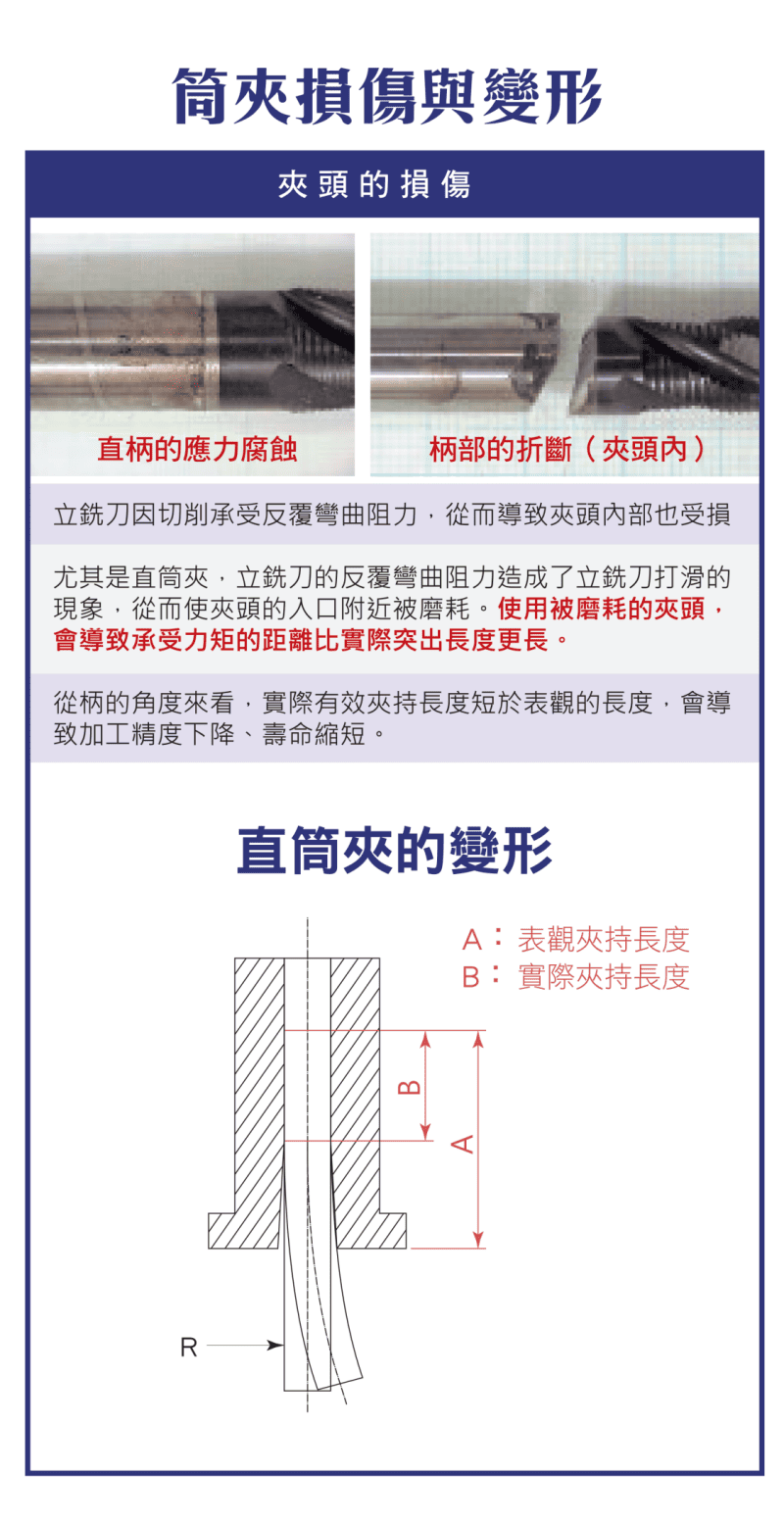
Two typical types of damage are stress corrosion of the straight shank and shank fracture (inside the collet). The main causes are repeated bending stress, prolonged high-load cutting and insufficient tool rigidity, which gradually wear the inside of the collet.
The Key Issue of Holding Length
The diagram uses A: apparent holding length and B: effective holding length to show the core problem—when the collet wears, the effective length B becomes less than the apparent length A, reducing gripping force, increasing the torque moment arm and making the tool bend more easily, which ultimately lowers accuracy and shortens tool life. The two holding lengths compare as follows:
| Item | Definition | Effect after collet wear |
|---|---|---|
| A: Apparent holding length | The length that appears to be gripped by the collet | Unchanged (looks the same) |
| B: Effective holding length | The length that actually provides gripping force and support | B becomes less than A, reducing gripping force, increasing the torque moment arm and making the tool bend more easily |
Collet Deformation & Tool Slippage
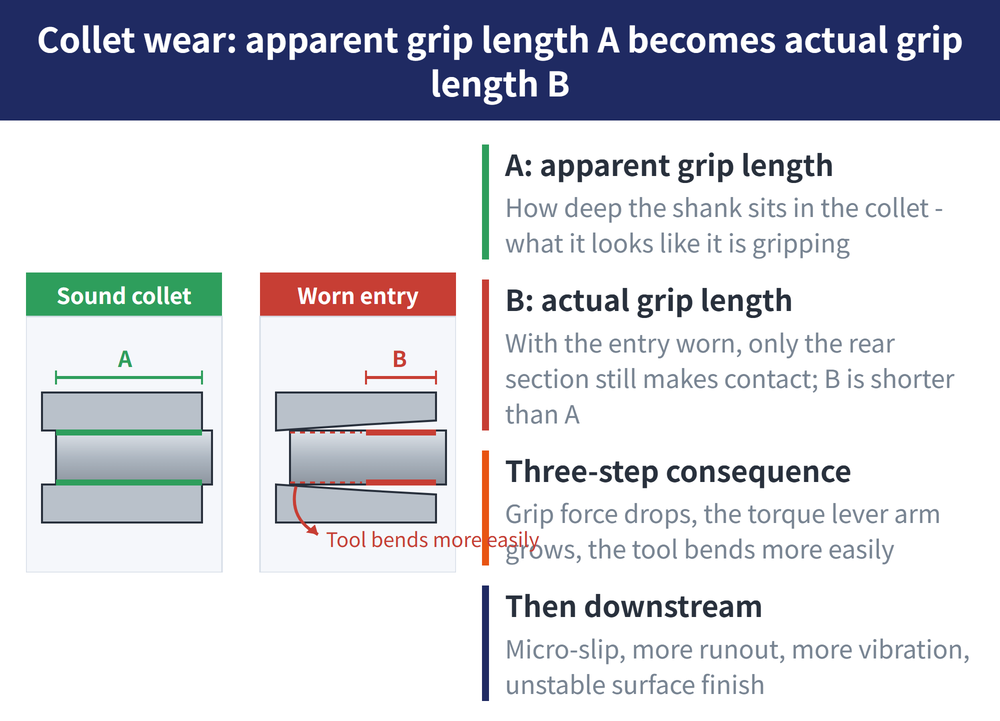
When the collet mouth wears, the tool slips slightly and grips unevenly, further increasing tool runout, machining vibration and surface-quality instability.
Tips for Improving Stability
| Aspect | Recommendation |
|---|---|
| Collet management | Replace worn collets regularly; avoid using deformed collets |
| Tool use | Control tool overhang length; increase tool rigidity |
| Cutting conditions | Reduce cutting load; avoid excessive feed and speed |
For the relationship between overhang length and tool bending, see End Mill Length vs Deflection.
FAQ
What problems does collet damage cause?
Tool slippage, dimensional errors and reduced tool life; a worn collet mouth also increases tool runout and vibration and destabilizes surface quality.
What's the difference between apparent and effective holding length?
A is the apparent (visible) holding length; B is the effective holding length. When the collet wears, B becomes smaller than A, lengthening the torque moment arm so the tool bends more easily, lowering accuracy and life.
Why do collets get damaged?
Repeated bending stress, prolonged high-load cutting and insufficient tool rigidity gradually wear the collet near its mouth, and can even cause straight-shank stress corrosion or shank fracture inside the collet.
How can I improve clamping stability?
Replace worn collets regularly, avoid deformed collets, control tool overhang, increase rigidity, and reduce cutting load and excessive feed/speed.
For the full reading guide on this topic, see Tool Life and Wear: A Complete Reading Guide.
This article is part of End Mills: The Complete Guide - Know the Cutter, Choose It, Set the Conditions; Toolpaths Are Another Line; that guide shows how the whole topic fits together.