
How to Choose a Collet: ER / SK / Pull-Back / Straight
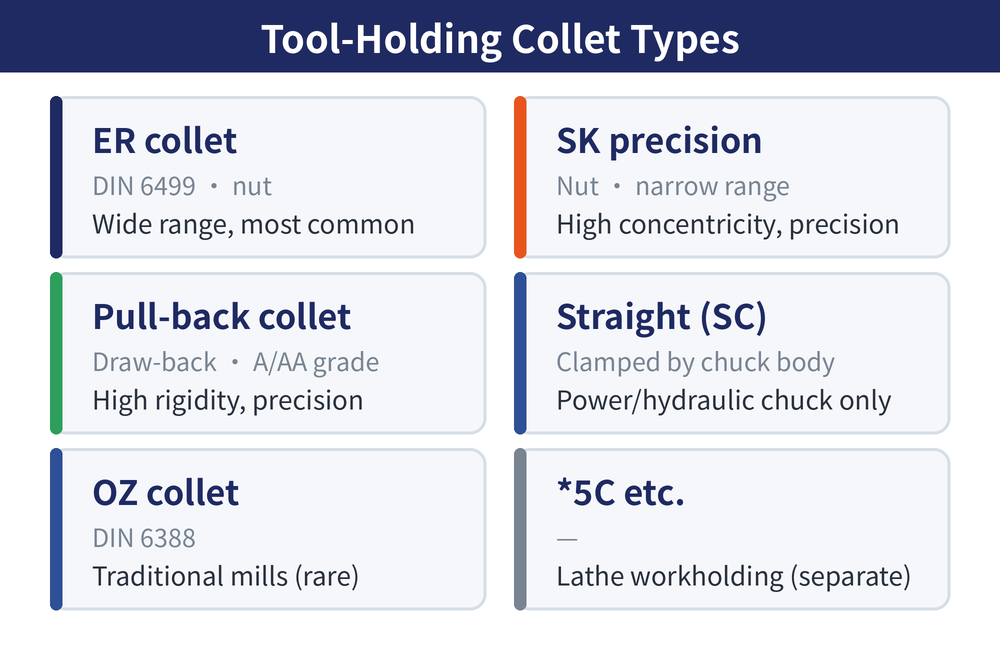
A collet is the gripping element between the tool and the chuck; its concentricity, clamping range and grip directly set the tool's runout, rigidity and which holder you should use. There are four main tool-holding collets: ER (general-purpose, wide range), SK precision (narrow range, high concentricity), pull-back (Mini-Nose / slim, drawn back to clamp, slim nose, high concentricity) and straight (a straight, single-bore sleeve clamped by a power or hydraulic chuck body). They differ in clamping geometry, clamping method and precision, and that decides which chuck-type holder they pair with. This guide compares each tool-holding collet's type and clamping method, and explains how the collet drives holder selection.
1. Why the collet directly affects the holder and the cut
In machining, the collet grips the tool shank and is then fitted into a chuck-type holder. The collet's concentricity (runout), clamping range, grip force and clamping method directly set the tool-tip runout, cutting rigidity and dimensional accuracy—and they decide which chuck-type holder you need. Pick the wrong collet and even the best holder and tool cannot perform; this is why the collet directly drives holder selection.
2. Nut-compression collets: ER, SK and OZ
These three all clamp by a nut pressing the collet into the chuck taper; they differ in range and precision:
| Type | Clamping method | Clamping range | Concentricity / rigidity | Matching holder / use |
|---|---|---|---|---|
| ER collet (DIN ISO 15488, formerly DIN 6499) | Nut compresses into taper | Wide (~1mm per collet, double-angle) | Good (better in precision grade) | ER chuck; most universal |
| SK precision collet (NIKKEN system, 8° taper) | Nut compression | Narrow (bore ≤3mm ~0.25; >3mm ~0.5mm, ref.) | High concentricity and grip | Precision chuck; high-speed precision |
| OZ collet (DIN ISO 10897, formerly DIN 6388) | Nut compression | Medium | Medium | Traditional mills (uncommon) |
The SK precision collet commonly comes in three styles: SK standard, SK-E (end mill dedicated, higher grip) and SK-CL (sealed / through-coolant). SK and traditional OZ are different systems—do not mix. Values in the table are typical reference; follow the catalogue.
3. Pull-back and straight collets
These two are not clamped by a nut; their clamping geometry and matching holders differ from the section above:
| Type | Clamping method | Clamping range | Concentricity / rigidity | Matching holder / use |
|---|---|---|---|---|
| Pull-back collet (Mini-Nose / slim) | Draw bar pulls the collet back into the taper (no bulky front nut) | Single size (one bore each) | High concentricity (precision ~≤5µm, per catalogue); slim long nose, rigidity not its strength | Pull-back (slim) collet holder; deep cavity / narrow slot, high-speed precision |
| Straight collet (SC) | Clamped by the chuck body (power / hydraulic) | Single bore (one shank size each) | Via chuck body; high rigidity | Power milling chuck, hydraulic chuck |
*Note: lathe workholding collets such as 5C grip the workpiece, not the tool, and belong to a different category from the tool-holding collets covered here.
4. How the four collets clamp (clamping method)
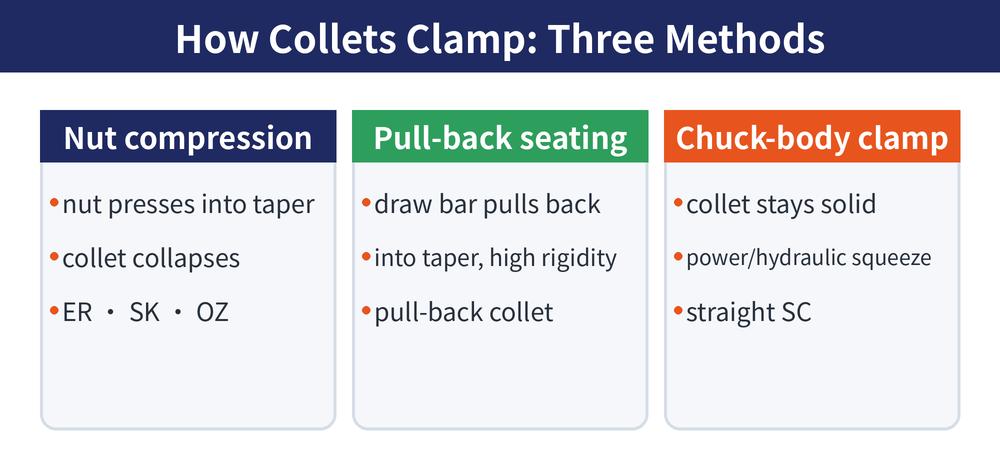
Collets clamp in different ways, which sets their rigidity and matching holder. Tool-holding collets use three main methods:
| Method | How it clamps | Used by |
|---|---|---|
| Nut compression | Tighten the nut to press the collet into the chuck taper | ER, SK, OZ |
| Pull-back seating | A draw bar behind the chuck pulls the collet back into the taper; the nose can be made slim (Mini-Nose) to reach deep cavities | Pull-back collet |
| Chuck-body clamping | The collet does not collapse; the chuck body (power or hydraulic) squeezes a straight sleeve | Straight (SC) |
5. How the collet drives holder choice and selection
Once the collet type is set, the chuck-type holder follows—they are matched. Choose by need:
| Requirement | Suggested collet | Matching holder |
|---|---|---|
| General milling/drilling/tapping | ER collet | ER chuck |
| High-speed, high-precision milling | SK precision collet | Precision chuck |
| Deep cavity / narrow slot, high-speed precision | Pull-back (slim) collet | Pull-back collet holder |
| Heavy cutting, maximum rigidity | Straight collet | Power milling / hydraulic chuck |
| Through-coolant needed | SK-CL / SC-CL sealed type | Matching sealed chuck |
Further reading: ER Collet Specs & Torque, Tool Holder Clamping Methods, Collet Damage and Deformation.
FAQ
Q: What is the difference between ER and SK collets?
Both clamp by nut compression, but ER has a wide range (~1mm per collet) and is the most universal, for general milling/drilling/tapping. SK precision is narrow (bore ≤3mm ~0.25mm; >3mm ~0.5mm, reference) but with higher concentricity and grip, for high-speed, high-precision milling. ER for versatility, SK for precision.
Q: What is a pull-back collet and how does it differ from ER?
A pull-back (Mini-Nose / slim) collet is clamped by a draw bar behind the chuck that pulls the collet back into the taper (not nut compression). Its strengths are a slim front that reaches into deep cavities / narrow slots, good concentricity and high-speed precision; each collet fits one shank diameter. Because the nose is slim and long, rigidity is not its strength—for high rigidity and heavy cutting use a power or hydraulic chuck instead. ER, by contrast, uses nut compression with a wider range and is more universal—a different clamping method.
Q: Why does a straight collet need a power or hydraulic chuck?
A straight collet is a straight-wall, single-bore sleeve that does not collapse by itself; it relies on the chuck body (strong mechanical or hydraulic) to squeeze it. This gives high rigidity and concentricity for heavy cutting, but each collet fits only one shank diameter—unlike ER, which spans a range. A sealed version (SC-CL) supports through-coolant.
Q: Can a collet clamp beyond its marked size?
ER covers about 1mm per collet; SK is narrow, and pull-back and straight collets are one bore each. In principle you pick the collet for the shank diameter and should not clamp outside the marked range, or concentricity and grip drop and the collet is easily damaged. Actual ranges follow each catalogue.
For the full reading guide on this topic, see Hole Accuracy: A Complete Reading Guide.
This article is part of Tool Holders: The Complete Guide - One End Meets the Spindle, the Other Holds the Cutter; that guide shows how the whole topic fits together.
Published: 2026-07-21 | Last updated: 2026-08-08









