
ER Collet Specs & Tightening Torque: ER8–ER50 Sizing
ER collets are the most universal gripping element in CNC machining, ranging from ER8 to ER50, where the number is the collet's large-end outer diameter. Each series spans a clamping range, but a single collet covers only a narrow slice of it (about 0.5–2mm, depending on size). Correct selection means watching three things at once: clamping range (pick the right collet), tightening torque (use a torque wrench per the catalogue) and runout grade (which directly drives tool runout). This guide covers the ER8–ER50 large-end diameters and how to select them, tightening-torque principles, runout grades, and correct fitting and care—so you can match the ER collet chuck properly.
1. How to read ER collet sizes
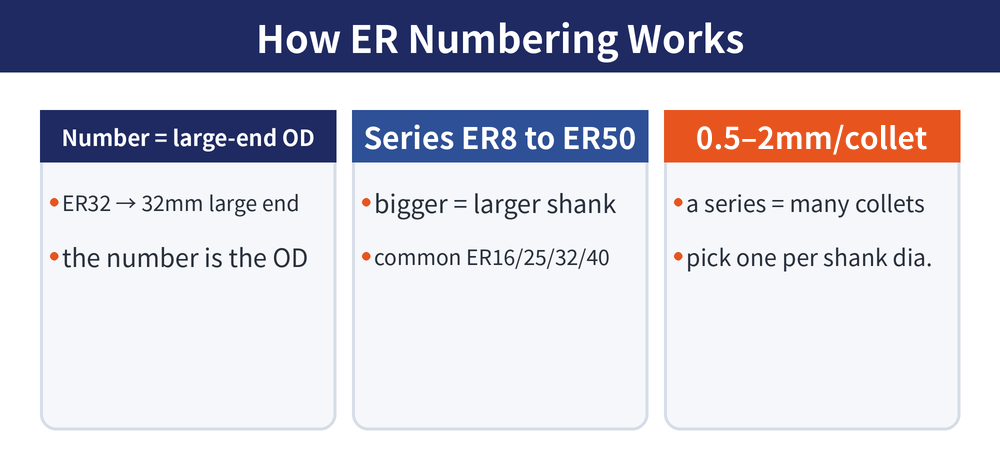
The ER number is the large-end outer diameter (mm) of the collet—ER32 means a 32mm large end. ER collets are made to DIN ISO 15488 (ER/ESX, formerly DIN 6499). Each ER series spans a clamping range; the bigger the number, the larger the shank it can hold. Common series and ranges:
| Series | Large-end OD | Clamping range (ref.) | Typical use |
|---|---|---|---|
| ER11 | 11 mm | 1–7mm | Small tools, engraving |
| ER16 | 16 mm | 0.5–10mm | Small work, drill/tap |
| ER20 | 20 mm | 0.5–13mm | Small–medium general |
| ER25 | 25 mm | 1–16mm | General milling |
| ER32 | 32 mm | 1–20mm | Most common, general milling |
| ER40 | 40 mm | 2–26mm | Larger dia., heavy cut |
| ER50 | 50 mm | 10–34mm | Large-diameter work |
A smaller ER8 series also exists, clamping 1–5mm. Each range runs from the lower limit of the smallest collet in the series to the upper limit of the largest (per the Ann Way 2026 tool catalogue ER collet table); brands differ slightly, so follow the catalogue for the collets you use.
2. Each collet covers only a narrow slice: 0.5–2mm depending on size
Note: an ER series spans the "whole range", but a single collet collapses only a narrow slice, 0.5–2mm wide depending on size. For example, the ER32 series covers a whole span of shank sizes but is made up of many collets, each marked with its own narrow range (e.g. 12–11mm). So choosing an ER collet means "fix the ER series first, then pick the specific collet for your shank diameter"—you cannot use one collet for the whole range. The width each collet covers, by size:
| Size | Width per collet | Example |
|---|---|---|
| ER8, ER11 | 0.5mm (the two smallest, 1 and 1.5, each fit a single size) | ER11-07: 7.0–6.5mm |
| ER16, ER20 | Whole-number sizes (e.g. 06) 1mm, except the smallest, 01, at 0.5mm; half sizes (e.g. 6.5) 0.5mm | ER20-13: 13–12mm; ER20-12.5: 12.5–12mm |
| ER25, ER32, ER40 | 1mm | ER32-12: 12–11mm |
| ER50 | 2mm (even sizes only) | ER50-34: 34–32mm |
The width in the table is the listed range, which is not the same as the recommended range: the same catalogue notes that the recommended clamping range for ER8–ER20 is 0.5mm, so although whole-number ER16 and ER20 collets are listed 1mm wide, only 0.5mm is recommended. Also, the same standard ER collet fitted to certain special holders drops from 1mm to 0.5mm per collet; if you are not using a standard ER holder, follow that holder's catalogue.
Width per collet and the recommended range per the Ann Way 2026 tool catalogue ER collet table; the 0.5mm on special holders per the same catalogue's MER holder notes.
3. Tightening torque (reference)
ER clamps by a nut pressing the collet into the taper bore, so tightening torque directly affects grip and runout. Too loose: weak grip, the tool slips; too tight: damages the collet and nut, cutting life and accuracy. Manufacturers are more specific: tightening too hard raises internal stress so runout actually gets worse, and exceeding the specified torque can crack the collet or even the chuck body. Always use a torque wrench per the catalogue:
| Series | Suggested torque (ref. Nm) | Note |
|---|---|---|
| ER16 | To be confirmed | Varies widely by nut type (standard/mini/high-torque) and brand—always follow the catalogue torque table |
| ER20 | To be confirmed | |
| ER25 | To be confirmed | |
| ER32 | To be confirmed | |
| ER40 | To be confirmed |
Nut makers' torque tables apply under different conditions (the nut type and the collet type used both change the values), so this table gives no general values and marks them "To be confirmed"; tighten with a torque wrench to the catalogue torque table for the nut you use (standard, mini or high-torque).
4. Runout grades
An ER collet's runout directly sets tool-tip runout, surface finish and tool life. It is usually split into standard and high-precision grades; high-precision work should use the high-precision grade and stay clean:
| Grade | Runout (ref.) | Use |
|---|---|---|
| Standard | ~≤0.010 mm | General milling/drilling/tapping |
| High-precision | ~≤0.005 mm | High-speed, finishing, small tools |
Runout is usually measured at some distance from the collet face (e.g. 3×diameter); actual specs and conditions follow the catalogue. For even higher accuracy, consider SK precision collets or straight-collet systems.
5. Correct fitting and care
Fit and remove tools in the order ①–⑤:
| Point | Detail |
|---|---|
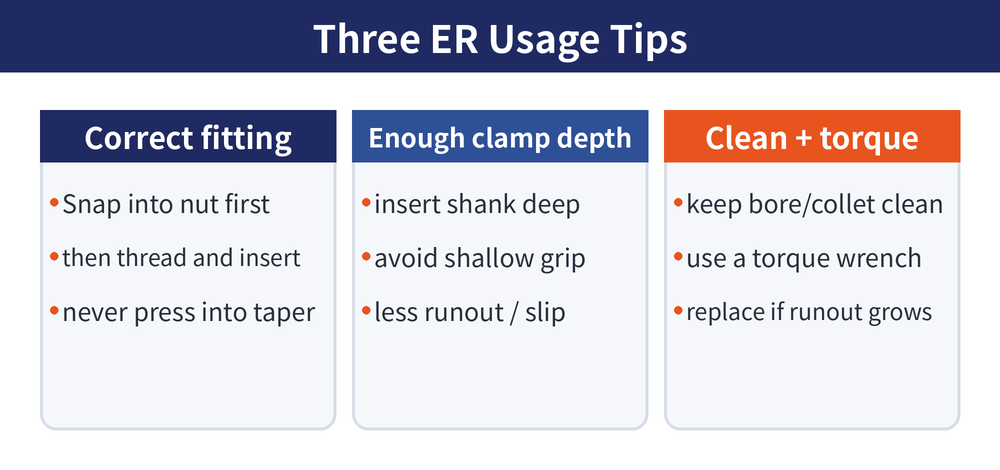
| ① Cleaning | Wipe the taper bore, the collet inside and out, the inside of the nut and the shank clean first, and blow fine chips out of the collet slots with air—chips or oil directly magnify runout |
| ② Correct fitting | Snap the collet into the nut's eccentric ring at an angle first, then thread the nut onto the chuck and insert the shank; never press the collet straight into the chuck taper first—it damages the collet and taper |
| ③ Clamping depth | Insert the shank deep enough; shallow gripping causes runout and slippage |
| ④ Tightening | Tighten by hand first, then with a torque wrench to the catalogue torque (principles in section 3); while tightening, hold the chuck in a clamping stand or brace it with an open-end wrench—do not just hold the chuck by hand |
| ⑤ Removing the tool | Loosen the nut only until the tool can be taken out, and watch for the tool springing out as it comes free |
| Through-coolant | Use a sealed collet when coolant must reach the cutting edge |
| When to replace | Collets are consumables—replace when runout grows, the gripping face is worn, there are cracks, or it will not clamp tight |
Fitting and removal steps summarised from NIKKEN and EMUGE instructions for collet-type holders.
Further reading: How to Choose a Collet: ER / SK / Straight / Pull-Back, Collet Damage and Deformation, Tool Holder Taper Specs.
FAQ
Q: What range can an ER32 clamp?
The ER32 series as a whole clamps shanks from 1 to 20mm (per the Ann Way 2026 tool catalogue; brands differ slightly, so check the catalogue you use); but that span is for the whole series—a single ER32 collet covers only 1mm, so you pick the specific collet for your shank (e.g. a 12mm shank uses the 12–11mm collet). Choose an ER collet by fixing the series first, then selecting the right-sized collet.
Q: How tight should an ER collet be?
There is a recommended torque by ER size and nut type; look it up in the catalogue torque table for the nut you use. Always use a torque wrench per the catalogue: too loose gives weak grip and slippage; too tight damages the collet and nut and lowers life and accuracy. Actual torque follows the manufacturer's catalogue.
Q: Does ER collet runout matter?
Yes. ER runout is amplified into tool-tip runout, affecting surface finish and tool life. Use standard grade (~≤0.010mm) for general work, and high-precision grade (~≤0.005mm) for high-speed, finishing or small tools, keeping the taper bore and collet clean. Values follow the catalogue and measuring conditions.
Q: How often should ER collets be replaced?
ER collets are consumables with no fixed life. Replace when runout grows, the gripping face is worn or marked, there are cracks, or it will not clamp tight even when properly tightened. Wrong fitting (not snapping into the nut first) or long-term over-tightening also shortens life.
For the full reading guide on this topic, see Hole Accuracy: A Complete Reading Guide.
This article is part of Tool Holders: The Complete Guide - One End Meets the Spindle, the Other Holds the Cutter; that guide shows how the whole topic fits together.
Published: 2026-07-21 | Last updated: 2026-10-24









