
Choosing a Boring Cycle: How G76 and G85-G89 Differ
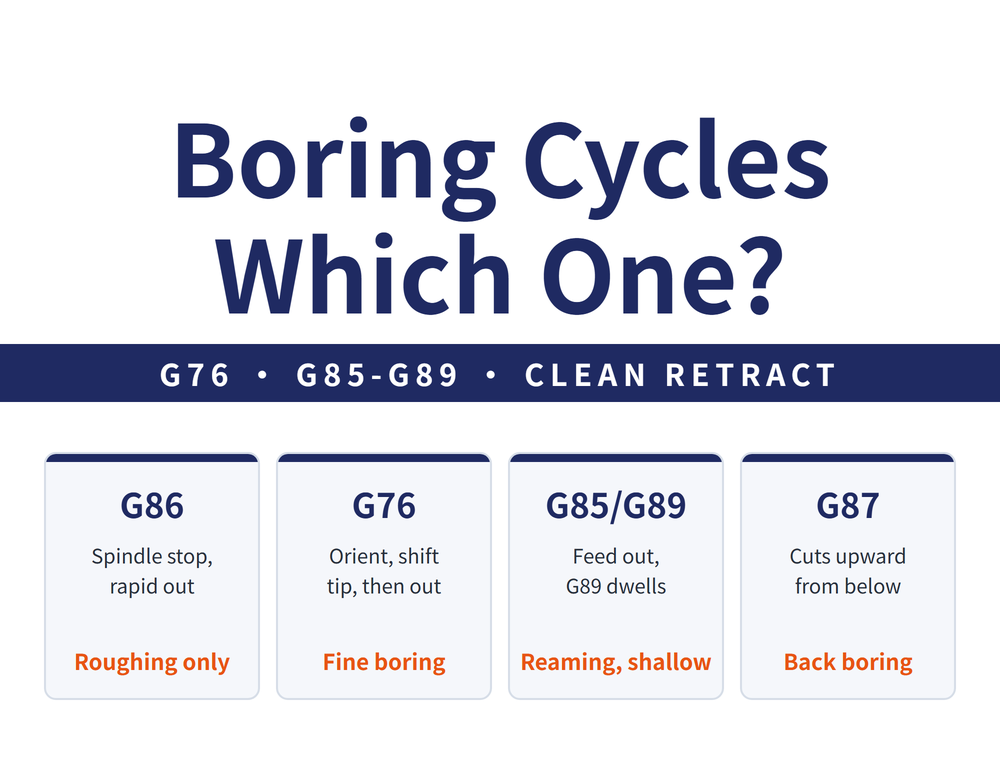
Boring cycles differ in almost one thing: whether the tool tip touches the finished bore wall on the way out. G86 for roughing stops the spindle and rapids out; G76 for fine boring stops the spindle at a fixed angle and shifts the tip away from the wall before retracting; G85 for reaming and shallow fine boring feeds out, and G89 adds a dwell at the bottom; G87 bores upward from the back of the hole; G88 stops at the bottom and the operator retracts by hand.
1. Six boring cycles: how each one stops and retracts
Boring has two concerns drilling does not: the hole must hold size, and the tip is still in the hole when it retracts. That is why drilling needs three cycles and boring needs six.
| Cycle | At the bottom and on the way out | Use |
|---|---|---|
| G86 | Spindle stops, rapid retract | Roughing; the tip may mark the wall |
| G76 | Spindle stops at a fixed angle, tip shifts off the wall, rapid out, shift restored | Fine boring; no wall contact |
| G85 | Spindle keeps turning, feeds out | Reaming, shallow fine boring |
| G89 | As G85, plus a dwell at the bottom | Fine boring of shallow blind or stepped holes |
| G87 | Reversed: the tool goes below the hole first, then bores upward | Back faces and counterbores behind the hole |
| G88 | Stops at the bottom; the operator retracts by hand, then resumes | Commonly used for boring blind holes |
Which address letters and units set the shift amount or dwell time varies by control; follow the control manual.
2. Three questions pick the cycle
| Step | Ask | Answer and cycle |
|---|---|---|
| 1 | Fine boring needed? | No → G86; yes → question 2 |
| 2 | Fine boring, or reaming / a shallow hole? | Fine boring → G76; reaming or shallow → G85, with a dwell → G89 |
| 3 | Unusual direction or condition? | Bore upward → G87; stop at the bottom and retract by hand → G88 |
In one line: G86 rapids out regardless; G76 moves clear first; G85 and G89 feed out so they do not mark; G87 reverses the geometry and so the retract; G88 stops at the bottom and leaves the retract to a person.
3. G86 for roughing, G76 for finishing: one extra move
G86 stops the spindle at the bottom and rapids straight out, so the tip may leave a mark on the wall. Roughing is followed by finishing, which cuts the mark away, so speed wins.
In fine boring the wall is the finished surface. G76 first stops the spindle at a fixed angle, shifts the tip a small amount away from the wall, rapids out, and then restores the shift. That extra move buys a retract with no wall contact.
The shift amount depends on the part and machine; there is no universal value. For fine boring tools and overhang, see Fine Boring and Tool Overhang: Single-Edge Tools and Five Principles.
4. G85 and G89 for reaming and shallow holes: feeding out does not mark
G85 keeps the spindle turning at the bottom and feeds out at the cutting feed; feeding out does not mark the wall, so no shift is needed. It is common for reaming and shallow fine boring.
G89 also feeds out like G85, but dwells at the bottom first. Before using G88 or G89 for the first time, check the bottom-of-hole motion in your control manual.
5. G87 back boring: reversed geometry, reversed retract
G87 bores upward from the back of the hole, for example a rear step or counterbore that cannot be reached from the entry side. The tool stops the spindle at a fixed angle, shifts the tip, moves down to the R point below the hole, then restores the shift, restarts the spindle and bores upward.
Because the R point lies below the end of the cut, G87 can only return to the initial point, not to the R point, so it works with G98 only, never G99. A retract that runs opposite to the other cycles and only accepts G98 is G87 geometry, not a machine or program fault.
The tool must pass through the pre-drilled hole after shifting, so the hole must be large enough; for estimating the minimum pre-drilled diameter for back boring, see section 2 of Boring Bar and Head Selection: Rigidity, Micro-Adjust and Coolant Delivery.
6. Where to retract: G98 and G99
| Code | After each hole the tool returns to |
|---|---|
| G98 | The initial point (higher) |
| G99 | The R point (lower) |
The rule is the same as for drilling cycles: if fixtures, bosses or other obstacles sit between holes, use G98. The only exception is G87, which takes G98 only. For the three drilling retracts and this pair in full, see Choosing a Drilling Cycle: G81, G73 and G83 as a Three-Step Fallback.
For boring methods, tools and the rigidity rule, start with Boring Basics: Four Boring Methods and the Rigidity-First Rule.
7. Frequently Asked Questions (FAQ)
Q: What is the difference between G76 and G86?
The retract. G86 stops the spindle and rapids out, so the tip may mark the wall and it suits roughing only; G76 stops the spindle at a fixed angle and shifts the tip off the wall before retracting, so it suits fine boring.
Q: Fine boring leaves a mark on the wall on the way out. What should I check first?
Check whether the cycle is one like G86 that rapids out after stopping the spindle. For fine boring use G76 so the tip moves clear first; for reaming or shallow holes, G85 feeds out instead.
Q: Why can G87 not use G99?
G87 is the back boring cycle that cuts upward from behind the hole; its R point lies below the end of the cut, so it can only return to the initial point and works with G98 only.
Q: How large should the G76 shift be?
There is no universal value; set it for the actual part and machine, and follow the control manual for the address letter and units.
Last updated: 2026-10-22
For the full reading guide on this topic, see Hole Accuracy: A Complete Reading Guide.









