
Drilling Feed Rate & Chip Control: Optimal Range
Drilling feed directly affects chip form, process stability and hole accuracy. Too low a feed causes chisel-edge sliding and unstable entry, producing polygonal holes and long chips that block evacuation; too high a feed makes thick chips, raising cutting load and chipping risk. A suitable feed lets chips break evenly and evacuate smoothly. This guide covers feed's effects, how to set the feed and center-drill principles to stabilize hole quality.
1. What Feed Affects
Feed simultaneously drives cutting force, chip form, process stability and hole accuracy — one of the most critical adjustable variables in drilling.
2. Problems with Feed Too Low
| Trait | Result |
|---|---|
| Chisel-edge sliding, unstable entry | Polygonal holes (e.g. triangular) |
| Insufficient cutting | Long chips, difficult evacuation |
| Lower accuracy | Unstable diameter and roundness |
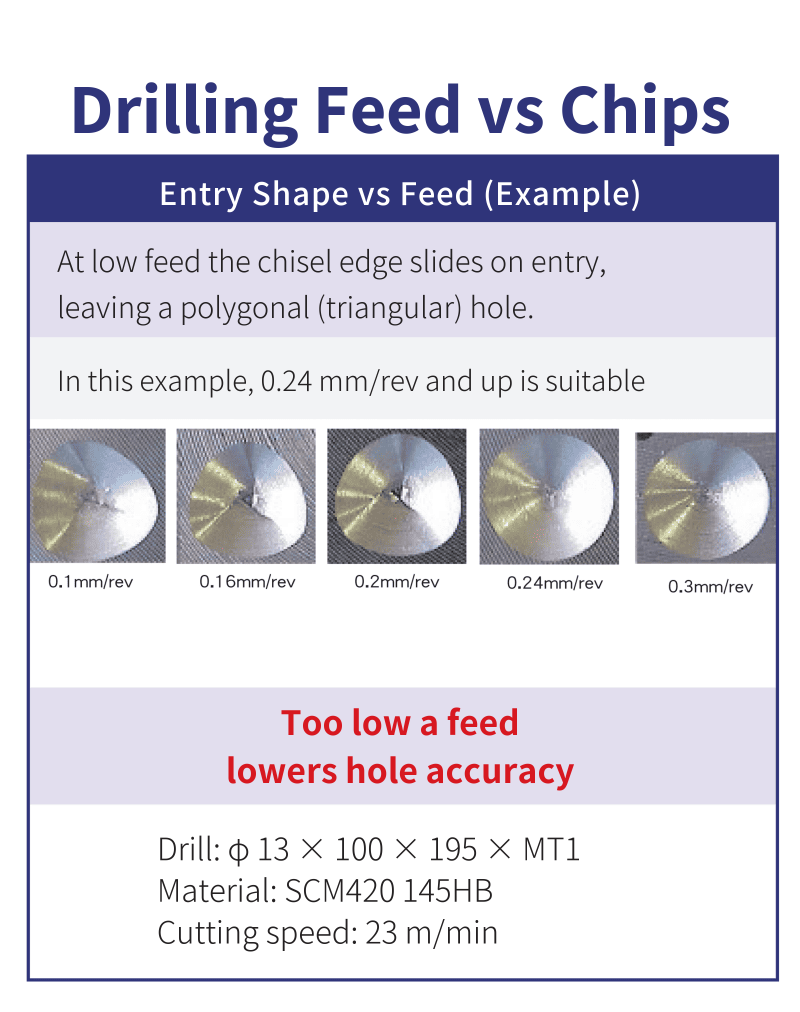
The opening chart is a manufacturer example (per NACHI technical data): a φ13 drill in SCM420 (145 HB) at 23 m/min left a triangular hole entry when the feed was too low, and in this example only 0.24 mm/rev and up was a suitable feed. It is one set of conditions, but it makes a counter-intuitive point: a more cautious feed does not necessarily give a more accurate hole.
3. Problems with Feed Too High
| Trait | Risk |
|---|---|
| Higher cutting load | Excessive resistance, unstable cut |
| Thicker chips | Higher risk of edge chipping |
4. Setting the Feed (Reference)
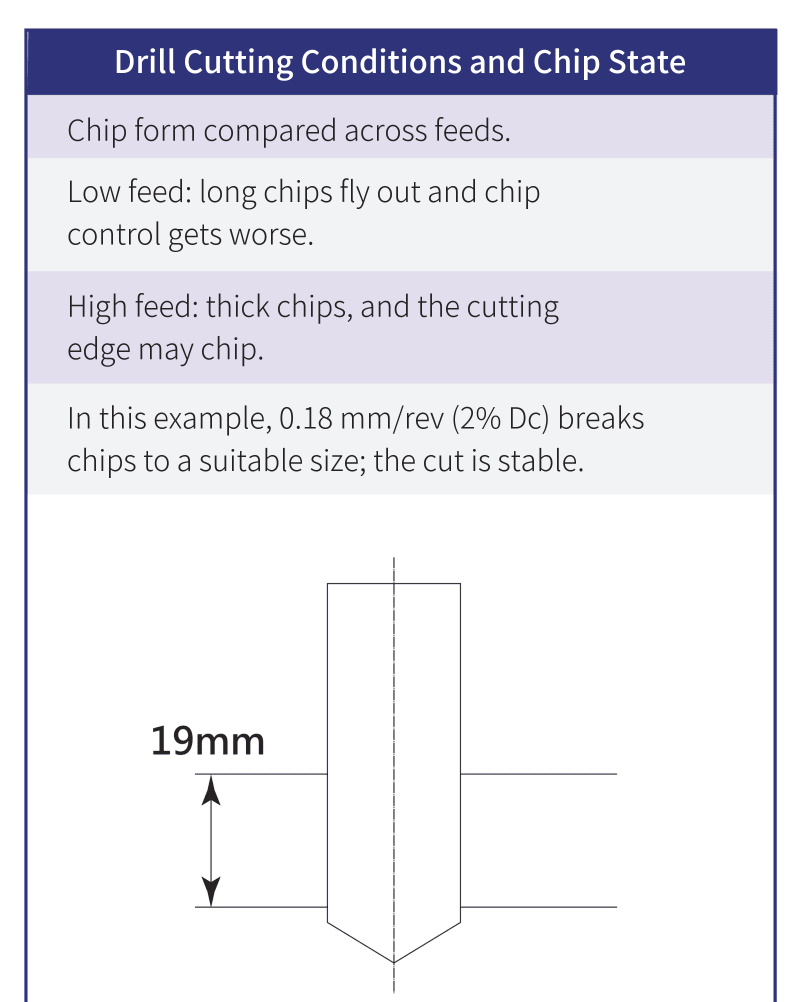
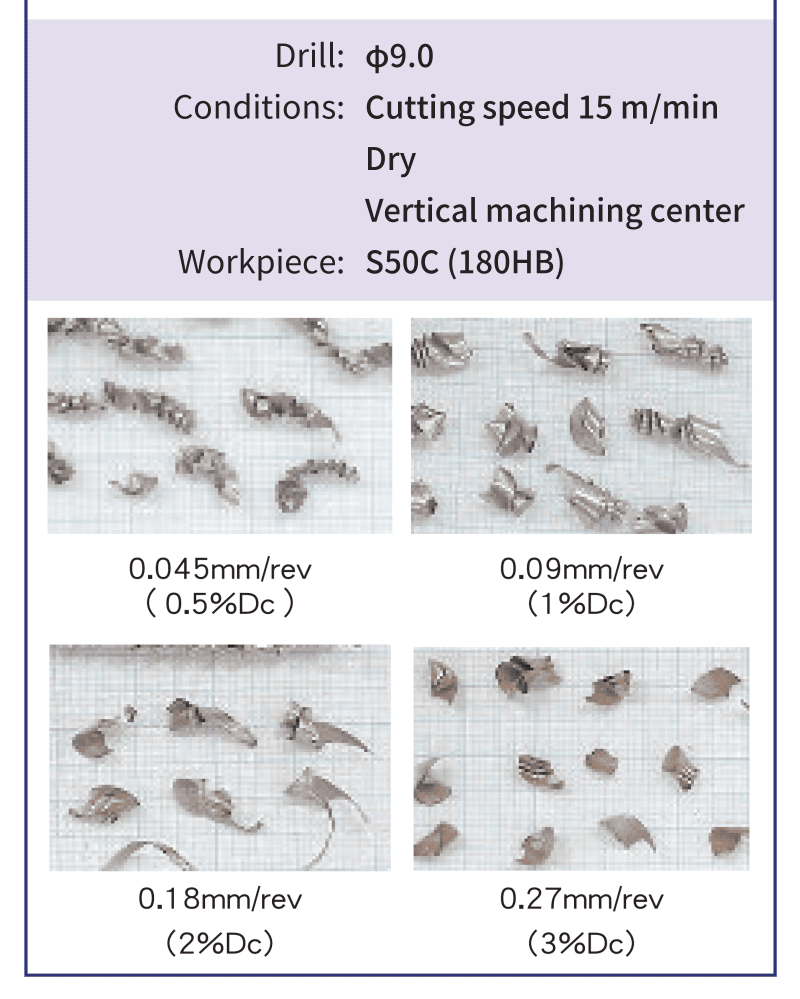
There is no single “best” feed that holds for every drill. One published manufacturer test shows the direction (per NACHI technical data): a φ9 drill in S50C (180 HB) at 15 m/min, dry, comparing the chips at four feeds per revolution.
| Feed per rev | Share of drill dia. | Chips |
|---|---|---|
| 0.045 mm/rev | 0.5% | Long and stringy, wrap easily; poor evacuation |
| 0.09 mm/rev | 1% | Long and stringy, wrap easily; poor evacuation |
| 0.18 mm/rev | 2% | Broken to a suitable size; stable cut |
| 0.27 mm/rev | 3% | Thicker chips |
In this test the suitable point lands at about 2% Dc, but it is one drill in one material, and the maker does not present it as a rule — change the drill or the material and you test again. In practice, take a starting value from the method in the Drilling Parameters Guide, then adjust by the chip: long, wrapping chips mean go up; clearly thicker chips mean come down.
5. Chip Form vs Hole Quality
| Feed | Chip | Evacuation |
|---|---|---|
| Low feed | Long chips | Prone to wrapping |
| Moderate feed | Short broken chips | Good evacuation |
| High feed | Thick chips | High cutting load |
For full chip-form reading, see Drill Chip Formation Guide.
6. Center-Drill Principles
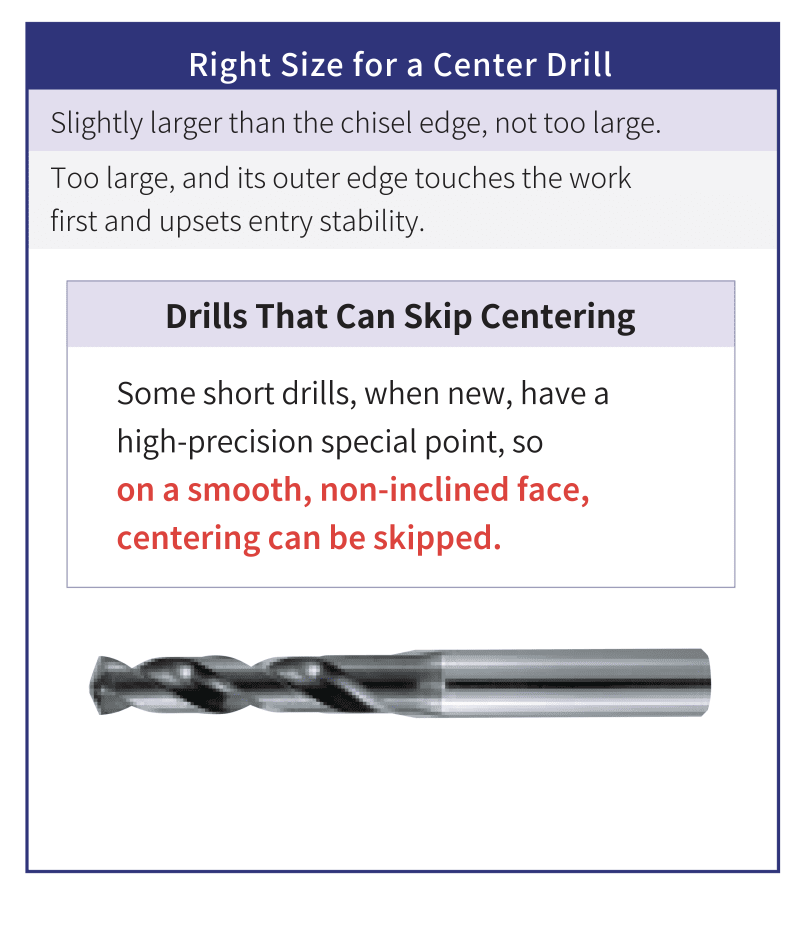
When using a center drill, its diameter should be slightly larger than the drill's chisel-edge length, but not too large — oversizing ruins entry stability. Some drills with good self-centering (manufacturer examples: AGESS, SGESS, GSS) can skip centering on flat, non-inclined surfaces; follow the maker's recommendation.
7. Optimization Tips
| Tip | Note |
|---|---|
| Suitable feed | Start from a calculated value, then adjust up or down by the chip; one maker example lands near 2% Dc, which is not a rule |
| Watch the chip | Use chip form as the adjustment cue |
| Match cutting speed | Balance feed and speed together |
FAQ
Q: What feed should I use for drilling?
There is no single number for every drill. In one maker example (φ9 drill in S50C) chips broke to a suitable size at about 2% Dc (0.18 mm/rev), were long and stringy at 0.5%–1%, and thickened at 3%; a different drill or material needs a new test. Take the starting value from the calculation for your material and tool, then adjust by the chip.
Q: Why does low feed produce polygonal holes?
At low feed the chisel edge slides and entry is unstable, so the drill can self-excite vibration and cut triangular/polygonal holes, while chips lengthen and evacuation worsens.
Q: What happens if feed is too high?
Too high a feed makes thick chips and raises cutting load and resistance, increasing the risk of edge chipping and instability — especially on low-rigidity machines.
Q: Do I always need a center point first?
Not always. Some self-centering drills (manufacturer examples) can skip centering on flat, non-inclined surfaces. If centering, the center drill should be slightly larger than the chisel-edge length and not too large.
For the full reading guide on this topic, see Chip Control: A Complete Reading Guide.
This article is part of Drill Bits: The Complete Guide - Start From Depth-to-Diameter, Then Pick the Drill and Set the Conditions; that guide shows how the whole topic fits together.
Published: 2026-03-19 | Last updated: 2026-10-31









