
Choosing a Flap Disc: Shape Sets the Contact Angle, Grit Follows the Job, Diameter Caps the Speed
Most people ask one thing when buying a flap disc: what grit. But shape, grit and diameter are three separate axes - shape sets the working angle, grit follows the job and the conversion, and diameter caps the speed the machine may run. This guide treats them separately and flags the one that catches people out: moving from a fibre disc to a flap disc at the same grit number gives a finer finish than expected.
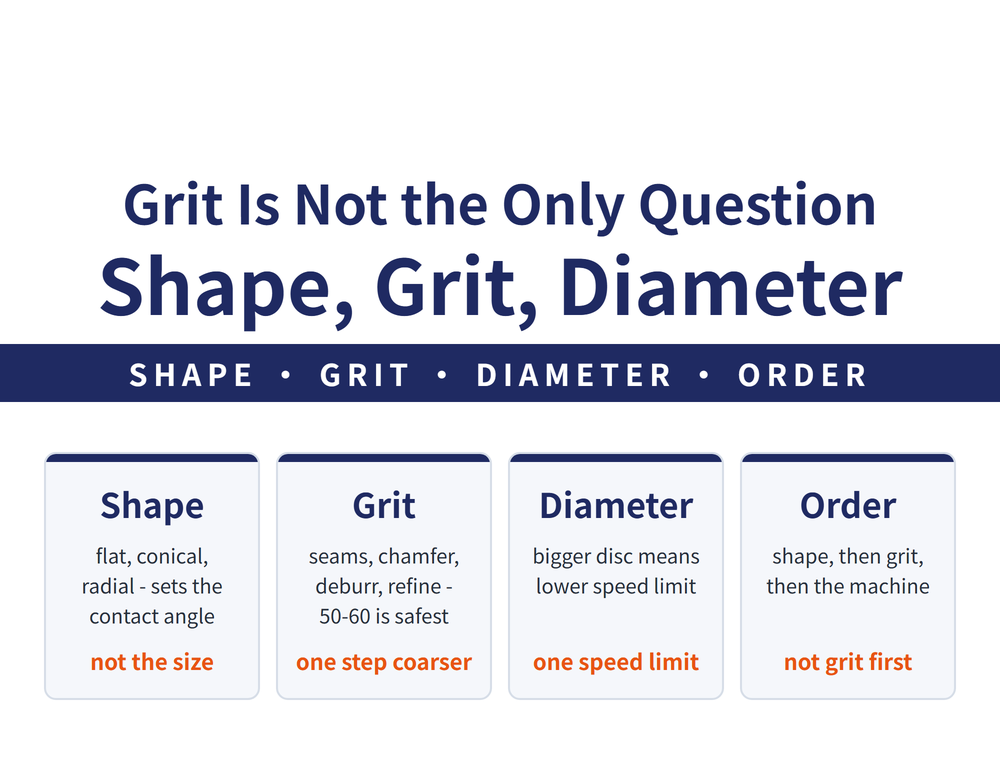
1. There Are Three Axes, and Most People Use Only One
The usual question on the shop floor is "what grit". Grit is one axis of three, and the other two each decide whether the job works.
| Axis | What it actually decides | What goes wrong |
|---|---|---|
| Shape | The angle you are meant to work at | Only the rim cuts - wear concentrates, efficiency drops |
| Grit | How fine the finish is and how fast it goes | Switching from another abrasive gives a finer finish than expected |
| Diameter | The speed the machine may run | Change discs without changing the setting and you overspeed |
The three do not substitute for each other: the right grit on the wrong shape still leaves only the rim working once you tilt the tool. The next three sections take one axis each; section 5 covers the order.
2. Shape Sets the Contact Angle, Not the Size
Flap discs come in three common shapes. The difference is not the dimension but the angle each is designed to be worked at - the contact angle is between the abrasive face and the workpiece face, not a question of how the tool feels in the hand.
| Shape | Grinding area | Suited to | Best contact angle |
|---|---|---|---|
| Flat | Larger | Surface grinding | 0-15° |
| Conical | Narrower | Weld seams, chamfering, deburring | 10-25° |
| Radial (curved) | Follows the curve | The type made for fillet welds | Not stated by the maker |
10-15° is the overlap where either works. Outside that band the answer is a different shape, not more force. Tilt a flat disc to 25° on a weld and only the rim cuts; lay a conical disc flat on a panel and the contact area is too small - both are hard work for little return.
📌 The radial type carries a cost point worth knowing: once its outer edge is worn it does not have to be scrapped and can be finished off as an ordinary flap disc. The fillet-weld type costs more per piece, but counting that in, it is not necessarily dearer overall.
3. Grit: Coming From a Fibre Disc, Go One Step Coarser
🔴 This is the sentence that catches people out: with a flap disc, choose one step coarser to reach the same finish a fibre disc gives. Keep the same number and the finish comes out finer than intended and the job runs slower.
| Application | Usual grit band |
|---|---|
| Weld seam work | Coarse end (about 36-60) |
| Chamfering | Coarse end (about 36-60) |
| Deburring | Middle (about 50-80) |
| Surface refining | Middle into fine (about 50-120) |
Two patterns fall out of that table. First, the 50-60 band is the only one covering all four applications - if you are unsure, or one disc has to cover several operations, it carries the least risk. Second, the bands overlap heavily and no application maps to a single number, so there is room for error and no point agonising over one step.
The grain type is a separate choice from the grit number; for that see Choosing the Abrasive Grain. For how the spec fields on a coated abrasive read, see Reading Coated Abrasive Specs.
4. Diameter Caps the Speed: Go Bigger and You Must Slow Down
The safety limit on a flap disc is peripheral speed - the surface speed at the rim - not RPM. One and the same speed limit converts into a different RPM for every diameter:
v (m/s) = D (mm) × π × n (RPM) ÷ 60,000
Read backwards, that is the practical point: with the speed limit fixed, diameter and permitted RPM are inversely related. Increase the diameter by half and the permitted RPM falls to roughly two thirds. Fitting a larger disc to the same angle grinder without changing the setting is overspeeding it.
🔴 Always use the figures marked on the disc in your hand - do not extrapolate from another disc, and do not carry a small-diameter RPM across to a larger one. Speed limits across abrasive types differ by a factor of seven; see How Fast Abrasive Tools May Run. For pre-use checks and why discs break, see Why Grinding Wheels Crack.
5. The Order: Shape, Then Grit, Then Diameter
The three axes have an order. Starting from grit is the usual wrong start, because grit cannot be settled until you know which operation you are doing.
| Step | Ask yourself | What follows |
|---|---|---|
| 1 Shape | Flat on a surface, or tilted into a weld or chamfer | The angle band follows |
| 2 Grit | Which operation, and what am I switching from | Remember to go one step coarser |
| 3 Diameter | Can the machine setting match it | If not, change the setting - do not just fit it |
📌 Step three is not "fit whatever is in the drawer". Diameter is the only axis that reaches back into the machine setting, and getting it wrong is not the same order of problem as the other two - those cost efficiency, this one is a safety matter.
6. How to Read Product-Line Ratings
Catalogues often grade product lines with stars, from an entry-level general line, through an all-material performance line, to a special line built for one task.
📌 Stars are a relative grade within one maker’s own range - how its lines compare on performance, life and price - not an absolute cross-brand measure. Comparing one maker’s four stars with another’s is not comparing the same thing.
What can be compared are the fields everyone has to state and that mean the same thing everywhere: grain type, grit, maximum peripheral speed and RPM, dimensions and bore. Compare the fields that line up. For how to compare cutting tool spec sheets across brands on the same principle, see Comparing Cutting Tool Brands: Which Spec Fields Line Up, and Which Only Count Within One Catalog.
7. Frequently Asked Questions (FAQ)
Q: Can one flap disc do both weld seams and surface refining?
Yes, but neither will be ideal. On grit, the 50-60 band is the only one covering all four applications, so it is the lowest-risk choice for a disc that has to do both. On shape there is no compromise available - welds want the disc tilted (the conical band) and panels want it flat (the flat band), and the two only overlap across 10-15 degrees. Once the volume is there, two discs usually work out cheaper.
Q: Moving from fibre discs to flap discs, how do I convert the grit number?
Go one step coarser. At the same number a flap disc leaves a finer finish than a fibre disc, so keeping the number gives a finer result than intended and runs slower. This has nothing to do with the grain type - it comes from the difference in construction - so changing brand will not change it.
Q: Do I need to change the machine setting for a larger disc?
Yes. The limit is peripheral speed, not RPM, and one speed limit converts into a different RPM for every diameter - the larger the disc, the lower the permitted RPM. Fitting a larger disc without changing the setting is overspeeding it. Use the figures marked on that disc; do not extrapolate.
Q: Can star ratings be compared across brands?
No. Stars are a relative grade inside one maker’s own range, describing how its lines compare on performance, life and price, with no shared baseline. For a cross-brand comparison use the fields that are defined the same way everywhere: grain type, grit, maximum peripheral speed and RPM, dimensions and bore.
This article is part of Deburring and Surface Finishing: The Complete Guide - Which Tool, Which Material, and What to Do in Volume; that guide shows how the whole topic fits together.
Published: 2026-09-25 | Last updated: 2026-10-28









