
Grinding Machine Troubleshooting: Mechanical Faults, Three Hydraulic Root Causes and Two-Level Maintenance
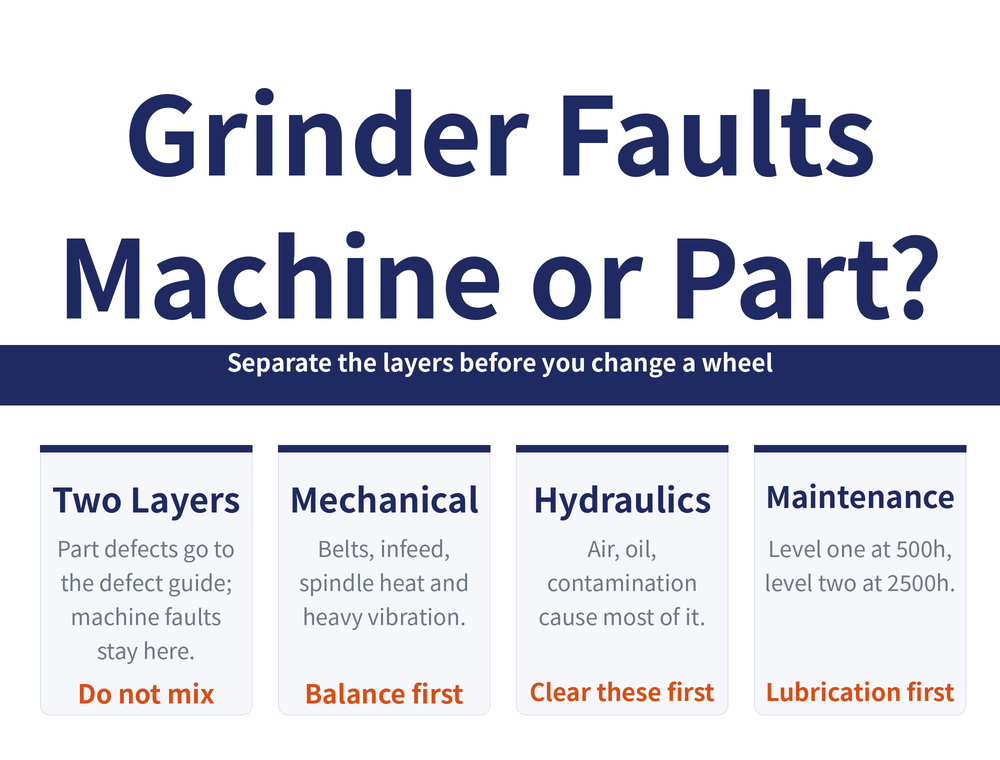
A bad workpiece and a broken machine are two different problems, and chasing the wrong layer means changing three wheels before you find the cause. This guide maps the common mechanical faults of a grinding machine, the three root causes behind most hydraulic trouble and six table symptoms, then closes on maintenance — poor lubrication shows up in almost every fault group.
1. First separate the layers: bad workpiece or broken machine
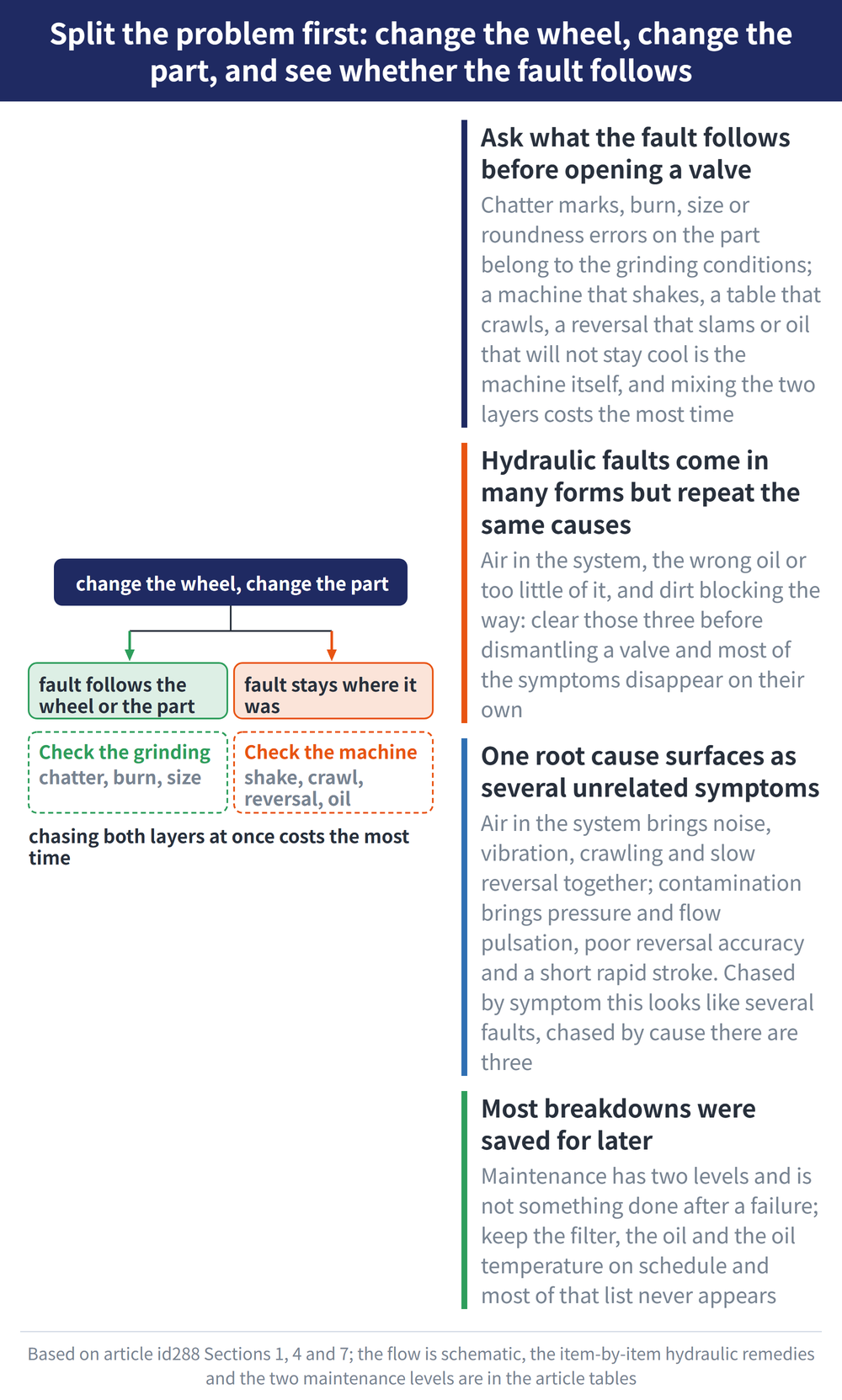
Chatter marks, burn, size or roundness out of tolerance are grinding condition problems. A machine that shakes, a table that crawls, a reversal that bangs, an oil temperature that will not come down — those mean the machine itself has a fault. Mixing the two layers is what wastes the day.
How to split them: fit a new wheel and a new workpiece. If the problem repeats in the same place, it is the machine (this guide). If the problem follows the wheel or the part, it is the grinding condition — see Grinding Defect Troubleshooting.
2. Drives, infeed and spindle overheating
| Fault | Check first | Remedy |
|---|---|---|
| Belt slipping | Low tension, stretched belt, idler too loose | Retension the belt and idler; rosin powder as a last resort (never on a new belt) |
| Noisy drive | Belt surface polished, oil contamination | Clean off the oil; replace the belt if needed |
| Cross feed inaccurate | Leadscrew and nut clearance | Typically set to 0.06~0.10mm |
| As above | Nut not locked down | Turn the screw while tightening the nut for even contact |
| As above | Dial float, bent screw or axial drift | Remove dial float; recondition screw and bearings |
| As above | High slideway friction, wheelhead stick-slip | Add slideway oil or hand-scrape the ways |
| Spindle bearing hot | Spindle-to-bearing clearance too tight | Reset the running clearance |
| As above | Low oil level, wrong viscosity or dirty oil | Top up with correct viscosity; flush bearing and oil system |
| As above | Bearing shell surface not smooth enough | Scrape the bearing shell working face |
3. The machine shakes: where the vibration comes from
| Source | Remedy |
|---|---|
| Wheel out of balance, spindle clearance too large | Balance the wheel precisely first, then reset bearing clearance |
| Motor or hydraulic pump vibration | Anti-vibration pads plus dynamic balancing; isolate the pump motor |
| Loose assemblies or foundation bolts | Retighten assemblies; level the machine and lock the anchor bolts |
| External vibration source | Site the grinder away from it; add an isolation trench |
| Asymmetric part, excessive or uneven stock | Add counterweight and reduce speed; even out the grinding stock |
Three more have a single cause each. Headstock spindle wobble is spindle wear — scrape or replace the shell and reset clearance. Gear noise comes from excessive mesh backlash, worn gears or a misaligned shaft, made worse by poor lubrication. Table skewed to the bed ways grinds taper on the part, so scrape the bed ways in time. For wheel balancing itself see Grinding Wheel Mounting and Balancing.
4. Hydraulics: clear out air, oil and contamination first
Hydraulic faults come in many named types but the causes repeat. Clear these three root causes before you open a valve and most symptoms disappear on their own.
| Root cause | Symptoms it produces | Do this first |
|---|---|---|
| Air in the system | Noise and vibration, stick-slip, slow or failed reversal | Find leaking joints by the oil-fill method; suction pipe 200~300mm below oil level, lift under 500mm; bleed repeatedly |
| Wrong oil or low oil level | Pump will not draw, stick-slip, fast temperature rise | Too viscous, change down; fill to the sight line; if oil runs hot, move up in viscosity and control the rise |
| Contamination blockage | Pressure and flow pulsation, poor reversal accuracy, short rapid stroke | Clean the filter and valves, clear damping orifices and throttle ports, refill with clean oil on a schedule |
5. Table stick-slip and speed problems
| Symptom | Most likely cause | Action |
|---|---|---|
| Stick-slip at low speed | Air in the system; uneven friction from way accuracy or lubrication | Bleed and retighten seals; scrape the ways; piston rod bend within 0.2mm, concentricity within 0.04mm |
| Uneven speed both ways | Unequal leakage at the two cylinder ends; bleed valve left open | Adjust both gland covers so leakage matches; close the bleed valve after use; straighten the rod |
| Rapid stroke too slow | Not enough inlet flow: poor suction, worn pump, blocked valve port | Check suction line and filter; repair or replace the pump; clean relief and throttle valves |
6. Reversal problems
| Symptom | Most likely cause | Action |
|---|---|---|
| Shock at reversal | Poor seating of the pilot check valve; working pressure set too high | Lap the seat, replace an out-of-round ball; lower working pressure, raise back pressure; bleed the air |
| Sluggish start after reversal | Throttle screwed down too far; low working pressure; air in system | Open the throttle screw; raise pressure moderately; bleed; clear dirt and burrs from the spool |
| Dead point, no reversal | Pilot pressure too low; spool jammed; solenoid or spring failed | Raise pilot pressure at the reducing valve; clean and deburr the spool; service solenoid and spring |
Two more usually appear together. Low system pressure is mostly a relief valve that has failed or stays open, a pump turning the wrong way, or internal leakage in pump and cylinder. Heavy leakage starts from working pressure set too high, worn spool and bore, aged seals and loose fittings. Fast oil temperature rise has four suspects at once: pressure set too high, internal clearances too tight, viscosity too high, and a tank that is too small or piping too thin and too long.
7. Maintenance: most faults are the ones you skipped
Across the tables above, poor lubrication takes a line in almost every group — it is the single most common cause of grinder faults. Three daily habits: confirm oil at the wheelhead, table and slideways before start-up; clean the coolant settling tank and renew the fluid weekly; change the oil in the reservoir every 3~4 months and clean the filter on schedule. Never place tools, gauges or workpieces on the table or the ways.
| Location | Lubricant |
|---|---|
| Wheel spindle plain bearing | Precision machine tool spindle oil (source lists L-AN2) |
| Grinder slideways | N32, N68 lubricating oil |
| Internal grinding spindle unit and high-speed precision rolling bearings | ZL-3 lithium grease |
| General rolling bearings | ZG-3 calcium grease |
When purchasing, follow the specification given in your machine manual. Scheduled maintenance has two levels: level one at 500 running hours, level two at 2500 hours. For how machine accuracy itself is verified, see Grinding Machine Accuracy and Acceptance.
8. Frequently Asked Questions (FAQ)
Q: The grinder keeps shaking — check the wheel or the machine first?
Balance the wheel precisely first, then work into the machine. The order is wheel balance, spindle and bearing clearance, loose assemblies and anchor bolts, motor and hydraulic pump, external sources. For an asymmetric part, add counterweight and reduce speed.
Q: The table jerks along at low speed — what is that?
That is stick-slip, and it has two families of cause: air in the hydraulic system, or slideway friction that is too high or uneven. Bleed and retighten every joint face first, then check way accuracy and lubrication; piston rod bend should be within 0.2mm over its length.
Q: Oil temperature keeps climbing — should I switch to a thinner oil?
The other way round. When oil runs hot and thins out, move up in viscosity, and look for the heat source among four suspects: pressure set too high, internal clearances too tight, a tank with poor heat dissipation, and piping that is too thin or too long.
Q: What is the difference between level one and level two maintenance?
Level one comes at 500 accumulated running hours, led by the operator: partial teardown, cleaning, clearing oil passages and resetting running clearances. Level two comes at 2500 hours, led by maintenance staff: partial disassembly and repair to restore accuracy locally.
This article is part of Grinding Wheels and Machines: The Complete Guide - Reading the Wheel, Mounting It, Dressing It, and Tracing Defects; that guide shows how the whole topic fits together.
Published: 2026-08-17|Last updated: 2026-08-17









