
Choosing Grinding Wheel Grit, Grade, Bond and Structure: Workpiece First, Then the Job, Then the Defect
You do not need to weigh all five fields of a wheel spec at once - decide them in order. First the workpiece material sets the abrasive and the direction of grade (the harder the work, the softer the wheel). Then the job sets grit, bond and structure (coarse and open for roughing; fine and dense for finishing and form grinding). Finally, read the defects back: burn means go softer and more open, scratches and fast wheel wear mean go harder, loading means coarser and more open. This article walks through that order and explains how wheel and dressing work together when you need a low roughness finish.
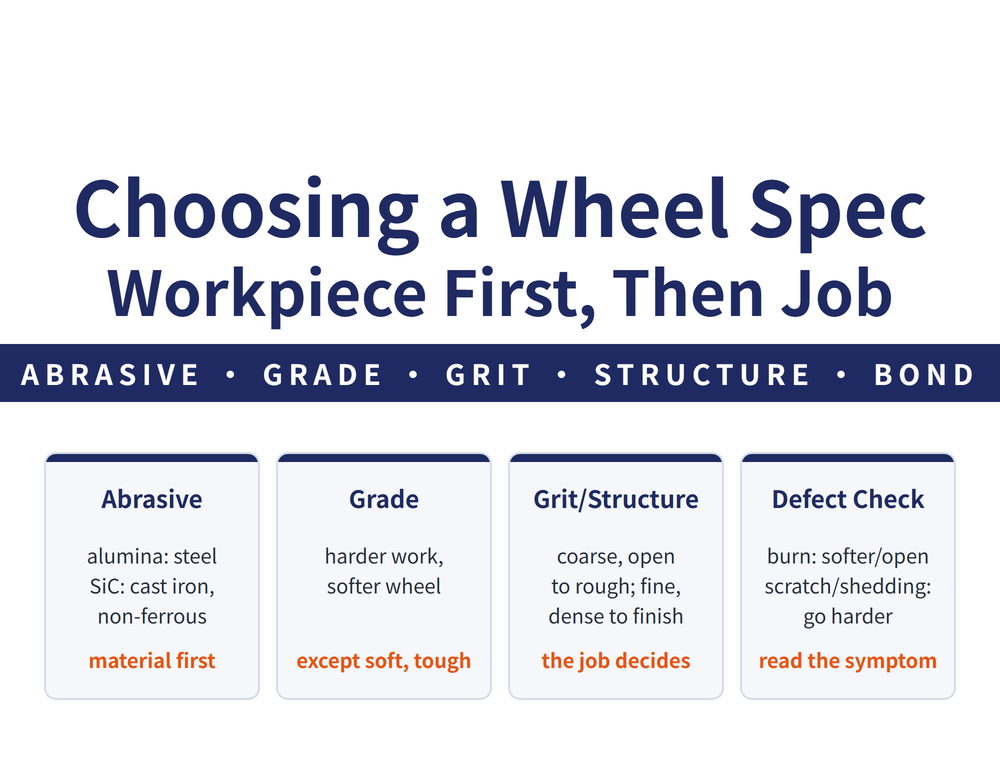
1. Set the order: material, job, defect
How to read the five fields of a wheel marking is covered in Reading a Grinding Wheel Marking: Abrasive, Grit, Grade, Structure and Bond; this article is about choosing once you can read it. Do not think about all five fields at once. Go in three steps, each answering one question:
| Step | Question | Fields it decides |
|---|---|---|
| 1. Workpiece material | What is it, tough or brittle, how hard | Abrasive; direction of grade |
| 2. The job | Roughing or finishing, large contact or small, must the form hold | Grit, bond, structure |
| 3. Defect check | What came out wrong | Which field to change, and which way |
Diamond and CBN wheels follow a different logic; see Diamond or CBN Wheels: Abrasive, Bond, Grit, Concentration and Shape Codes. Internal, creep feed and high speed grinding each correct the general choice; see Why Internal Grinding Is the Hardest: Get the Wheel and the Quill Right First, Creep Feed Grinding: When to Take It All in One Pass, and What Happens When Cooling Cannot Keep Up and High Speed Grinding Wheels and Parameters: Five Selection Items, the k Value Chart and a Parameter Table.
2. Abrasive: is the workpiece tough or brittle?
The first cut is the workpiece's tensile strength: strong, tough steels take the tougher alumina family; weak or hard-brittle cast iron, copper, aluminium and non-metals take the harder, more brittle silicon carbide family. Silicon carbide also wears chemically and fast on steel, so alumina grinds steel and silicon carbide does not - the two are not interchangeable.
| Situation | Choose | Why |
|---|---|---|
| General carbon and alloy steel | A brown aluminium oxide | General purpose, cheap, the most widely used |
| Finishing, tool sharpening, work prone to burn or distortion | WA white aluminium oxide | Slightly harder than A, cuts in easily, less heat and distortion |
| High-vanadium steel, heat-resistant alloys, stainless | SA single-crystal alumina | Resists fracture, long life; made in small volume, keep it for hard-to-grind work |
| Heavy-duty grinding, titanium alloys, austenitic stainless | ZA zirconia alumina | Tough, takes heavy loads |
| Cast iron, copper, aluminium, rubber, non-metals | C black silicon carbide | Sharp, conducts heat well; suits dry grinding and heat-sensitive work |
| Finish-grinding carbide | GC green silicon carbide | Harder, more brittle and sharper than C |
On heat-resistant alloys silicon carbide also reacts with the alloying elements and wears fast; switch to single-crystal alumina there. For picking the grain of handheld tools (flap discs, flap wheels), see Choosing an Abrasive: Match the Grain to Your Workpiece and Problem.
3. Grit: trade stock removal against finish
The finer the grit, the more grains cut at once and the finer the surface; the price is shallower cuts, less cutting force and easier loading. So grit is a trade between stock removal and surface:
| Go coarser when | Go finer when |
|---|---|
| Roughing with large stock, efficiency first | Accuracy and roughness requirements are tight |
| Large contact or deep cut (face grinding a flat can go coarser than peripheral) | Form grinding, where the wheel profile must hold |
| Soft, tough metals such as brass and pure copper, to avoid loading | Small stock and small contact; wet grinding can go finer than dry |
| Rigid machine; volume production that values output | High speed grinding: 1 to 2 grit sizes finer than conventional |
🔴 Hard materials have no single grit direction. Hardened steel, alloy steel and carbide conduct heat poorly and burn or crack easily, so one practice goes slightly coarser; another practice takes hard-brittle materials finer. The two practices do not target exactly the same materials - confirm with a trial grind. Typical uses of each grit range are in Reading a Grinding Wheel Marking: Abrasive, Grit, Grade, Structure and Bond.
4. Grade: the harder the work, the softer the wheel
Wheel grade is how easily the grains shed, not how hard the abrasive is. The basic rule: hard work, soft wheel - the grains dull quickly, and a softer wheel lets dull grains drop out and expose new ones (self-sharpening); soft work, hard wheel, so grains do not fall out before they are dull. The exception is soft, tough metal such as soft bronze and brass: chips load the wheel, so use a coarse grit and a soft wheel.
| Situation | Which way |
|---|---|
| Large contact area (surface and internal grinding) | Softer |
| Poor heat conductors that burn easily; thin-wall parts | Softer, more open structure, more coolant |
| Dry grinding | 1 to 2 sub-grades softer than wet |
| Cylindrical plunge grinding | Softer than traverse grinding, against burn |
| Rigid machine | A softer wheel is usable |
| Form grinding; interrupted surfaces | Harder |
| Small bores; long, slender bores | Harder (slender bores, against bell-mouthing) |
One line to remember: too hard, dull grains stay and rub until the work burns; too soft, grains leave before they are used up, the wheel wears fast and accuracy slips.
5. Bond: speed, cooling and holding the form
The bond decides whether the wheel tolerates heat and water and whether it has any elasticity. The wrong choice has bad consequences; the weak points of each bond are below:
| Bond | When to choose it | Avoid |
|---|---|---|
| V vitrified | Most grinding; form grinding where the profile must hold | Brittle; not for heavy impact loads |
| B resinoid | Snagging, cutting off, high speed discs; fine grits can do mirror grinding | Lower heat resistance; not acid or alkali resistant |
| R rubber | Centerless regulating wheels, fine polishing, ultra-thin cut-off wheels | Dense, not for roughing; poor oil and heat resistance |
| Mg magnesite | Poor heat conductors and large-contact special uses | Hydrolyses; no wet grinding |
To judge a bond, look at three things: strength (higher runs faster and resists bursting), how hard it grips the grains (a stronger grip needs less bond for the same grade, leaving larger pores), and stability in coolant (in wet grinding acids, alkalis, oil and water all attack it).
6. Structure: pores carry chips and heat away
Structure is the volume ratio of grains, bond and pores. The pores do two jobs: hold chips and carry coolant into the grinding zone. Soft, tough work, large contact areas and sticky hard-to-grind materials struggle to clear chips and cool, so an open structure prevents loading and burn; form and precision grinding need a dense structure to hold the shape.
| Structure No. | Typical use |
|---|---|
| 0-3 (dense) | Heavy duty, form and precision grinding, hard-brittle materials |
| 4-7 | Centerless, cylindrical and internal grinding, hardened steel, tool sharpening |
| 8-12 | Roughing, tough but not hard work, thin-wall and slender parts, surface grinding |
| 13-14 (open) | Heat-sensitive materials such as non-ferrous metals, plastics, rubber |
⚠ More open is not always better: too open wears fast and needs frequent dressing, and in form and precision grinding it cannot hold the wheel face's shape.
7. Reaching a low roughness: wheel and dressing together
Low roughness grinding falls into three grades by Ra, each with its own wheel - but the structure is always dense:
| Grade | Ra (μm) | Wheel |
|---|---|---|
| Precision grinding | 0.16-0.04 | WA or PA (chromium alumina), grit 60-80, vitrified bond |
| Super-finish grinding | 0.04-0.0125 | WA or PA, finer grit, resinoid or rubber bond |
| Mirror grinding | ≤ 0.01 | Micro grit W14 and finer, resinoid bond with graphite, extra-soft grade |
Two places people go wrong: (1) a low roughness does not always mean a finer wheel - grit 60-80 dressed finely breaks into a mass of micro-edges at an even height and gets there too; the dressed wheel surface is copied onto the work in proportion, and a dull diamond dresser leaves a dull, burn-prone surface. (2) Cast iron normally takes silicon carbide, but switch to alumina for low roughness: silicon carbide is too brittle to dress into even micro-edges, and the graphite in cast iron breaks them down as well.
More spark-out passes at the end of finishing give a better surface; for actual speeds and depths see Grinding Parameters by Material: Stainless, Hardened Steel and Titanium. The machine's spindle runout, infeed accuracy and vibration have to keep up as well; how to check them is in Grinding Machine Accuracy: Error-to-Defect Map and the Four Acceptance Tests.
8. When the part comes out wrong: trace the defect back to the spec
| Symptom | What the wheel is usually doing | Change |
|---|---|---|
| Burn, discoloration | Too hard or too dense; dull grains stay and heat up | A softer grade, more open, more coolant |
| Scratches | Too soft; loose grains get dragged across the work | Raise the grade moderately |
| Loading, no cutting | Soft, tough or sticky material fills the pores | Coarser grit, more open, slightly softer |
| Fast wheel wear, size drifts | Too soft, or too open | Harder, denser |
| Form drifts | Not enough form holding | Finer grit, harder, denser |
| Roughness not reached | Dressing not fine enough, or too few spark-out passes | Dress first, add passes, then think finer |
| Torn surface in precision grinding | A trait of coarse vitrified wheels | Use a finer resinoid-bond wheel |
For mounting and balancing the wheel, see Mounting and Balancing a Grinding Wheel: Fit, Flanges, Two-Stage Balance and Amplitude Check. Full causes and parameter fixes are in Grinding Defects: Tracing Chatter, Burn, Cracks and Size Errors.
9. Frequently Asked Questions (FAQ)
Q: Does a harder wheel last longer?
Not necessarily. Grade is how hard it is for grains to shed; too hard, and dull grains stay put and rub until the work burns. Choose a grade that keeps some self-sharpening without driving grinding temperature too high.
Q: Coarse or fine grit for hardened steel?
Both practices exist: hardened and alloy steels that conduct heat poorly and burn or crack easily often go slightly coarser, while another practice takes hard-brittle work finer. The two practices do not target exactly the same materials - confirm with a trial grind.
Q: Cast iron normally takes silicon carbide - why switch to alumina for low roughness?
Low roughness depends on dressing even micro-edges; silicon carbide is too brittle to form them, and the graphite in cast iron breaks them down, so an alumina wheel is used instead.
Q: The finish is not good enough - should I fit a finer wheel first?
Not yet. The dressed condition of the wheel is copied onto the work, so first make sure the dresser is sharp and the dressing fine, then add spark-out passes; only if that is still not enough, go to a finer grit.
This article is part of Grinding Wheels and Machines: The Complete Guide - Reading the Wheel, Mounting It, Dressing It, and Tracing Defects; that guide shows how the whole topic fits together.
Published: 2026-10-24 | Last updated: 2026-10-24









