
Mill-turn machines complete turning, milling, and even grinding in a single setup, which demands more from the tool holder interface than a single-function machine: it must handle both rotating and static tools while delivering both axial and radial rigidity. This guide covers HSK-T and PSC (Capto), the two interfaces most commonly used on mill-turn machines.
1. Why Mill-Turn Machines Demand More from Tool Holder Interfaces
A multi-task machine (mill-turn) is defined as "a combination of a turning center and a machining center" - in one setup it can complete turning, milling, contour milling, angular milling and even grinding, typically with two spindles (main and sub) plus a B-axis spindle that machines both the front and back of a workpiece. This "done in one operation" approach means the tooling system must accept both rotating tools and non-rotating tools (turning tools), and because roughing through finishing is often done in a single setup, it needs excellent rigidity and repeatability in both the axial and radial directions - exactly where the traditional 7:24 steep taper falls short, and why HSK-T and polygon interfaces (PSC/Capto) are favored on mill-turn machines.
The full taper picture: see Spindle Taper Systems Overview.
2. HSK-T: An HSK Variant Built for Mill-Turn
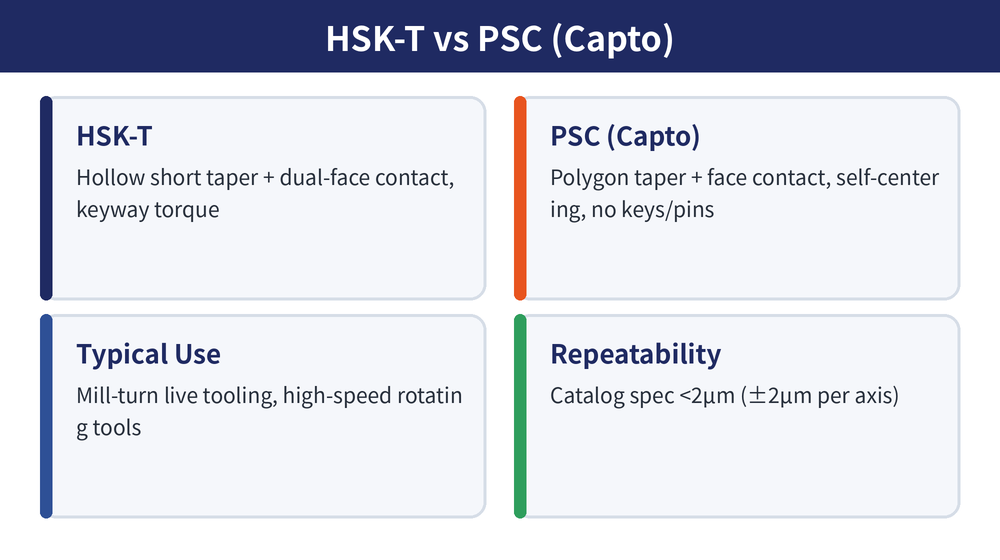
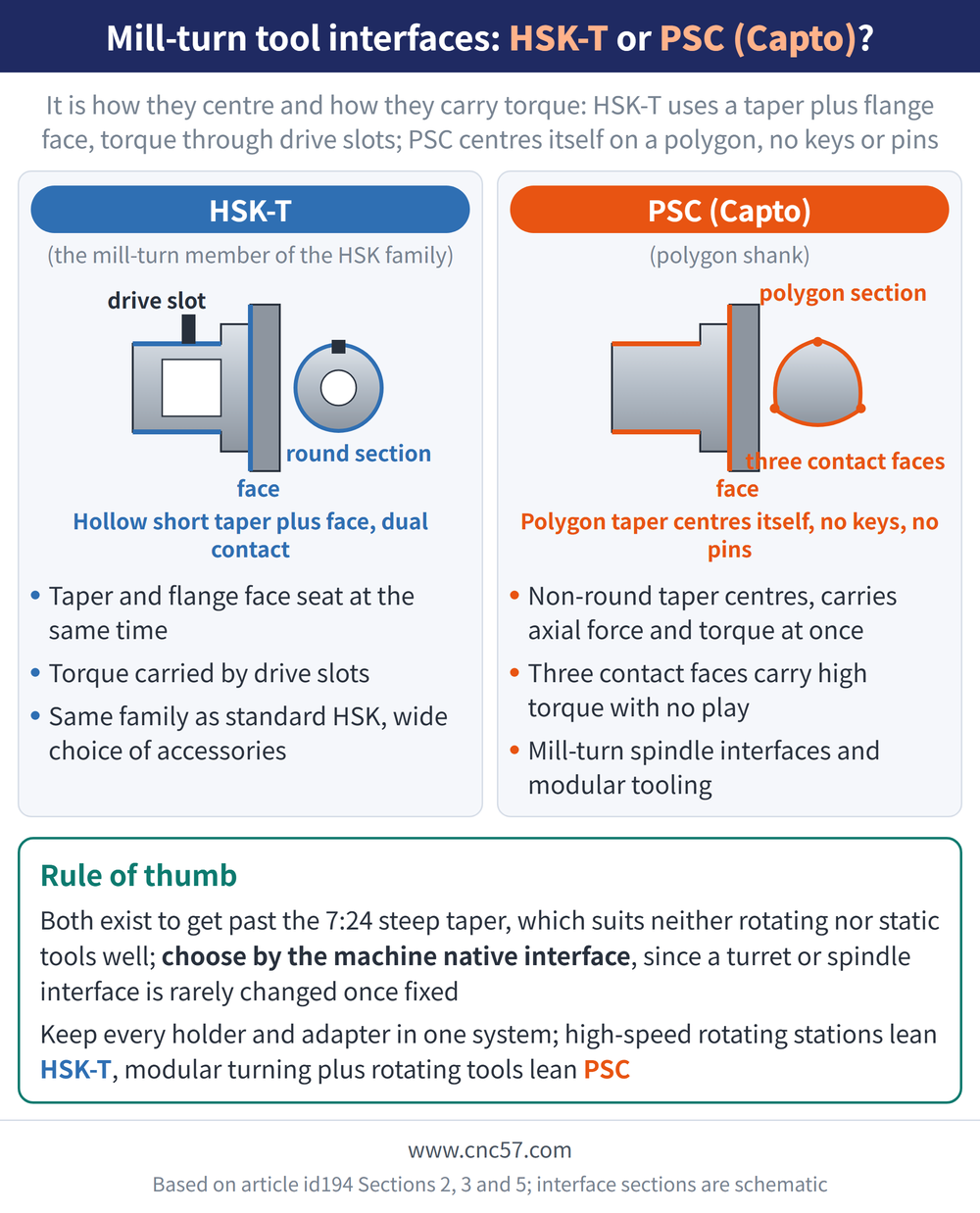
The HSK family comes in several sub-types for different purposes (HSK-A/C general-purpose, HSK-E/F for high-speed machining), and HSK-T is the variant specifically designed for mill-turn and live-tooling turret applications. It uses the same hollow short taper plus simultaneous taper/flange dual-face contact as other HSK types, but is built to handle the combined axial and radial loads of switching between turning and milling operations.
BT vs HSK in detail: see BT vs HSK Spindle Taper Comparison.
3. PSC (Capto): Three-Way Location via a Polygon Interface
PSC (Polygon Shank Connection - the same system marketed as Sandvik Coromant Capto, introduced in 1990 and adopted as ISO 26623 in 2008) uses a non-circular polygon taper to solve three location problems at once:
| Direction | Mechanism | Function |
|---|---|---|
| Radial centering | The conical portion of the polygon | Provides radial location |
| Axial force transfer | Low taper angle plus face contact | Ensures cutting forces reach the flange contact surface; good bending stiffness |
| Torque transfer | Self-centering from the polygon shape itself | No drive keyway needed; transmits high torque through 3 contact faces with no play in the interface |
4. PSC Durability, Accuracy, and Size Range
This "self-centering by shape, no keys or pins for torque" design is, in principle, more durable than holders that rely on keys or pins - those parts inherently have fit clearance, which tends to grow with wear and degrade precision over time; the self-centering polygon design avoids that problem entirely.
Published repeatability figures are under 2 μm (±2 μm in center height, length, and radial direction), attributed to simultaneous radial and axial contact plus self-centering; with off-machine measurement, first-part-correct is achievable with little to no trial cutting in principle. Common interface sizes range from C3 (32 mm) to C8 (80 mm), with two clamping methods - segmented clamping (for fast/automatic tool change) and center-bolt clamping (for modular tooling setups) - to suit different use cases.
Quick-change and modular holders: see Quick-Change / Modular Tool Holder Guide.
5. Choosing Between HSK-T and PSC
| Aspect | HSK-T | PSC (Capto) |
|---|---|---|
| Location principle | Conical taper plus flange dual-face contact | Non-circular polygon taper plus face contact, self-centering |
| Torque transfer | Via drive keyway | Via the polygon shape itself - no keys or pins |
| Availability / compatibility | Part of the broader HSK family; wider range of peripheral accessories | More common as a specific brand/licensed system; primarily used in mill-turn and modular tooling |
| Typical use | Mill-turn live-tooling turrets, stations needing high-speed rotating tools | Mill-turn spindle interfaces, modular holder systems (covering both turning and rotating tools) |
Both exist to overcome the structural limitation of the 7:24 steep taper being "suited to neither rotating nor static applications." In practice, the choice comes down to whichever interface the machine builder specifies - once a mill-turn machine's turret or spindle interface is fixed, you generally can't swap systems, so selection is really about confirming the machine's native interface and keeping all holders and adapters within that same system.
FAQ
Q1: Is HSK-T the same interface as HSK-A?
Not exactly. HSK-T belongs to the same HSK family (DIN 69893) as HSK-A/C/E/F and shares the hollow-short-taper, dual-face-contact location principle, but it's a variant specifically designed for mill-turn/live-tooling turret applications. Always confirm exact specs and fit against the machine manufacturer's documentation - don't mix HSK-T with other HSK types.
Q2: Are PSC and Capto different systems?
PSC (Polygon Shank Connection) is the general standard name for this type of polygon interface (ISO 26623), while Capto is the brand name used by Sandvik Coromant. Both describe the same underlying self-centering polygon interface design - PSC can be thought of as the standardized generic term for it.
Q3: How can a polygon interface transmit high torque without keys or pins?
The polygon interface transmits torque through multiple contact faces from its shape alone (catalogs list transmission through 3 contact faces), with no play in the interface and no need for a drive keyway, key, or pin. Traditional cylindrical holders rely on keys or pins for torque transfer, and those parts inherently carry fit clearance that can widen with wear, gradually degrading precision.
Q4: Can a regular machining center use HSK-T or PSC?
In principle, yes, as long as the spindle interface is compatible, but the cost and peripheral accessories for these interfaces are relatively high-end, so they remain concentrated on mill-turn, multi-task machines, and advanced modular tooling systems. General-purpose milling machining centers still mostly use BT/ISO/HSK-A/HSK-E interfaces - base the choice on actual process requirements rather than chasing a higher-end interface for its own sake.









