
BT vs HSK Spindle Taper Systems Compared
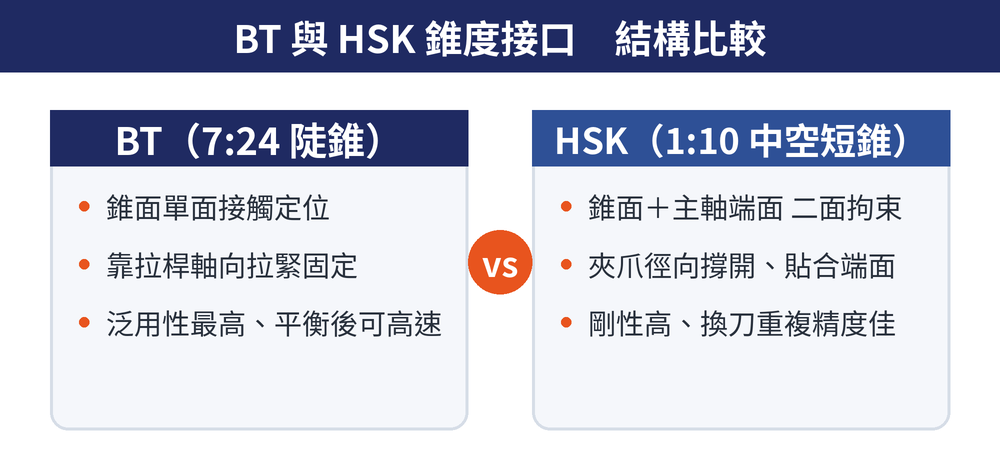
BT and HSK are the two most common spindle taper interfaces in CNC machining. BT uses a 7:24 steep taper with single-face contact, clamped by a drawbar, and is the most universal choice; HSK uses a 1:10 hollow short taper with dual-face constraint (taper plus spindle face), giving an edge in high-rpm and high-precision work. This guide compares BT and HSK in structure, rigidity, high-rpm suitability, tool-change repeatability and cost, and summarizes common spindle interface systems and selection tips.
1. Why the spindle taper interface matters
The taper interface is where the tool holder meets the spindle, and it governs four things: locating accuracy (whether tool and spindle centrelines are coaxial), clamping rigidity (resistance to deflection and vibration during cutting), tool-change repeatability (whether the tool tip returns to the same position after each change), and stability at high rpm (whether centrifugal force and thermal growth cause displacement). Choosing or mixing interfaces wrongly hurts surface finish and, at worst, causes runout and unstable cutting.
2. BT taper (7:24 steep taper)
BT (Japanese MAS 403 standard) uses a 7:24 taper—7 units of diameter change per 24 units of length—a non-self-locking "steep taper" clamped axially by a drawbar. It is symmetric, well balanced and the most universal interface on machining centres, with common sizes BT30 / BT40 / BT50. BT is "single-face contact": it locates on the taper only, leaving a gap between the spindle face and holder flange. BT also comes in a dual-contact version (BTP) that seats on the taper and the flange face together, but only when the spindle supports it and the drawbar force is high enough; see Dual Contact: Why the Flange Face Has a Gap Before Clamping.
| Size | Taper large dia. (ref.) | Pull stud thread (ref.) | Typical use |
|---|---|---|---|
| BT30 | approx. ø31.75 mm | M12 | Small/high-speed, drill-tap machines |
| BT40 | approx. ø44.45 mm | M16 | Most universal, general machining |
| BT50 | approx. ø69.85 mm | M24 | Large parts / heavy cutting |
The dimensions above are common industry reference values; confirm against each spindle and drawbar specification drawing.
3. HSK taper (1:10 hollow short taper) and dual-face constraint
HSK (German DIN 69893) uses a short 1:10 hollow taper. Its defining feature is dual-face constraint—the taper and the spindle face locate at the same time. Clamping is by internal segments that expand radially, pulling the hollow taper inward while pressing the holder flange against the spindle face. As rpm rises, centrifugal force expands the hollow taper slightly, which actually tightens the taper-and-face seating, so axial position stays stable at high rpm—something single-face BT contact struggles to match.
| Form | Features | Suited to |
|---|---|---|
| HSK-A | Drive slots and coolant holes, automatic tool change; most universal | High-speed machining centres |
| HSK-B | Coolant enters through the flange face; taper one size smaller, larger face contact | Rare |
| HSK-C | Same as A but manual tool change | Manual-change machines |
| HSK-D | Same as B but manual tool change | Rarer than B |
| HSK-E | Symmetric, no drive slots; best balance | Ultra-high-speed, high precision |
| HSK-F | Symmetric, no drive slots (friction drive like E); smaller shank than E for the same flange size | High-speed woodworking / light routing |
The number after the form (e.g. HSK-A63, HSK-A100) is the flange diameter in mm. Forms B, D and F use a taper one size smaller than A, C and E with the same flange, which gives a larger face contact. Main dimensions by size (mm):
| Nominal size d1 | A/C/E taper diameter d2 | A/C/E shank length l1 | B/D/F taper diameter d2 | B/D/F shank length l1 |
|---|---|---|---|---|
| 25 | 19 | 13 | — | — |
| 32 | 24 | 16 | — | — |
| 40 | 30 | 20 | 24 | 16 |
| 50 | 38 | 25 | 30 | 20 |
| 63 | 48 | 32 | 38 | 25 |
| 80 | 60 | 40 | 48 | 32 |
| 100 | 75 | 50 | 60 | 40 |
For example, the taper diameter of HSK-F63 is 38, the same as HSK-E50—that is what “one size smaller” means. A “—” marks a size with no dimensions listed.
Confirm dimensions and suitability against the manufacturer's catalogue.
4. BT vs HSK — key differences
| Item | BT (7:24 steep taper) | HSK (1:10 hollow) |
|---|---|---|
| Contact | Single-face (taper only) | Dual-face (taper + face) |
| Clamping | Drawbar axial pull | Segments expand radially, seat on face |
| Rigidity | Good | Higher (face support) |
| High-rpm suitability | Needs good balancing; taper bore expands and can shift axially at high rpm | Good; centrifugal expansion tightens seating |
| Tool-change repeatability | Good | Excellent (stable axial location) |
| Change speed | Average | Fast (short taper) |
| Cost | Lower, wide choice | Higher |
| Typical use | General CNC, machining centres | High-speed / high-precision, dies, aerospace |
5. Common spindle interface systems
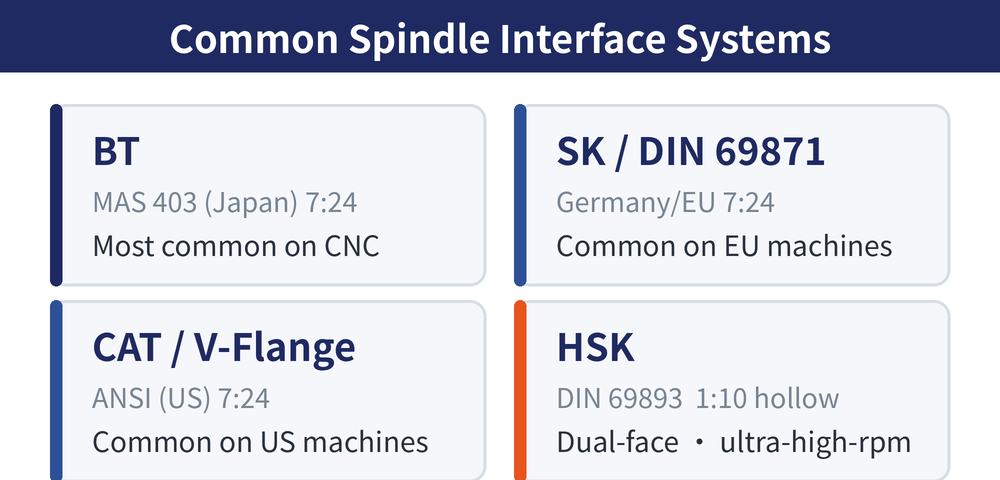
Besides BT and HSK, several other steep-taper and modular interfaces are common—most share the 7:24 taper and differ only in flange and retention-knob specs:
| System | Standard/region | Taper | Notes |
|---|---|---|---|
| BT | MAS 403 / Japan | 7:24 | Most common on CNC; symmetric |
| SK (DIN 69871) | Germany/EU | 7:24 | Common on EU machines |
| CAT (V-Flange) | ANSI / USA | 7:24 | Common on US machines |
| HSK | DIN 69893 | 1:10 hollow | Dual-face, ultra-high-speed / precision |
| Capto | ISO 26623 (polygon) | Polygon | Modular; common on mill-turn |
Although BT, SK and CAT are all 7:24 and look similar, their retention knobs (pull studs) and flange dimensions differ and are not interchangeable—always follow the machine spindle interface. See What Is a Pull Stud: Standards and Selection Basics for details.
6. Selection tips
| Requirement | Suggested interface | Why |
|---|---|---|
| General machining, budget first | BT40 | Most universal, wide holder choice, low cost |
| Large parts / heavy cutting | BT50 | Larger taper, higher rigidity |
| High-rpm, high-precision, dies/aerospace | HSK-A63 / HSK-E | Dual-face, better repeatability and balance |
| Existing machine | Match the spindle interface | Interface is fixed; avoid mixing |
Once the interface is set, real stability still depends on the holder's clamping method, dynamic balance and overhang. Further reading: Tool Holder Taper Specs (BT/NT/MT), Collet Damage and Deformation, Face Milling Clamping Guide.
FAQ
Q: Are BT and HSK interchangeable?
No. BT is a 7:24 steep taper clamped by a drawbar; HSK is a 1:10 hollow short taper clamped by radially expanding segments. Their spindle interfaces are structurally different and cannot be swapped. Choose the holder that matches your machine spindle interface.
Q: Why is HSK better for high rpm?
HSK combines a hollow short taper with dual-face constraint. At high rpm, centrifugal force expands the hollow taper slightly, which tightens taper-and-face seating and keeps axial position stable. BT single-face contact, by contrast, sees the taper bore expand at high speed and can shift axially—so HSK has the edge in ultra-high-speed, high-precision work.
Q: What is the difference between HSK-A and HSK-E?
HSK-A has drive slots and coolant holes and supports automatic tool change—the most universal form for machining centres. HSK-E is fully symmetric with no drive slots for the best balance, ideal for ultra-high-speed and high-precision work, but relies mainly on taper friction for torque. Choose based on the machine and application.
Q: My machine is BT—how can I raise rpm and precision?
The spindle interface cannot be changed, but within BT you can use precision-balanced holders, switch to shrink-fit or hydraulic clamping to cut runout, shorten tool overhang, and clean the taper regularly. These improve high-rpm stability and accuracy without changing the spindle.
This article is part of Tool Holders: The Complete Guide - One End Meets the Spindle, the Other Holds the Cutter; that guide shows how the whole topic fits together.
Published: 2026-07-20 | Last updated: 2026-10-24









