
Choosing and Using Handheld Cut-Off Wheels: Abrasive, Grade, Reinforcement, and What to Do Before and After Cutting
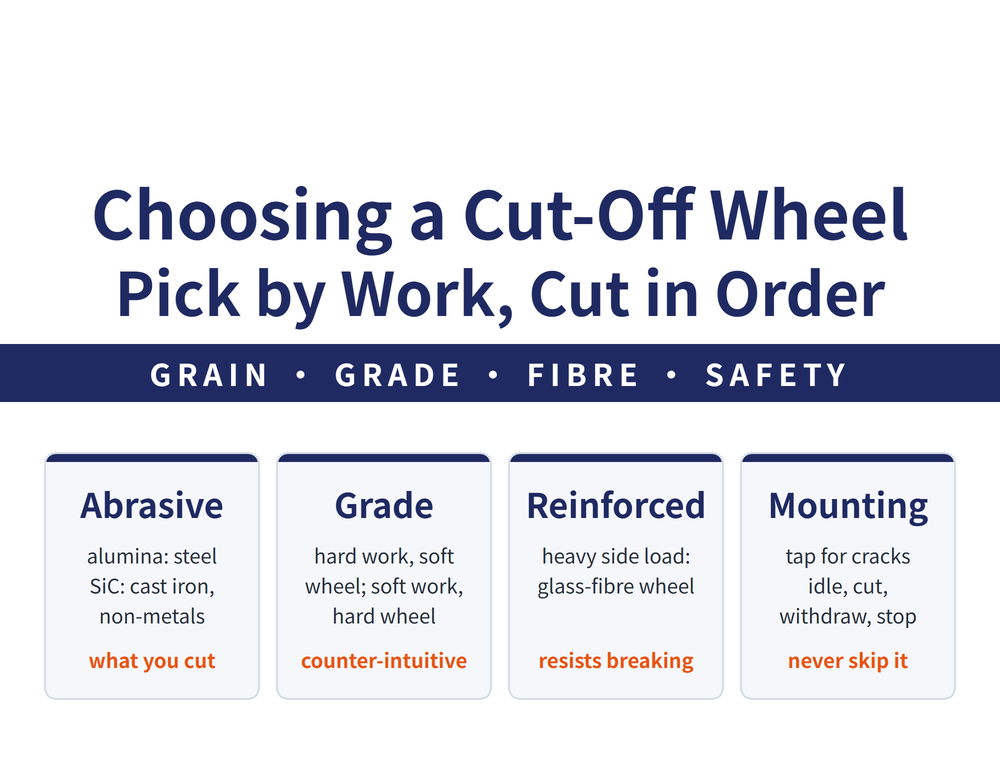
Pick a handheld cut-off wheel by the workpiece: alumina for steel, silicon carbide for cast iron and non-metals; for hardened and high-strength steel choose a softer wheel so dull grains shed quickly, and for soft material a harder one; where side load is heavy, choose a glass-fibre reinforced wheel. While cutting, set the feed pressure by the material rather than by force; before mounting, tap-test the wheel and let it run idle first; after cutting, withdraw before you stop the machine. This article covers how to choose, how to cut and how to cut safely, in that order.
1. What a cut-off wheel does well, and what it costs
Cutting with an abrasive cut-off wheel is faster than sawing or parting on a lathe, and kerf width and straightness are generally more even than sawing. It cuts hard materials such as hardened steel and metal carbides, as well as hard-brittle non-metals, and the wheel never needs dressing over its whole life.
The cost is the cut face: handheld metal cutting is generally dry cutting, so the face is rougher and may carry burrs, stains or even local hardening. What that means: if the cut face will be machined next, include the heat-affected layer in the machining allowance - a handheld cut is still fine; if the cut face itself needs accuracy, or the material must not burn, use stationary cut-off equipment with coolant.
2. Dry or wet: handheld metal cutting is generally dry
| Method | What it needs | What you get |
|---|---|---|
| Dry | No coolant; simple equipment | Fast; rougher face, possible heat effects |
| Wet | A coolant circulation system | Accurate cut, few burrs, no burn; cutting rate about half of dry |
| Immersion | The work is cut submerged in coolant | Best cooling; common for metallographic samples |
Handheld metal cutting is generally dry, so it sits in the first row. If the cut face will be machined next, include the heat-affected layer in the machining allowance - a handheld cut is still fine; if the cut face itself needs accuracy, or the material must not burn, use stationary cut-off equipment with coolant; the five cutting methods of a stationary cut-off machine are in Stationary Cutting: Choosing Among Five Methods.
3. How to choose: abrasive, grit, grade, bond
| Item | How to choose |
|---|---|
| Abrasive | Alumina for steel; silicon carbide for cast iron, non-metals and some rare metals |
| Grit | Depends on whether you need a fast cut or a smooth face with few burrs |
| Grade | Harder wheel for soft material; softer wheel for high-strength and hardened steel |
| Bond | Mostly resinoid for dry cutting; rubber or rubber-resin for wet cutting with a required finish |
Grade runs against intuition: hard material takes a soft wheel, because a soft bond lets dull grains drop out and expose new ones, so the wheel keeps cutting and runs cooler. The price is shorter wheel life. With a low-power tool, or when the work thickness is close to the tool's capacity, a softer wheel is also an option.
Vitrified bond is too hard in nature to make ultra-thin cut-off wheels; the usual bonds are resinoid and rubber. How abrasive, grit and bond are chosen for grinding-machine wheels is in Choosing Grinding Wheel Grit, Grade, Bond and Structure: Workpiece First, Then the Job, Then the Defect.
4. Reinforcement and thickness: heavy load, reinforced wheel
A cut-off wheel with glass-fibre fabric layers is a reinforced wheel and resists breaking better. Where side load is heavy or working conditions are demanding, use a reinforced wheel; it can also be run at a higher surface speed.
Thickness has an upper limit, set by diameter:
| Wheel diameter (mm) | Maximum thickness (mm) |
|---|---|
| Up to 150 | 4.76 |
| 150-300 | 6.25 |
These are limits, not recommendations; the actual thickness follows the product marking. Matching a handheld tool to these wheels is covered in Matching Handheld Grinders to Their Drives: Tool First, Then Speed, Power and Coupling.
5. How to cut: before mounting, start-up, cutting, finishing
| When | What to do |
|---|---|
| Before mounting | Tap it lightly with a wooden mallet; a dull sound means a possible internal crack - do not use it |
| Start-up | Run idle for 2 minutes, confirm it runs normally, then start cutting |
| Cutting | More feed pressure on hard material, less on soft; aim for a cut you can control easily |
| Finishing | Withdraw from the work first, then stop the machine |
Feed pressure generally stays below 20 kgf; the measure is that the operator can cut with control, not by force.
6. Safety: speed, expiry, guard and clothing
| Item | Requirement |
|---|---|
| Speed | Use the wheel at the working speed marked on it; overspeed is the most direct cause of bursting |
| Guard | The tool must have a wheel guard fitted |
| Clothing | Work clothes or close-fitting clothing; long hair tucked under a cap |
For a reinforced cut-off wheel, the marked maximum speed is a ceiling, not the best value - the best value may be a third or more below it and has to be found by trial. Maximum surface speeds by abrasive type, and how surface speed relates to RPM, are in How Fast Can an Abrasive Run: Same Sheet of Abrasive, Seven Times the Limit. Cut-off wheels also carry an expiry date set by standard, and an expired wheel looks no different; goods-in and storage are in Abrasives Have an Expiry Date Too: Markings, Stock Rotation and Storage.
7. Frequently Asked Questions (FAQ)
Q: Harder or softer cut-off wheel for hardened steel?
Softer. A soft bond lets dull grains drop out and expose new ones, so the wheel keeps cutting and runs cooler; a harder wheel is for soft material. The price of a soft wheel is shorter life.
Q: When should I choose a reinforced cut-off wheel?
When side load is heavy or working conditions are demanding. A reinforced wheel contains glass-fibre fabric layers, resists breaking better and can be run at a higher surface speed.
Q: What should I check before mounting a cut-off wheel?
Tap it with a wooden mallet; a dull sound means a possible crack, so do not use it. Then check the marked working speed, the expiry date and the tool's guard, and run it idle for 2 minutes before cutting.
Q: Why does a handheld cut face discolour and harden?
Handheld metal cutting is generally dry, so heat stays in the cut face, which can leave stains or even local hardening. If the cut face will be machined next, include the heat-affected layer in the machining allowance - a handheld cut is still fine; if the cut face itself needs accuracy, or the material must not burn, use stationary cut-off equipment with coolant.
This article is part of Deburring and Surface Finishing: The Complete Guide - Which Tool, Which Material, and What to Do in Volume; that guide shows how the whole topic fits together.
Published: 2026-10-24 | Last updated: 2026-10-24









