
Matching Handheld Grinders to Their Drives: Tool First, Then Speed, Power and Coupling
The most common mistake in choosing a handheld grinder is getting the order backwards: buying the machine first, then hunting for tools that fit it. The right order is tool first - the abrasive and the speed it needs - with the machine as the supporting act. This guide splits the choice into three gates - speed, power under load, coupling - and lays out which machine type suits which job, and how to decide between air and electric.
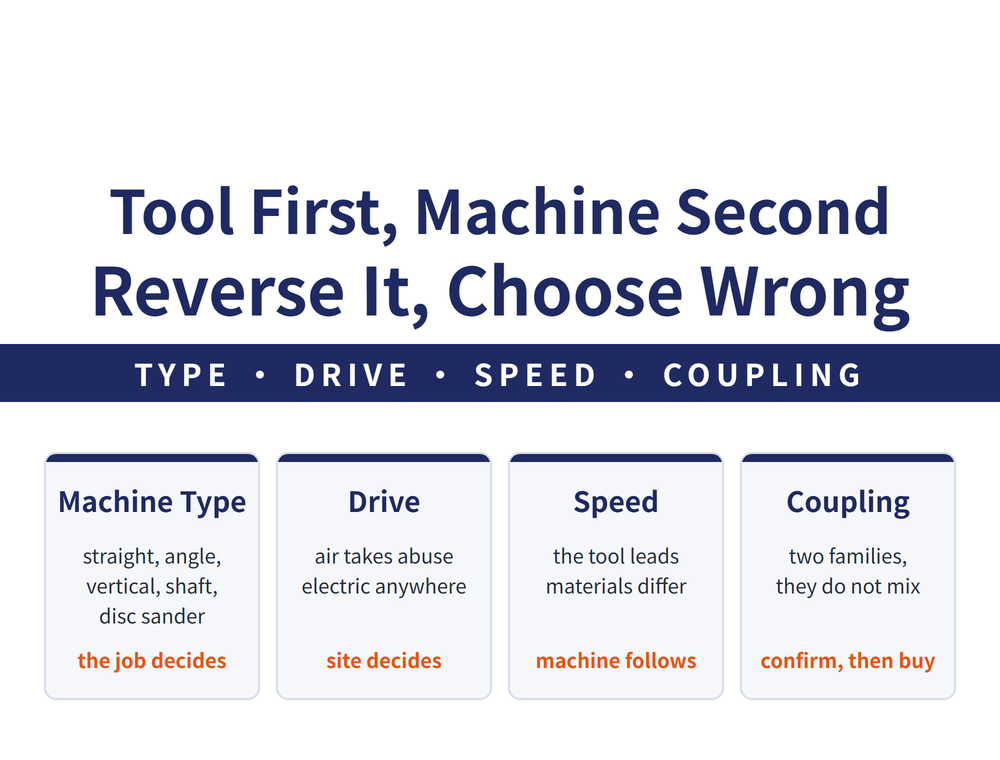
1. The Order: Abrasive Tool First, Machine Second
Four gates - and the makers’ own first selection rule fixes the order: choose the drive to suit the abrasive tool’s recommended speed; decide what will be mounted, then pick the machine - never the other way round.
| Gate | The question | If it fails |
|---|---|---|
| 1 Speed | Can the machine deliver what the tool wants | Too fast is a safety problem; too slow, an efficiency one |
| 2 Power | Does the speed hold under load | Sags the moment you press - no cut, all heat |
| 3 Form and size | Does it reach the work, can it be held | Cannot reach, or wears the operator out |
| 4 Coupling | Does the collet or spindle thread match | Will not mount - or mounts badly and runs out |
Gate 2 is the overlooked one: anyone can print a no-load speed; power means holding speed under load - and the load is set by the workpiece material, the tool’s cutting behaviour and the contact pressure together.
2. Machine Types: The Job Picks the Form
The difference between types is not which is better, but what each is designed for:
| Type | Abrasive tools it carries | Suited to |
|---|---|---|
| Straight | Plain wheels, small cone wheels | Fettling large parts, dressing welds, de-rusting |
| Angle grinder | Depressed-centre wheels, flap discs, cut-off wheels, brushes | The all-rounder; work depressed-centre wheels at about 15-30° |
| Vertical | Cup wheels, mainly | Downward faces - the tool’s own weight provides pressure, easy over long spells |
| Flexible shaft | Mounted points of all shapes | Die and mould work, complex cavities; light handpiece, quick changes |
| Disc sander (coated) | Coated discs on backing pads | Sheet-metal weld dressing, pre-paint surfaces; safety and conformability are the point |
Two boundaries people ask about: depressed-centre wheels are used tilted (laid flat, only the rim carries load); and a coated-disc sander’s advantages over bonded wheels are safety, weight, curve-following and no dressing - disc specifics in Reading Coated Abrasive Specs. For mounted points and their centrifugal-force rules, see Mounted Points and Flap Wheels.
3. Air or Electric
| Drive | Strength | Weakness and prerequisite |
|---|---|---|
| Air | Simple, durable, tolerates brief overload without burning out - suits continuous, repetitive work | Needs adequate compressed air; hose bore and pressure per spec |
| Standard electric | Most common, works anywhere | Sensitive to dusty environments |
| High-frequency electric | Holds speed at rated load | Needs a frequency converter - supply-limited |
The criterion is site conditions, not machine quality: on a line with stable compressed air, the air tool’s overload tolerance is hard to replace; away from any compressor, it is electric’s territory. And the oil rate and hose bore on an air tool’s spec sheet are not suggestions - they are the conditions under which it delivers its rated power.
4. Speed Follows the Tool and the Material
Speed has two layers - do not mix them: the limit is the safety value marked on the tool; the working speed is where results are best - what the limits mean is covered in How Fast Abrasive Tools May Run. The working speed then follows the material:
Taking coated-disc sanding as the worked example, the reference pattern is: mild steel and aluminium take higher speeds, stainless needs to come down markedly (roughly a third lower at the same diameter), and a size up in disc diameter also means turning the speed down. The numbers themselves vary by tool and maker; the pattern is what travels: the harder and stickier the material, and the larger the diameter, the lower the speed - and every change of tool or material sends you back to that item’s own recommendation.
🔴 Running one speed for everything is the classic disc-sanding mistake - stainless discoloured by heat is usually a speed problem before it is a grain problem. Material-specific measures: Deburring and Finishing by Material; looking up grinding parameters: Grinding Parameters by Material.
5. Flexible-Shaft Systems: Couplings Have No Grey Zone
A flexible-shaft system is three parts - drive motor, shaft, handpiece - matched separately, in a fixed order:
| Step | Match what |
|---|---|
| 1 The shaft’s speed range | Chosen first, from the job |
| 2 The motor’s speed range | Must cover the shaft’s |
| 3 The compatibility matrix | Is the pairing rated best, usable, or not applicable |
| 4 Both end fittings | Drive-end standard and handpiece coupling both match |
🔴 The hardest rule: drive-end connection standards (such as the DIN 10 and DIN 15 families) are mutually incompatible with no "close enough" - it is not a speed mismatch, it physically does not mount. Confirm which family your drive is before ordering. ⚠ And the matrix only answers speed range and fittings - never whether the torque suffices; that goes back to the power gate in section 1.
6. Two Safety Ceilings, Not Recommendations
| Ceiling | Content | Why it is hard |
|---|---|---|
| The marked maximum speed | The maximum permissible speed on the tool and its label - never exceeded under any circumstances | It is a safety limit; the "best results" speed is a different number, both printed in catalogues - never use the latter as the former |
| 180 mm brush diameter, handheld | Brushes on handheld drives must not exceed 180 mm diameter, whatever the wire | Beyond that the job belongs on stationary equipment, not on a bigger handheld |
This section and the abrasive-side rules are two ends of one requirement: the speed the machine can give and the speed the tool can take must both be satisfied. Brush wire and style selection: Choosing a Wire Brush; pre-mount checks for abrasives: Why Grinding Wheels Crack. For cut-off wheels on an angle grinder, how to choose one and what to do before and after cutting, see Choosing and Using Handheld Cut-Off Wheels: Abrasive, Grade, Reinforcement, and What to Do Before and After Cutting.
7. Frequently Asked Questions (FAQ)
Q: Why not buy the machine first and match tools to it?
Because the tool owns the speed decision. Every abrasive tool carries its own recommended speed and safety limit, and the machine can only accommodate them; fix the machine first and you have locked the usable tools into that machine’s speed band. The usual result is "it mounts, but at the wrong speed" - too fast breaches the tool’s limit and is a safety issue, too slow will not cut. The makers’ first selection rule says: the tool to be mounted comes first.
Q: How do I actually decide between air and electric?
By site conditions, not by machine quality. On a line with stable compressed air, an air tool is simple, durable and briefly overloadable without burning out - hard to replace for continuous work. Without a compressor it is electric territory: standard electric goes anywhere but dislikes dust; high-frequency holds speed under load but needs converter supply. And treat the air spec’s hose bore and oiling rate as prerequisites, not references.
Q: The shaft coupling does not match - can I adapt it?
Do not plan on it. Drive-end standards are physically incompatible families, and the compatibility matrix marks every cross-family pairing not applicable - this is not a speed mismatch, it does not mount. Before ordering, confirm which family the drive belongs to and which coupling the handpiece takes; both ends must match. And remember the matrix answers compatibility only - torque adequacy is a separate power check.
Q: Stainless is discolouring from heat - change the grain or drop the speed?
Check the speed first. The classic disc-sanding mistake is one speed for everything, and stainless wants a markedly lower working speed than mild steel; if it still burns at the right speed, then move to a cooler-running grain. The order: confirm the speed follows the material, confirm the contact pressure is not excessive, then look at grain selection - three independent levers, and changing them all at once tells you nothing about which one worked.
This article is part of Deburring and Surface Finishing: The Complete Guide - Which Tool, Which Material, and What to Do in Volume; that guide shows how the whole topic fits together.
Published: 2026-09-25 | Last updated: 2026-10-24









