Mold Steel Equivalency Chart: Cold-Work, Hot-Work & Plastic
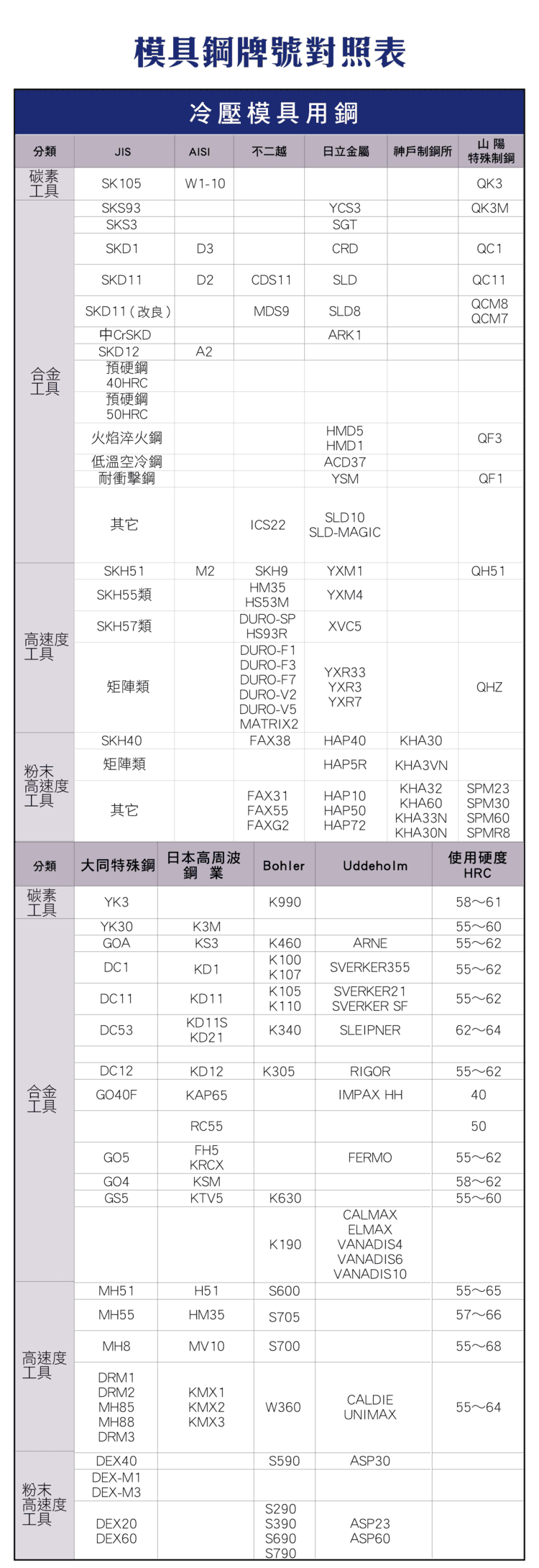
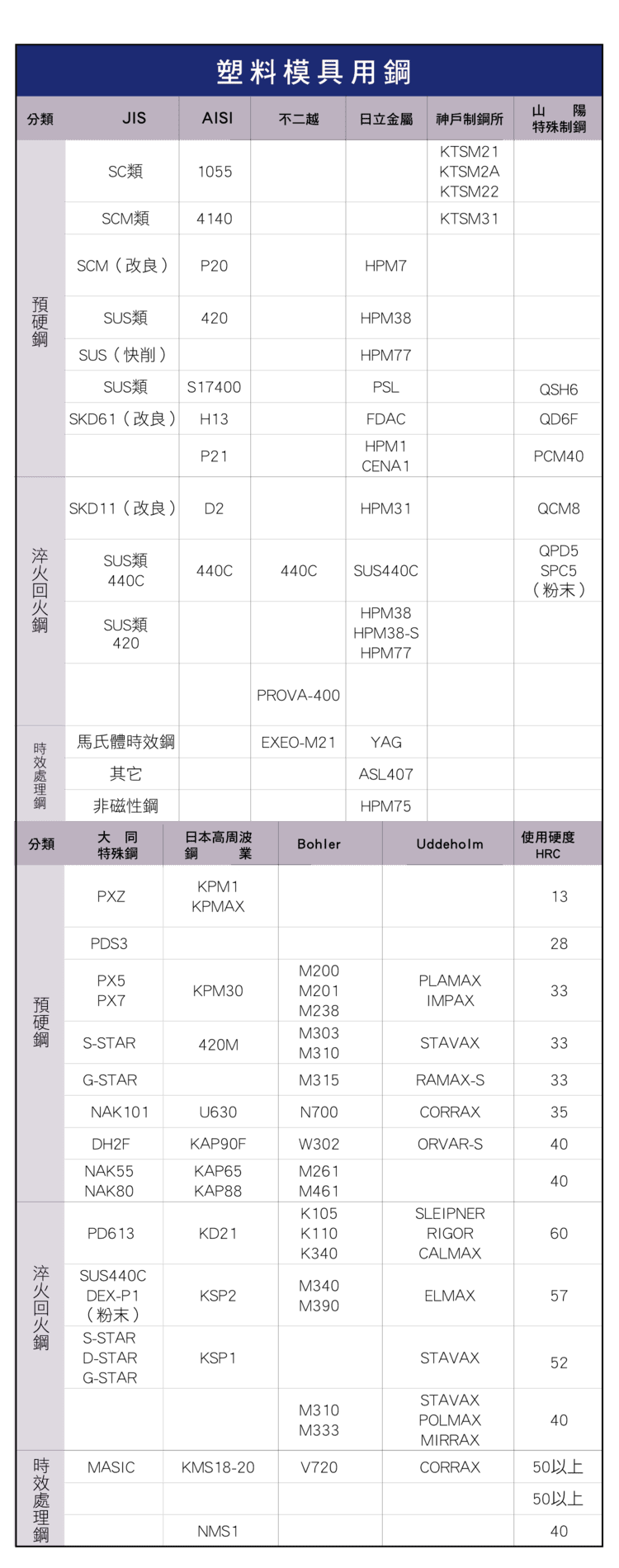
A mold steel equivalency chart maps grades across JIS (Japan), AISI (USA) and major specialty mills, covering cold-work, hot-work, plastic, high-speed and powder high-speed steels. It lets engineers quickly find equivalent grades for substitution, sourcing and machining planning, and shows each grade's hardness range and applications. For the material-group concept, see ISO Workpiece Material Classification.
Five Main Categories of Mold Steel
Mold steels split into five categories by use and working temperature; representative grades, hardness and typical applications below.
| Category | Representative grades | Hardness (typical range) | Characteristics | Typical use |
|---|---|---|---|---|
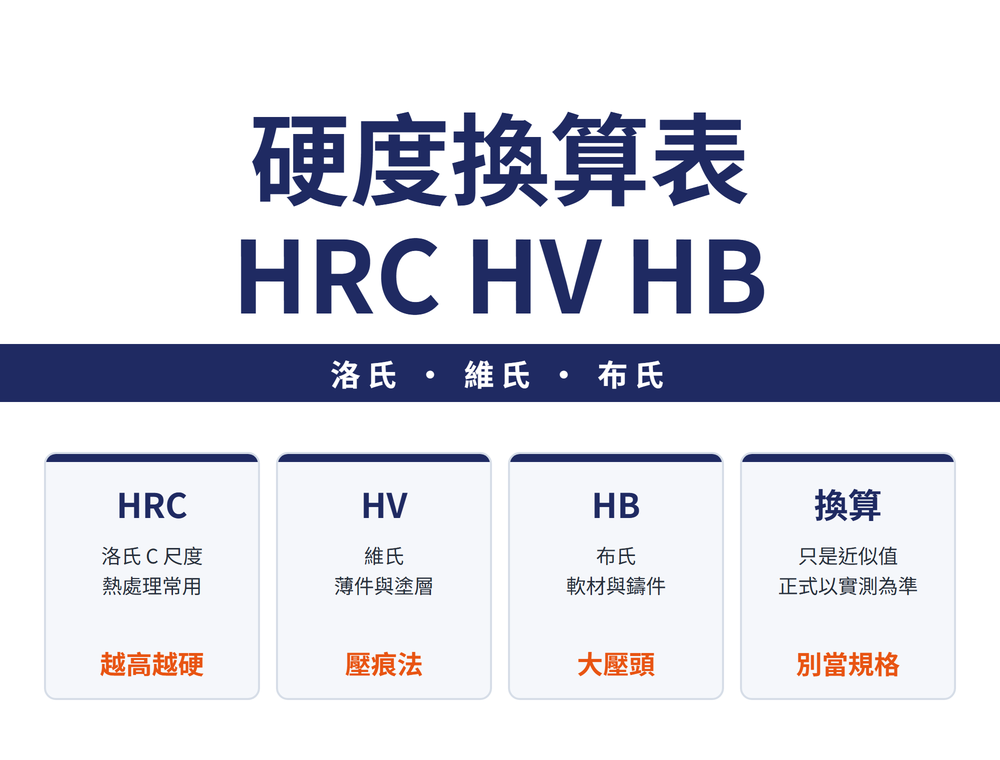
| Cold-work tool steel | SKD11, SKD1, SLD | ~HRC 55–62 (quenched and tempered) | High wear resistance, high hardness | Stamping/blanking/forming dies |
| Hot-work tool steel | SKD61, SKD6, SKD5 | ~HRC 40–52 | High thermal-fatigue resistance, good toughness | Die-casting, hot-forging dies |
| Plastic mold steel | P20, HPM7, NAK80, S-STAR | ~HRC 30–40 (pre-hardened) | Good polishability, dimensional stability | Plastic injection / high-gloss molds |
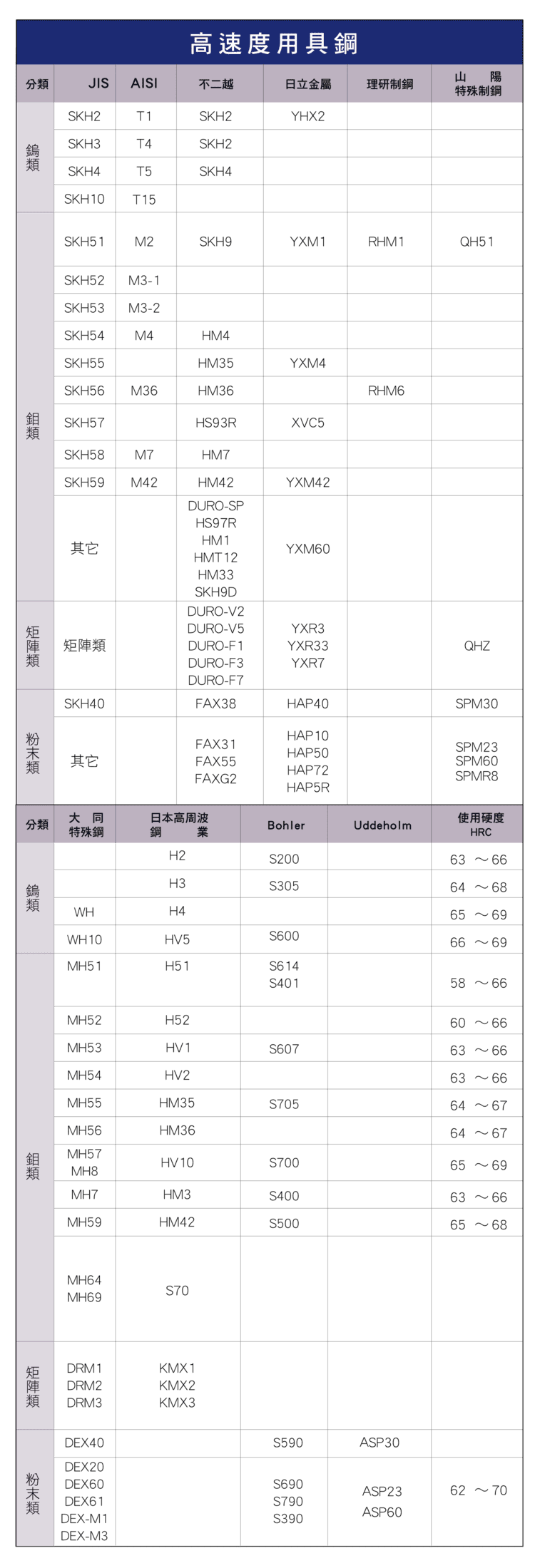
| High-speed tool steel | SKH51, SKH55, SKH57 | SKH51 ~HRC 58–66, SKH55 ~HRC 64–67, SKH57 ~HRC 65–69 (mill-rated working hardness; see the high-speed tool steel chart below) | High red hardness, heat resistant | Cutting tools, high-speed machining |
| Powder high-speed steel | ASP23, ASP30, ASP60 | HRC 60+ | Uniform structure, high wear resistance | High-precision, long-life tooling |
Equivalent-Grade Substitution
Different mills give the same performance class different brand names with similar composition and properties. Use the table to find equivalents.
| Category | JIS | AISI | Mill brand (example) |
|---|---|---|---|
| Cold-work | SKD11 | D2 | SLD (Hitachi) |
| Hot-work | SKD61 | H13 | DAC (Daido) |
| Plastic mold | P20 | — | HPM7 (Hitachi), IMPAX (Uddeholm) |
| High-speed | SKH51 | M2 | YXM1 (Hitachi) |
Hot-Work Tool Steel Cross-Reference
| JIS | AISI | Use |
|---|---|---|
| SKD61 | H13 | Die-casting / hot-forging dies (most common) |
| SKD6 | H11 | Hot-work dies needing higher toughness |
| SKD5 | H21 | High-temperature, high-load hot-work dies |
Major Mill Cross-Reference
Mold steel supply centers on a few specialty mills; when substituting, note "different brand name, similar performance".
| Mill | Region | Common grade series |
|---|---|---|
| Hitachi Metals (YSS) | Japan | SLD, HPM, YXM series |
| Daido Steel | Japan | DAC, NAK series |
| Bohler | Austria | K, W, M series |
| Uddeholm | Sweden | IMPAX, ORVAR, SVERKER series |
Selection Advice & Engineering Notes
Key factors are hardness requirement, wear resistance and thermal stability; the right steel extends mold life, lowers maintenance cost and improves machining stability:
| Item | Description |
|---|---|
| Stamping / cold-work | SKD11 ↔ D2 ↔ SLD — wear resistance. |
| Die-casting / hot-work | SKD61 ↔ H13 ↔ DAC — thermal-fatigue resistance. |
| Plastic molds | P20 ↔ HPM7 ↔ IMPAX — polish & stability. |
| Cutting tools | SKH51 ↔ M2 ↔ YXM1 — red hardness. |
Mold steels are mostly high-hardness materials; cutting conditions must match the hardness state — see End Mill Cutting Conditions Guide. The same grade differs greatly in machinability between annealed (softer, ISO P) and heat-treated (hard, ISO H) states, so tool and parameter choices must be considered separately.
※ The tables give common approximate equivalents; hardness values are indicative ranges. Verify exact composition and properties against each mill's datasheet.
FAQ
What are the AISI and mill equivalents of SKD11?
SKD11 (JIS) ≈ D2 (AISI) ≈ SLD (Hitachi), a cold-work tool steel of ~HRC 55–62 after quench and temper, common for stamping and forming tools. For the JIS-to-AISI mold steel mapping, see Section 5 of Die and Mold Steel Machining Guide.
Are SKD61 and H13 the same steel?
They are equivalent hot-work tool steels: SKD61 (JIS) ≈ H13 (AISI) ≈ DAC (Daido), ~HRC 40–52, used for die-casting and hot-forging dies.
Which steels are used for plastic molds?
Commonly P20, HPM7 (Hitachi), NAK80 (Daido) and IMPAX (Uddeholm) — pre-hardened steels (~HRC 30–40) with good polishability and stability for injection and high-gloss molds.
How does powder HSS differ from regular HSS?
Regular HSS has high red hardness, and its working hardness depends on the grade (mill-rated: SKH51/M2 ~HRC 58–66, SKH55 ~HRC 64–67, SKH57 ~HRC 65–69); powder HSS (e.g. ASP series) is made by powder metallurgy for a more uniform structure and better wear resistance, reaching HRC 60+, ideal for high-precision, long-life tools. For how SKH maps to the AISI M and T series and how cobalt and powder grades are split, see HSS Grades Decoded.
This article is part of Workpiece Materials: The Complete Guide - Name the Metal First, Then Match the Tool; that guide shows how the whole topic fits together.
Published: 2026-03-25 | Last updated: 2026-10-25