
Die and Mold Steel Machining Guide: Six Families, Hardness Grades and Tool Choice
Mold steel is hard to machine not because one grade is tough, but because the whole family has systematically low machinability (most below half of a free-cutting steel). Sort out three things first — family, delivery hardness and machinability; this guide also opens with the mix-up that a grade called "718" can be a plastic mold steel or a nickel superalloy.
1. First, the mix-up: two grades called "718" are not the same steel
The classic trap is 718: ASSAB 718 is a pre-hardened plastic mold steel close to a modified AISI P20 (supplied at roughly HRC 30, ready to machine), while Inconel 718 is a nickel-based superalloy, the hardest-to-cut S group in the ISO classification. They only share the number 718; composition and machining difficulty are worlds apart.
Cutting conditions do not transfer at all, so the first step with any grade is to confirm the standard and family, not just read the number. For cross-standard equivalence see the mold-steel equivalency chart, and for the ISO grouping see the ISO workpiece material classification; figures from brand catalogues defer to each manufacturer's datasheet.
2. The six mold-steel families: start from "what it is for"
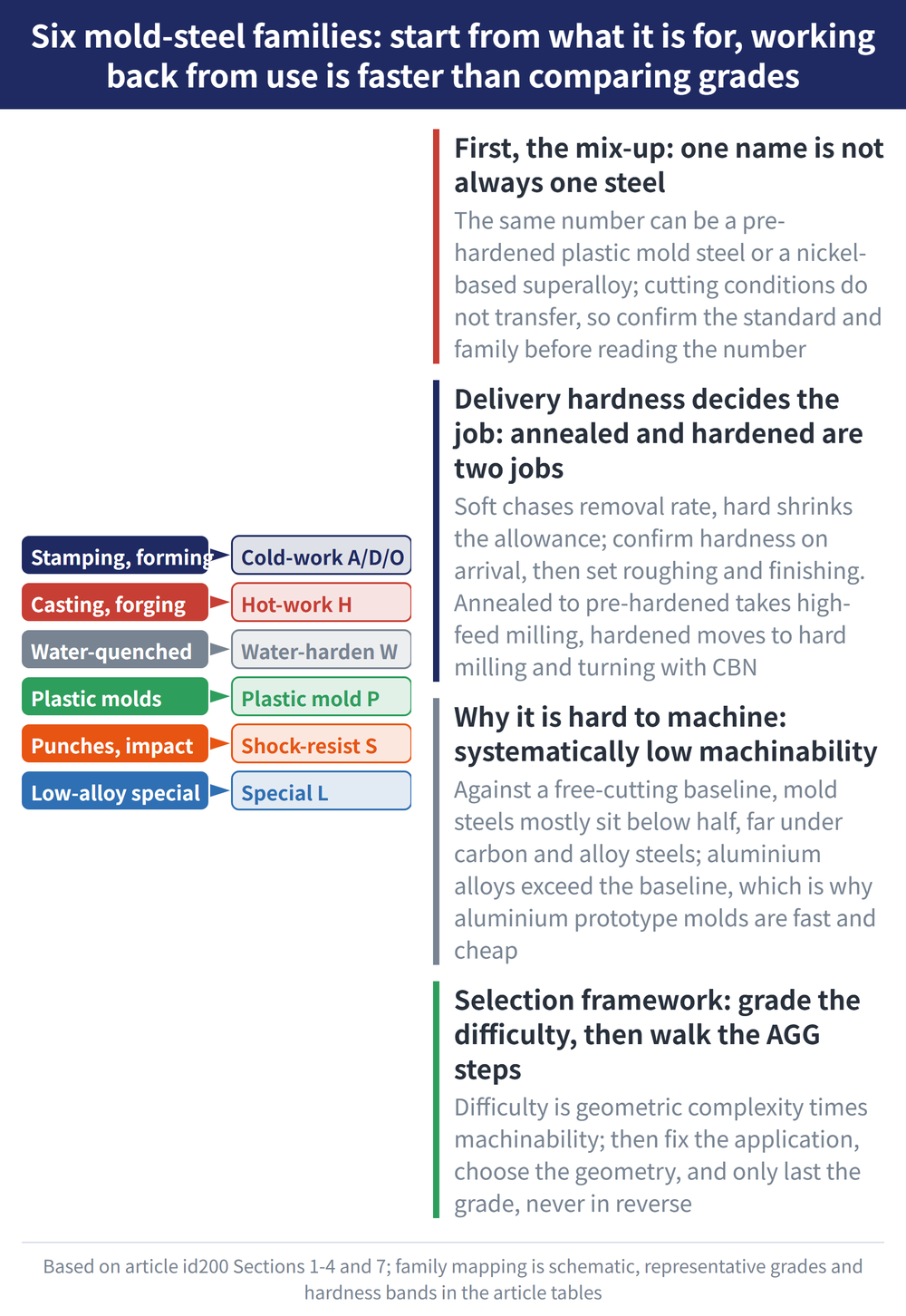
Mold steels split into roughly six families under the AISI/SAE standard; working back from use to family is faster than comparing grades.
| Family | Role and character | Representative grades |
|---|---|---|
| Cold-work | Room-temperature stamping, extrusion and forming; splits into A (air-hardening medium alloy), D (high carbon, high chromium) and O (oil-hardening) | A2, D2, D3, O1 |
| Hot-work (H series) | Die casting, hot forging and extrusion dies working at high temperature | H11, H13, H21 |
| Water-hardening (W series) | Water-quenched carbon tool steel, low cost | W1, W2 |
| Plastic mold (P series) | Injection and forming plastic molds, mostly supplied pre-hardened | P20, P21 |
| Shock-resistant (S series) | Punches, hot forging dies and cold extrusion dies taking impact | S1, S5, S7 |
| Special-purpose (L series, low alloy) | Low-alloy, application-specific forming parts | L6 |
Family classification and representative grades are organised from the AISI/SAE standard and the ISCAR die and mold guide; check each steelmaker's datasheet for actual grade composition.
Beyond the six families, maraging steel is increasingly common in plastic molds: pre-hardened to about HRC 30–36 for machining and reaching about HRC 58 after ageing, but its higher cost limits use. Martensitic stainless (such as 420), alloy and carbon steels (such as 4140), aluminium and beryllium-copper also appear in mold parts, with aluminium the first choice for prototype molds thanks to easy machining and low cost.
3. Hardness and delivery state: annealed and hardened are two different jobs on the same steel
What matters even more than the family is the delivery hardness: annealed and hardened are two jobs — soft chases removal rate, hard shrinks the allowance. The common delivery-hardness states break down as below.
| Delivery state | Hardness range |
|---|---|
| Soft annealed | ≤ HB 250 |
| Pre-hardened (low) | HRC 30–37 |
| Pre-hardened (high) | HRC 38–44 |
| Hardened (low) | HRC 45–49 |
| Hardened (medium) | HRC 50–55 |
| Hardened (high) | HRC 56–63 and above |
The hardness grades are organised values from the ISCAR die and mold guide, not measurements by this site; steelmakers define each grade slightly differently. For conversion between scales (HRC, HV, HB and tensile strength), see the hardness conversion chart.
"Pre-hardened steel" has no single definition, generally taken as below HRC 45, and the boundary drifts as tool capability improves. The practical rule: confirm the hardness on arrival, then set the roughing and finishing philosophy.
4. Why mold steel is "hard to machine": systematically low machinability
The real reason mold steel is hard to machine is that the whole family has systematically low machinability. The table below takes AISI 1212 free-cutting steel as the 100% baseline:
| Material class | Representative grades and machinability (%) |
|---|---|
| Carbon steel | 1045 = 57%, 1020 = 72%, 1212 = 100% (baseline) |
| Alloy steel | 4140 = 66%, 4340 = 57%, 8620 = 68% |
| Mold steel | D2 = 27%, H13 = 46%, P20 = 38%, S7 = 45%, A2 = 42%, O1 = 42% (mostly 25–49%) |
| Grey cast iron | Class 20 = 73%, Class 40 = 48% |
| Aluminium alloy | 6061-T = 200%, 7075-T = 140% |
Machinability figures are AISI/SAE published test results relative to AISI 1212 = 100% (organised in the ISCAR die and mold guide), a manufacturer example, not measurements by this site; actual values vary with heat-treatment state and batch.
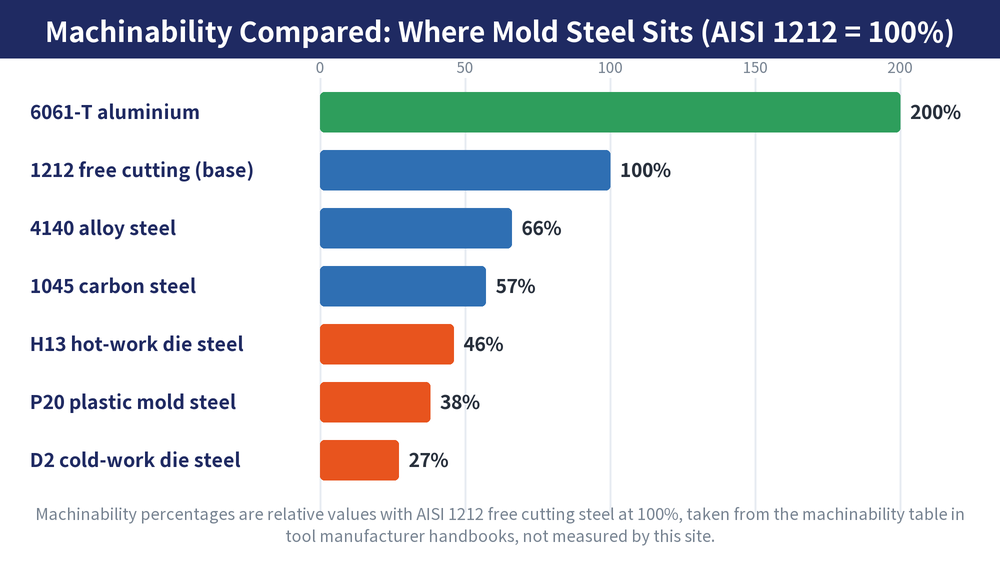
Mold steels mostly fall in 25–49%, far below carbon and alloy steels at 57–100% — the root reason mold machining demands so much of tool wear resistance and toughness. Aluminium alloys instead exceed the baseline (140–200%), confirming aluminium prototype molds machine fast and cheap.
The same material often carries different figures in different machinability tables: 8620 is 68% here, but about 66 (annealed) in the table in section 3 of How Easy Is a Material to Cut?. Why the tables differ and how to read the index are covered in section 4 of that article.
5. JIS versus AISI: read SKD11 as D2
Taiwanese mold shops handle Japanese (JIS) and US (AISI) names side by side, so one steel often carries two or three names. The table below lists the most common correspondences.
| JIS grade | AISI equivalent | Class |
|---|---|---|
| SKD11 | D2 | Cold-work |
| SKD1 | D3 | Cold-work |
| SKD12 | A2 | Cold-work |
| SKD61 | H13 | Hot-work |
| SKT4 | L6 | Hot-work |
| SK105 | W1-10 | Carbon tool steel |
| SKH51 | M2 | High-speed steel (Mo type) |
JIS/AISI correspondence is from the Japan Special Steel Club 2017 revised edition (reprinted in a Hitachi catalogue); "equivalent" is a classification match, not identical chemistry, so always check each maker's datasheet when substituting across brands. For a fuller cross-reference see the mold-steel equivalency chart.
6. Choosing tools by hardness: soft, pre-hardened and hardened each play differently
Put hardness and machinability together and the direction for tool choice becomes clear; here it is by hardness band.
Soft annealed to pre-hardened (below HB 250 up to about HRC 44) is about efficient removal, and the mainstream is high-feed milling (HFM): small depth of cut with a very high feed per tooth, workable from soft material to pre-hardened steel. See the P-group steel machining guide.
Hardened above HRC 45 enters hard milling and hard turning with tight-allowance finishing, and uses CBN (cubic boron nitride), not diamond (diamond reacts readily with iron, so at high temperature it wears fast; steel needs CBN, ceramics or carbide). See the hardened-steel machining guide and the cutting tool materials guide.
For complex cavities the industry split is settled: HFM for roughing soft and pre-hardened steel, plunge milling for roughing complex cavities, and HSM (high-speed milling) for finishing hard steel.
7. A selection framework: grade the difficulty, then walk the AGG steps
Turn this into a selection: first judge machining difficulty, then choose tools by the AGG framework. Difficulty is geometric complexity times material machinability, in three levels — low, medium and high.
Once difficulty is set, choose tools in the AGG order, which must not be reversed:
| Step | Questions to answer |
|---|---|
| A — Application | Type of operation, workpiece material and hardness, required accuracy and finish, stock allowance, strategy, machining intensity, holding type, machine power and speed, coolant method |
| G — Geometry | Which cutting geometry suits the above; evaluate both indexable and solid concepts together, with no default assumption |
| G — Grade | Which tool material grade best fits the above needs |
AGG forces the order: application first, then geometry, and only last the grade, never the reverse. Tool purchase cost is a small share of cost per unit yet often the sole efficiency bottleneck, so aim for the most efficient tool, not the cheapest; to match material to the P/M/K/N/S/H groups see the tool material classification; for the machining route of cold-work, hot-work and high-speed tool steels from annealed to hardened, see the Tool Steel Machining Guide.
Last updated: 2026-10-21
8. Frequently Asked Questions (FAQ)
Q: Are ASSAB 718 and Inconel 718 the same steel?
No — they merely share the number 718. ASSAB 718 is a pre-hardened plastic mold steel close to a modified AISI P20 (roughly HRC 30, ready to machine); Inconel 718 is a nickel-based superalloy, the hardest-to-cut S group, and their cutting conditions do not transfer.
Q: Why is mold steel generally considered hard to machine?
Because the whole family has systematically low machinability: with 1212 = 100% as the baseline, mold steels mostly fall in 25–49% (D2 about 27%, P20 about 38%, H13 about 46%), far below carbon and alloy steels at 57–100%. Aluminium alloys instead exceed the baseline (6061 about 200%, 7075 about 140%).
Q: How hard is pre-hardened steel, and can it be finished directly?
It has no single definition, generally taken as below HRC 45 (P20 is usually supplied around HRC 30–37). It is made to machine on delivery without further heat treatment, so most can go straight from roughing to finishing; in practice confirm the actual hardness on arrival.
Q: What tools should I use on mold steel hardened above HRC 50?
Above HRC 50 you are in hard milling and hard turning, where CBN is common. Do not use diamond (PCD) on steel (carbon reacts readily with iron and wears fast at high temperature); iron-based hard materials need CBN, ceramics or carbide, paired with HSM for finishing.
This article is part of Workpiece Materials: The Complete Guide - Name the Metal First, Then Match the Tool; that guide shows how the whole topic fits together.









