HSS Grades Decoded: SK, SKH, M/T Series, Cobalt and Powder Metallurgy
The most common misreading on the shop floor is treating SK2 as a high speed steel. SK2 is a carbon tool steel, not HSS (High Speed Steel). Real high speed steels carry the SKH prefix under JIS, while cobalt and powder metallurgy are the two upgrade branches.
1. First Things First: SK2 Is a Carbon Tool Steel, Not HSS
SK is the JIS (Japanese Industrial Standards) prefix for carbon tool steel, which gets its hardness from a high carbon content and quenching, with no heat-resistant alloying elements. As soon as cutting heat builds up, it softens.
| JIS prefix | Name | Composition | Temperature it holds hardness to (typical) | Typical use |
|---|---|---|---|---|
| SK (e.g. SK2) | Carbon tool steel | High carbon, essentially no alloying elements | Around the 200°C level | Hand tools, files, punches |
| SKS | Alloy tool steel | Small additions of chromium, tungsten and vanadium | Slightly better than SK | Hand taps, circular saws, cold work dies |
| SKH | High speed steel (HSS) | Highly alloyed, some grades with cobalt added | Around the 600°C level | End mills, drills, taps, form tools |
The temperature levels are the typical figures the industry uses to separate material classes, not measurements taken by this site; the catalogue or standard governs.
A side note
Current JIS practice designates carbon tool steels by carbon content, so the old SK2 code corresponds roughly to today's SK120 family. When an old drawing shows SK1 to SK7, cross-check it against the current standard table before ordering material.
2. How SKH Maps onto the AISI M and T Series
AISI (the American Iron and Steel Institute) splits high speed steel into the T series (tungsten based) and the M series (molybdenum based). Catalogue tools on the market are mostly M series.
The numbers are identifiers only, not a quality ranking, so a bigger number does not mean a better steel.
| JIS SKH | AISI equivalent | System | Where it sits |
|---|---|---|---|
| SKH2 | T1 | Tungsten | The original general-purpose grade |
| SKH3 | T4 | Tungsten with cobalt | Cobalt added, higher hot hardness |
| SKH4 | T5 | Tungsten, high cobalt | Higher heat resistance again, lower toughness |
| SKH10 | T15 | Tungsten, high vanadium and cobalt | Outstanding wear resistance, difficult to grind |
| SKH51 | M2 | Molybdenum | The general-purpose workhorse, the most balanced |
| SKH52 | M3 class 1 | Molybdenum, high vanadium | More vanadium than M2 |
| SKH53 | M3 class 2 | Molybdenum, high vanadium | Vanadium raised again, wear resistance raised with it |
| SKH54 | M4 | Molybdenum, high vanadium | High wear resistance, poorer grindability |
| SKH55 | M35 | Molybdenum with cobalt | Sold as Co5, the entry point for difficult materials |
| SKH56 | M36 | Molybdenum with cobalt | More heat resistant than M35 |
| SKH59 | M42 | Molybdenum, high cobalt | Sold as Co8, for high hardness work |
The table above shows the equivalences the industry works with, not identical compositions element by element; when selecting material always confirm against the manufacturer's own catalogue. Not measurements taken by this site. The grade is only the starting point; for matching it to workpiece and coating see the P-M-K-N-S-H tool selection guide and material and coating selection by workpiece.
3. Cobalt Grades: Co5 and Co8
When plain HSS runs out of road there are two upgrade routes: add cobalt to raise hot hardness, or switch to powder metallurgy for a more uniform structure. The two can be combined, and both cost money.
Cobalt forms no carbides of its own; its job is to prop up matrix hardness at temperature, at the price of brittleness and poorer grindability.
| Trade name | Equivalent grade | Typical cobalt content | When to use it | Watch out for |
|---|---|---|---|---|
| Plain HSS | SKH51 / M2 | No cobalt | Carbon steel, cast iron, general work | The most widely used, so start here |
| Co5 | SKH55 / M35 | About 5% (typical) | Stainless and harder steels | More brittle, sensitive to vibration and clamping |
| Co8 | SKH59 / M42 | About 8% (typical) | Titanium and heat-resistant alloys, low speed under heavy load | More brittle again, needs a rigid machine |
The cobalt contents are the typical figures for each grade; the catalogue or standard governs, and these are not measurements taken by this site. For the overall strategy on difficult-to-cut materials see the titanium and superalloy machining guide.
4. Powder Metallurgy: One Grade Comes in Two Versions
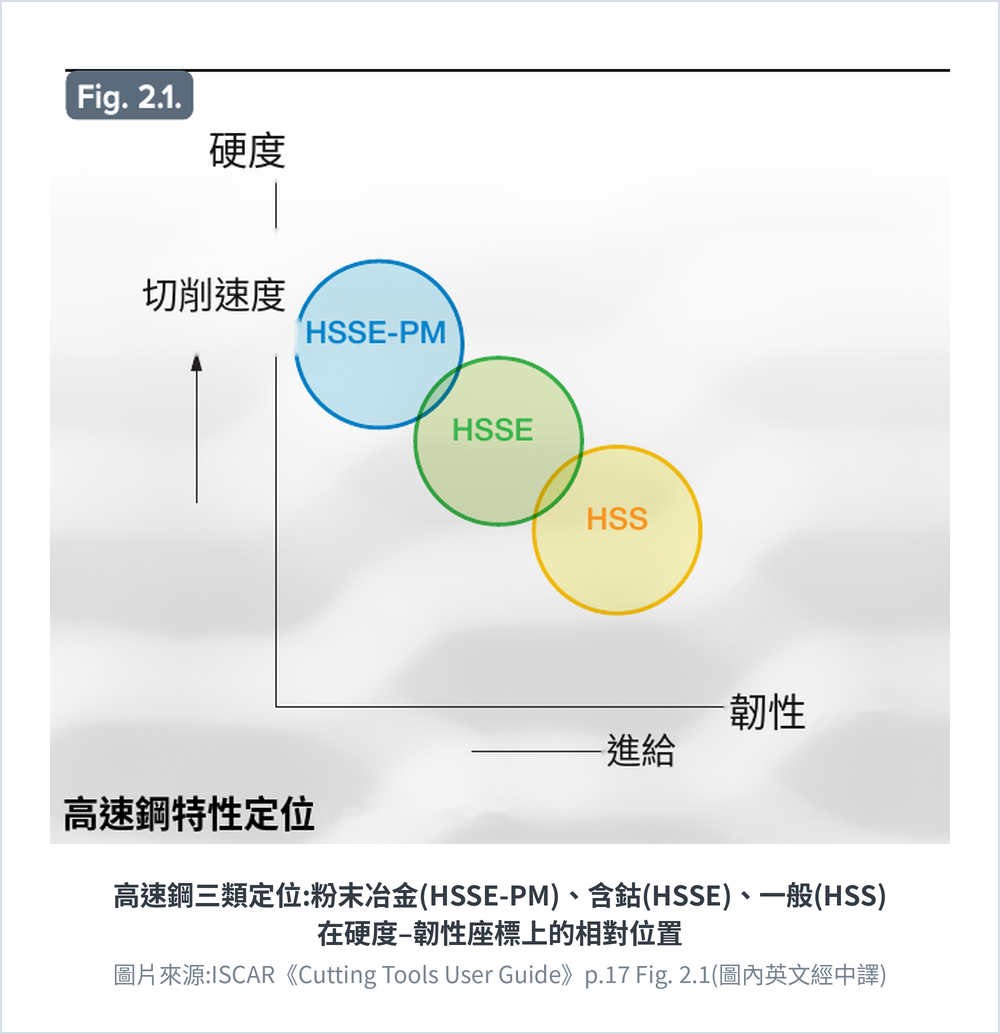
PM (Powder Metallurgy) consolidates atomised powder by isostatic pressing and sintering, giving fine and evenly distributed carbides; conventionally melted HSS carries coarse carbides and segregation, which is where chipping starts.
| Aspect | Melted HSS | PM-HSS |
|---|---|---|
| Carbide structure | Coarse and prone to segregation | Fine and even |
| Toughness and wear resistance | Pull against each other, so one is traded for the other | Both can rise together at the same composition |
| High alloy recipes | High vanadium and high cobalt turn brittle | Supports high vanadium and high cobalt, raising the ceiling |
| Grindability and dimensional stability | High vanadium grades grind badly | Grinds well, with less distortion |
| Cost | Low | High, a clear premium at the same grade |
A purchasing note: a catalogue saying "M42" is not saying "PM-M42". The melted and powder versions of one grade perform noticeably differently, so ask which process is being quoted.
HSS is often combined with nitriding, steam treatment or a PVD coating to extend tool life. For coating types see common tool coating materials at a glance; for the process difference see the difference between PVD and CVD coatings.
Manufacturer reference: the chart below shows where powder metallurgy (HSSE-PM), cobalt (HSSE) and plain (HSS) high speed steels sit relative to each other on a hardness and toughness map.
5. HSS and Carbide: When You Do Not Need to Switch
Carbide (a sintered tungsten carbide based material) beats HSS on both hardness and heat resistance, but the two divide the work rather than one replacing the other.
| Aspect | HSS | Carbide |
|---|---|---|
| Hardness and heat resistance | Lower, around the 600°C level | Clearly higher |
| Toughness | High, takes impact and interrupted cuts | More brittle, dislikes vibration |
| Regrinding and form tools | Easy to regrind, complex edge forms are practical | Needs dedicated wheels and skill |
| Demands on the machine | Works even on older machines | Needs both speed and rigidity |
| Cost | Low | High |
| Typical applications | Taps, broaches, saw blades, small batches | High-efficiency production, difficult-to-cut materials |
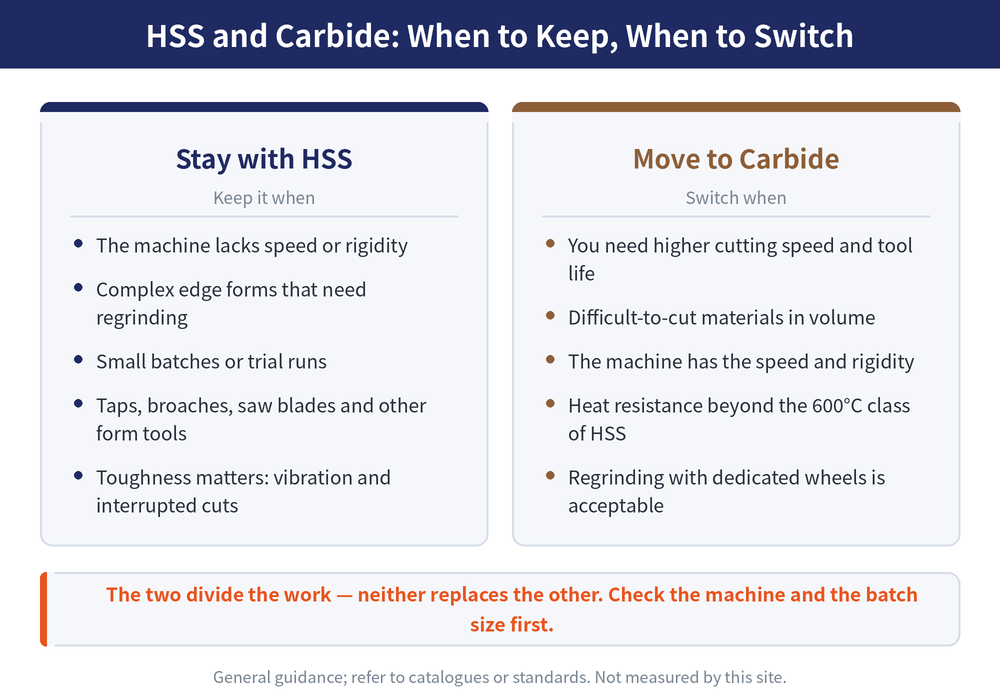
The rule of thumb: when the machine is short of speed or rigidity, when the edge form is complex and has to be reground, or when the batch is small, HSS is still the right answer; move to carbide only when the goal is higher cutting speed and tool life.
For converting speeds and feeds see the complete handbook of turning calculation formulas; for the end mill side of the trade-off see how to choose between carbide and HSS end mills; for reading carbide grades see carbide grades decoded; for choosing material by tool type see how to choose tool material by tool type; for converting hardness callouts see the hardness conversion chart; for the full material picture see the complete guide to cutting tool materials.
Last updated: 2026-07-31
6. Frequently Asked Questions (FAQ)
Q: Can SK2 be used as a high speed steel?
No. SK2 is a JIS carbon tool steel with no heat-resistant alloying, and typically softens noticeably around the 200°C level. Holding hardness under cutting heat requires an SKH high speed steel.
Q: Are SKH51 and M2 the same material?
They are the accepted industry equivalent, both molybdenum-based general-purpose grades, though the composition ranges are not identical element by element. Confirm the actual specification against the manufacturer's catalogue.
Q: Is cobalt HSS always better?
Not always. Cobalt raises hot hardness, which suits difficult-to-cut materials, but it also makes the tool more brittle and more dependent on machine rigidity and clamping stability. For general carbon steel work, SKH51 is usually the better value.
Q: Is powder metallurgy HSS worth the extra money?
It depends on the job. It pays off with high vanadium or high cobalt recipes, difficult-to-cut materials, and demands on tool life and dimensional stability; for general work a melted SKH51 is enough.
This article is part of Tool Materials and Coatings: The Complete Guide - Separate Substrate From Coating, Then Work Back From the Workpiece; that guide shows how the whole topic fits together.