
Turning Slender Shafts: Steady Rest or Follow Rest, Plus an Elastic Center and a Large Entering Angle
A shaft longer than 25 times its diameter sags under its own weight, grows with cutting heat and is pushed out of line by the cutting force, so size and shape drift. Choose the support first: a steady rest if you may turn the part end for end, a follow rest if you may not. Use an elastic tailstock center so it can give as the part grows, grind the tool with a large entering angle and a large rake to cut the radial force that bends the part, and keep the cutting speed moderate.
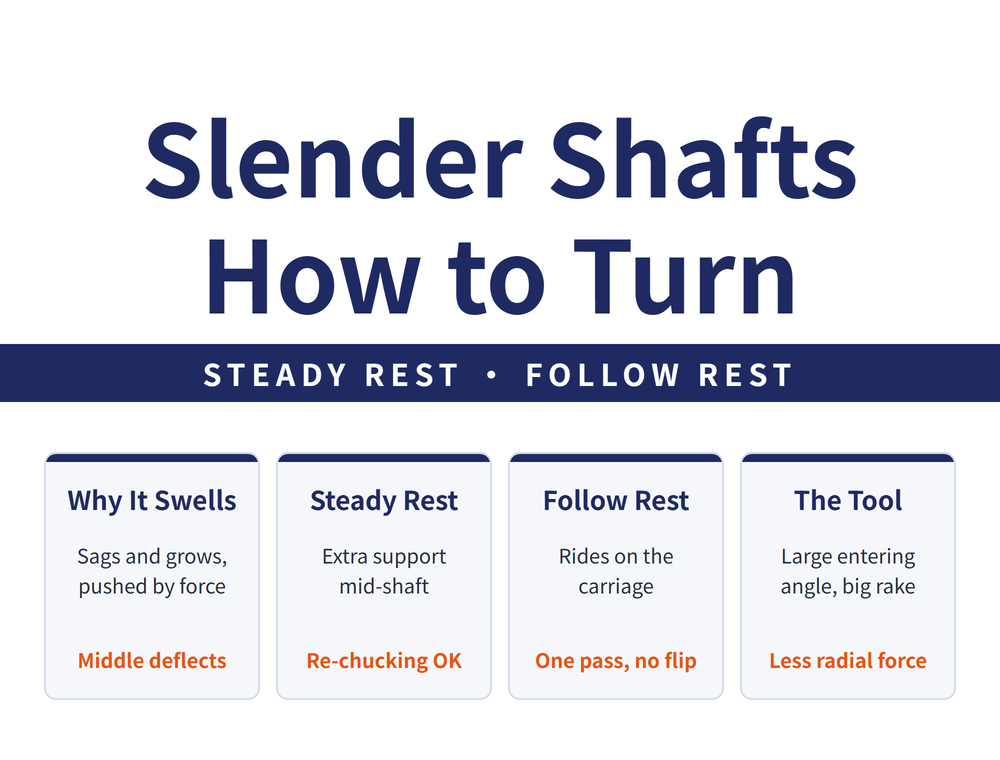
1. Why the middle comes out oversize: six problems with slender shafts
A shaft longer than 25 times its diameter is called a slender shaft. It is not stiff, and turning it brings all of these at once:
| Problem | What happens |
|---|---|
| Own weight | The part sags under its own weight |
| Cutting heat | The part grows with heat; held between two centers it bows, and can even seize |
| Cutting force | Pushes the part out of line and starts vibration, hurting size, shape and finish |
| Centrifugal force | Bending grows with speed, so very high cutting speeds are not suitable |
| Long cutting time | The tool wears along the length, so size drifts from end to end |
| Support devices | Follow rests and steady rests take real operator skill |
So there is no single trick: support, workholding, the tool and the cutting data all have to work together.
2. Steady rest or follow rest: can you turn the part end for end?
Both add support in the middle of the part; the difference is whether you may turn the part end for end and blend the cuts.
| Support | Use when | Key points |
|---|---|---|
| Steady rest | Turning end for end is allowed | Turn a groove mid-shaft for the jaws, or use a sleeve to skip the groove |
| Follow rest | Turning end for end is not allowed | Mounted on the carriage and travels with the tool; three-jaw types are stiffer than two-jaw |
Lap the follow-rest jaws to fit the turned diameter first, keep the jaw pressure moderate and lubricate well. A two-jaw follow rest has small contact faces and low stiffness and does not suit high-speed cutting. Reset the jaws after every pass.
3. Workholding: hold it short and let the center give
The usual setup is chuck-and-center: the chuck holds one end and the tailstock center supports the other.
| Where | What to do | Why |
|---|---|---|
| Chuck end | Keep the gripped length short and put a wire ring under the jaws | Stops the part from being locked in |
| Tailstock | Use an elastic (spring-loaded) center | When the part grows with heat, the center gives axially instead of bowing it |
| Center pressure | With the spindle running, you can stop the center head with your fingers | A quick check for moderate pressure |
| Tailstock quill | Extend it as little as possible | Less vibration |
Before semi-finishing and finishing, back the center off and let it just touch the center hole at low speed to reduce bending. Flood coolant throughout, both to lubricate and to hold back thermal growth.
4. Three common setups
Pick one by whether you may turn the part end for end and whether this is the finishing pass:
| Setup | Feed direction | Use when |
|---|---|---|
| Chuck and center (or two centers) + steady rest | Normal | Turning end for end is allowed |
| Chuck and elastic center + follow rest | Normal | Turning end for end is not allowed |
| Same, with a wire ring under the jaws | Reverse | Finishing |
Reverse feed means cutting from the chuck end towards the tailstock. For the other low-stiffness case, thin-walled parts, see How to Sequence Thin-Wall Turning: Roughing, Semi-Finishing, Finishing and Four Countermeasures Against Distortion.
5. Grinding the tool: cut the radial force that pushes the part
On the tool side there is one goal: push the part as little as possible.
| Parameter | Setting | Why |
|---|---|---|
| Entering angle | Large, often close to 90° | Small radial force, so less bending and vibration |
| Rake angle | Large | Lower cutting force |
| Inclination angle | Positive | Sends chips towards the unmachined surface |
| Nose radius | None or very small | Keeps the edge sharp and the force low |
| Tip height | Slightly above center for roughing, on or slightly below for finishing | — |
For how the entering angle drives radial force see Turning Tool Lead Angle Guide: Force, Chip & Tool Life. Start the cutting data from Turning Cutting Conditions Guide: Speed, Feed & Tool Life and keep the speed conservative: the faster it spins, the more centrifugal force bends the part.
FAQ
Q: What is a slender shaft?
A shaft whose length is more than 25 times its diameter. It is not stiff, so in turning it sags, grows with heat and is pushed out of line by the cutting force, which also causes vibration.
Q: Steady rest or follow rest?
Use a steady rest if you may turn the part end for end and blend the cuts; use a follow rest if you must turn the full length in one setup. A three-jaw follow rest is stiffer than a two-jaw one.
Q: Why does the middle of a long shaft come out oversize?
The middle is furthest from any support, so the cutting force pushes it away and the actual depth of cut drops. Add a steady or follow rest, use a large entering angle to cut the radial force, and lower the cutting speed.
Q: Why use an elastic tailstock center?
Cutting heat makes the part grow; a rigid center then bows the part or even locks it. An elastic center gives axially and absorbs the growth.
Last updated: 2026-10-20
For the full reading guide on this topic, see Turning: The Complete Guide.









