
Spark Testing for Steel Identification: Bursts Give Carbon, Streaks Give Alloy
The tag fell off, two heats got mixed on the rack, and chemical analysis takes days — but the job starts today. Spark testing means touching the steel to a grinding wheel and reading the sparks: bursts tell you the carbon, and what happens to the streak tells you whether it is alloyed. This guide gives you the reading order, the bands that map onto JIS grades, and one number for how accurate this method actually gets.
1. When You Reach for It
Spark testing is not lab work. It is something you do standing at the rack. Three situations bring it out:
The grade marking has fallen off or rusted away; two different materials ended up on the same rack; incoming stock needs a quick re-check before it goes on the machine. What these share is that they will not wait — analysis has to be sent out and queued, while the machine needs to run today.
🔑 What spark testing buys you is time. It does not hand you a grade. It hands you a band: roughly where the carbon sits, and whether the steel is alloyed. Narrow that band enough and it is sufficient to decide which cutter to reach for today, and whether the bar needs to go out for analysis at all.
2. Why It Works: Grit Burning in Mid-Air
The wheel tears a small particle off the steel. The particle flies away carrying its heat, oxidises and burns in the air, and draws a bright trail behind it. That trail is the streak.
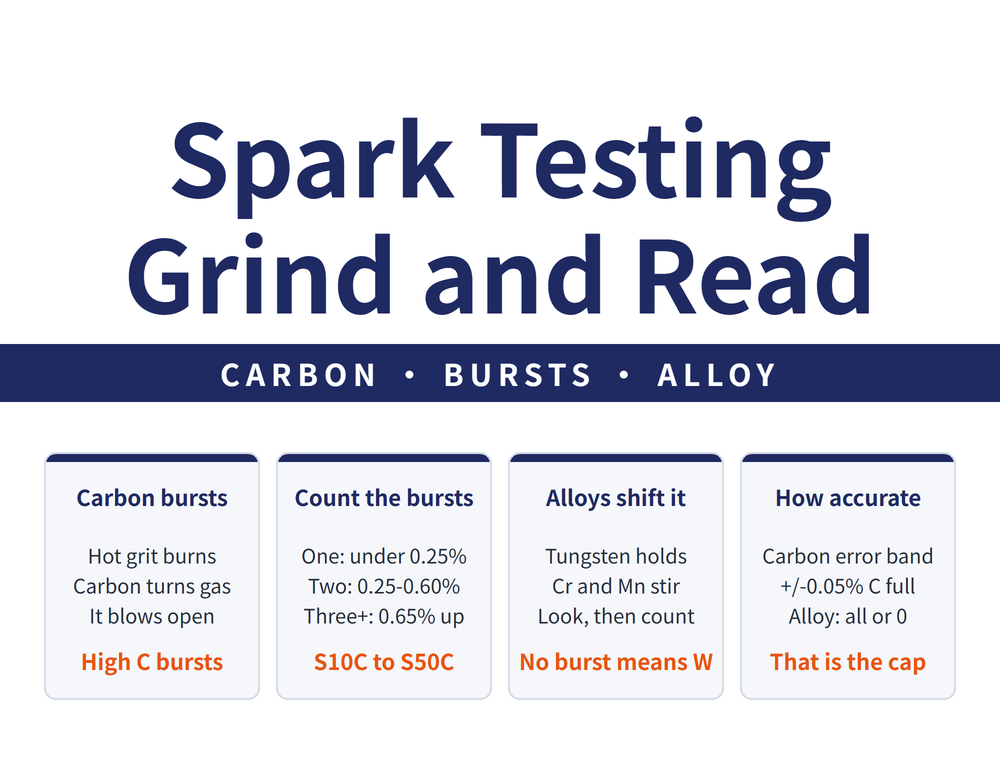
The streak bursts because carbon in the steel oxidises rapidly into gas and blows the hot particle open from the inside. More carbon means more bursts, and a livelier display — that is the whole basis of the method.
⚠ Alloying elements interfere. Tungsten suppresses bursting; chromium and manganese encourage it. So read in two layers: count the bursts to place the carbon, then look at whether the sparks are being held back or stirred up to judge whether it is alloyed.
3. How to Do It on the Floor
The equipment is an ordinary bench grinder with an aluminium oxide wheel. Speed and grit follow whatever the shop already has — what matters is not the parameters but keeping the observing conditions steady: same machine, same wheel, same pressure, so the difference you see is the material and not the setup.
Press the bar lightly to the wheel and let the sparks throw forward at an angle. Stand to the side and watch the whole stream, not directly behind it. Keep the background dark and the light off the stream; colour and fine detail disappear against a bright background.
🔑 Read the middle and tail of the streak, not the root. At the root the particle is still accelerating and the detail smears together; the layering of the bursts and the shape of the tail only resolve further out. For choosing and mounting the wheel itself, see Wheels for Tool Grinding: Abrasive, Shape and the Two Height Offsets.
⚠ Safety first: wear eye protection, clamp long bars, and check that the wheel is uncracked and the guard is in place. Each test needs only a few seconds of contact; there is no reason to lean on the wheel.
4. Carbon Steel: Count the Bursts
Carbon steel is the easy case because there is only one variable. Pick a streak you can see clearly and count how many times it bursts between appearing and dying out:
| Bursts | What it looks like | Carbon (typical range) |
|---|---|---|
| One | A four-way star; the fine lines thrown off are fairly coarse. Not many bursts, and the tail of the stream droops into a half arc | about 0.25% and below |
| Two | The thrown lines burst again; more forks, the lines stay crisp, and small flowers and powdery specks start to appear | about 0.25%–0.60% |
| Three or more | Layer bursting on layer, crowded and dense, filling three quarters of the stream or more; streaks short, straight and thrown hard | about 0.65% and above |
⚠ The carbon figures above are a typical range, shown for relative comparison. They place the material in a band; they are not measurements.
🔑 Once you have the band you can reach for a grade. JIS carbon steel is blunt about it: the number after the S is the carbon content times one hundred — S15C about 0.15%, S30C about 0.30%, S50C about 0.50%. So "two bursts" lands broadly in the S30C to S50C stretch, and "one burst" is usually S10C to S20C. For how the national systems line up, see Carbon and Alloy Steel Cross-Reference: AISI/SAE, JIS, DIN, EN.
5. Alloy Steel: Held Back or Stirred Up
With alloy steel, do not start by counting. Look at the temper of the whole stream first — alloying elements shift the burst count bodily, and a count taken under that influence cannot be mapped onto carbon.
| What the sparks do | Which element | Likely family |
|---|---|---|
| Barely bursts at all; long fine streaks in dull red to orange, very weak light, tail swelling and drooping into a dot | Tungsten (suppresses bursting) | Tungsten high speed steels such as the SKH series |
| Bursts unusually lively and regular; large flower shapes, many fine forks, plenty of powder, the stream yellow going toward bright white | Chromium (encourages bursting) | Chromium tool steels and chrome-moly steels such as SKD, SKS and SCM |
| Bursts with a large core showing a bright white node, a lot of powder, larger flowers, clearly stronger than carbon steel at the same carbon level | Manganese (the strongest promoter) | Higher-manganese structural and spring steels |
🔑 Tungsten is the easy one. High speed steel barely bursts — one or two very fine threads, dull colour, and a bar that feels unusually hard in the hand. Among a pile of carbon steel that is throwing sparks, that combination stands out and is hard to get wrong. For what the SKH codes actually mean, see HSS Grades Decoded: SK, SKH, M/T Series, Cobalt and Powder Metallurgy.
⚠ Chromium and manganese push the same way, so they are hard to separate. Both make the display livelier; the difference is that manganese gives a whiter node while chromium gives larger flowers and more powder. If you cannot tell, do not force it — recording "an alloy steel that is being stirred up" is already far more useful than "unknown".
6. How Accurate Does It Get
There is a ready answer to this. Taiwan's Class B heat treatment trade certification lists spark testing as a practical test item, with carbon steels from S10C to S50C and several SKH, SKD, SKS and SCM alloy steels as the test pieces — and its scoring rules put a number on "accurate":
| What is judged | Standard |
|---|---|
| Carbon steel: error in carbon content | ±0.05% C scores full marks; ±0.10% C next; ±0.20% C below that; beyond 0.20% C scores nothing |
| Alloy steel: grade identification | Correct scores, wrong scores nothing — there are no partial marks |
🔑 That ±0.05% C figure is useful because it says two things at once: one, a practised eye really does reach that accuracy; two, that is where the method's resolution ends. It will separate S30C from S50C. It will not separate one heat of the same grade from another.
How to practise is equally clear: keep a few bars of known grade as references, grind the unknown, grind the reference, and compare the two streams directly. Comparing beats remembering, and using one grinder keeps the conditions identical for free.
7. Where the Method Stops
Spark testing has firm limits, and stating them is more useful than glossing over them:
It gives you a band, not a grade. Confirming S45C against S50C, or producing a material certificate, still means chemical analysis. The role of spark testing is to narrow the field first and decide what needs to be sent, and which bars.
⚠ A treated surface will lie to you. Carburising and nitriding replace the carbon content of the surface layer, so grinding the outside reads the case, not the core. Grind past the case before testing, or use another method. For how deep the case runs and how much is left to cut, see How Much Is Left to Cut on a Case-Hardened Part: Case Depth Is Your Allowance Ceiling.
🔑 The point is what comes after the reading: once you know the carbon band and whether the steel is alloyed, the next decision is cutter material and cutting conditions. For that step, see Choosing Tools by Hardness: HB/HRC/HV and Tool Material.
8. Frequently Asked Questions (FAQ)
Q: Does spark testing need special equipment?
No — an ordinary bench grinder with an aluminium oxide wheel is enough. What you do have to control is the observing conditions: same machine, same wheel, dark enough background, so the difference you see is the material.
Q: Which part of the streak do I count?
The middle and the tail. At the root the particle is still accelerating and the detail smears together; the layering of the bursts and the tail shape only resolve further out.
Q: Why does high speed steel show almost no sparks?
Tungsten suppresses bursting, so high speed steel gives only one or two very fine threads, dull in colour and weak in light. That makes it the easiest family to recognise among carbon steels that are bursting freely.
Q: Can the result be used as a material certificate?
No. Spark testing gives a carbon band and tells you whether the steel is alloyed; a grade or a certificate still needs chemical analysis. Its value is narrowing the field so you know what to send.
Published: 2026-09-30 | Last updated: 2026-09-30









