
Carbon and Alloy Steel Cross-Reference: AISI/SAE, JIS, DIN, EN
The same steel carries its own designation under the American, Japanese and German or European standards. A cross-reference table gives an approximate equivalent, not an identical material, and swapping stock on the strength of the designation alone is a common source of quality incidents. This article lists the most widely traded carbon and alloy steel equivalents and explains what to confirm before substituting.
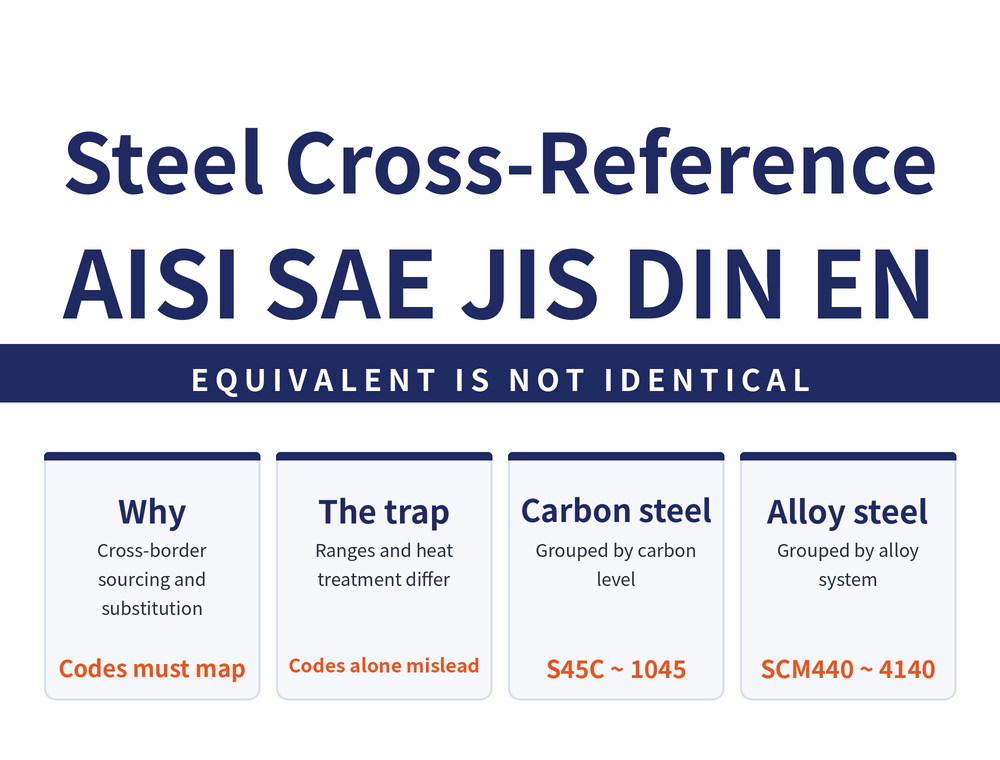
1. A Cross-Reference Is an Approximate Equivalent, Not an Identical Material
AISI/SAE is the American steel designation system, JIS is the Japanese one, and DIN and EN are the German and European ones. The same material is written differently once the standard changes, so purchasing and substitution have to start by matching the designations up.
But every cross-reference relationship is an approximate equivalent. There are four places where the two sides can differ.
| Where they differ | Why | Consequence |
|---|---|---|
| Composition range | The permitted bands for the elements and the ceilings on sulphur and phosphorus are not written the same way | Machinability, weldability and heat treatment response all change |
| Heat treatment condition | One grade may be shipped annealed, normalised or quenched and tempered | Hardness varies widely and the tool grade has to be reselected |
| Mechanical property provisions | The properties specified, the sampling position and the measurement conditions are different | The designations line up while the properties do not, and the drawing requirement is missed |
| Verification documentation | Whether a Mill Certificate comes with the material makes a large difference | There is no way to trace the heat number, and traceability requirements cannot be answered |
For a broader index across standards see the Metal Material Designation Cross-Reference, and for where steel sits among the workpiece material groups see the ISO Workpiece Material Classification; if the tag is lost and you need to identify the steel on the shop floor, see Spark Testing for Steel Identification.
2. Carbon Steel: Grouped by Carbon Content
The grouping logic for carbon steel is straightforward: the carbon content sets the trade-off between strength and machinability.
| Application group | AISI/SAE | JIS | DIN / EN | What it means for machining |
|---|---|---|---|---|
| Low carbon, general structural | 1020 | To be confirmed | C22 and similar | Soft and gummy, so built-up edge and burrs form easily; weldability is good |
| Medium carbon, machine structural | 1045 | S45C | C45 / EN 1.0503 | The most common of all, with the best balance of strength and machinability; usually supplied in the quenched and tempered condition |
| Medium-high carbon | 1055 / 1060 | S55C / S58C | C55 / C60 and similar | Wear resistance rises and toughness falls; cutting forces are high and edges wear fast, and these grades go into springs and wear parts |
| Free-machining steel (non-leaded) | 1215 | To be confirmed | 9SMn36 / EN 1.0736 | Chips break cleanly, which suits automatic lathe work |
| Free-machining steel (leaded) | 12L14 | To be confirmed | 9SMnPb36 / EN 1.0737 | As above; whether lead is present must be confirmed case by case |
Cells marked "To be confirmed" in this table and in the alloy steel table below: no verified JIS equivalent has been found yet; check against the JIS standard or the mill certificate before purchasing.
Carbon steel is the bulk of the P group of steels, and the general tooling and parameter approach is set out in the P-Class Steel Machining Guide. For how elements other than carbon move machinability, see Metal Elements and Their Effect on Machinability.
3. Alloy Steel: Grouped by Alloy System
With alloy steel the question is what was added and what it was added for. Chromium and molybdenum raise hardenability, nickel makes up the toughness, and high-carbon chromium goes the wear-resistance route.
| Alloy system | AISI/SAE | JIS | DIN / EN | What it means for machining |
|---|---|---|---|---|
| Chromium-molybdenum (general-purpose quenched and tempered) | 4140 | SCM440 | 42CrMo4 / EN 1.7225 | The mainstay for shafts, die bases and fixtures; cutting forces in the quenched and tempered condition are clearly higher |
| Chromium-molybdenum (low carbon, for case hardening) | 4130 | SCM430 | 25CrMo4 | Lower in carbon, friendly to weld, and commonly taken down the case hardening route |
| Nickel-chromium-molybdenum (high strength) | 4340 | To be confirmed | 34CrNiMo6 | Large-section shafts; hard and tough after quenching and tempering, which tests the toughness of the cutting edge |
| Chromium steel (case hardened gears) | 5120 | To be confirmed | 20MnCr5 and similar | Cut in the soft condition before case hardening, then moved to grinding or hard turning once hardened |
| Bearing steel | 52100 | SUJ2 | 100Cr6 | High-carbon chromium; the annealed and the hardened conditions are worlds apart in difficulty |
For how the hardness band drives tool grade and edge preparation, see the Hardness and Tool Selection Guide; mould and die steels form a separate family, cross-referenced in the Mold Steel Equivalency Chart.
4. How to Read the Designations
The designations follow rules of their own, and reading them properly saves half the table lookups.
| System | Rule | Example |
|---|---|---|
| AISI/SAE four-digit | The first two digits are the alloy system and the last two are a carbon content index | A leading 41 means chromium-molybdenum; 4140 carries more carbon than 4130 |
| JIS symbols | S..C denotes a machine structural carbon steel, and the letter groups name the alloy system | SCM is chromium-molybdenum, SNCM is nickel-chromium-molybdenum, SCr is chromium and SUJ is bearing steel |
| DIN / EN name designations | The leading figure is the carbon content, followed by the element symbols and their content indices | 42CrMo4 is chromium-molybdenum; C45 is a plain carbon steel |
| EN material number 1.xxxx | A pure number carrying no meaning in itself, with one number naming one material | 1.0503 and 1.7225; the least ambiguous thing to use on an enquiry or an order |
5. Four Things to Confirm Before Substituting
Reading the designation is only the first step. Do not move the material until the following four have been confirmed.
| What to confirm | How to confirm it | Risk of not confirming |
|---|---|---|
| Composition range | Read the text of both standards and compare it against the composition report for that heat | A borderline element falls outside acceptance and heat treatment does not come out as expected |
| Heat treatment condition | Ask clearly whether the stock ships annealed, normalised or quenched and tempered | Carrying parameters over unchanged invites edge chipping or a poor surface |
| Mechanical property requirements | Match the items called out on the drawing against the test conditions of that standard | The non-conformance only surfaces at final inspection |
| Mill Certificate | Ask about the traceability requirement first, then specify that the certificate ships with the material | It cannot be obtained after the fact, and there is no ground to stand on in a dispute |
Of the four, the heat treatment condition comes first — one grade annealed and the same grade quenched and tempered are two completely different jobs to cut. The designation only tells you the direction of the composition; the condition is what decides how the tool should be run. For how to judge it, see the Heat Treatment and Machinability Guide.
The cross-reference relationships in this article are the approximate equivalents in common industry use. The composition ranges and mechanical property provisions of the individual standards are not completely identical; the text of each standard or the mill documentation governs, not measurements taken by this site.
6. Frequently Asked Questions (FAQ)
Q: Can an approximate equivalent be substituted directly?
Not as a matter of course. An approximate equivalent only says the application and the alloy system are close, while composition ranges and property provisions may still differ, so check the text of the standards and confirm the Mill Certificate before substituting.
Q: Are AISI 1045 and JIS S45C the same material?
They are one of the most widely accepted equivalents in the industry, but they remain two materials under two standards. Everyday work usually treats them as interchangeable; tight drawing requirements still call for a clause-by-clause check.
Q: Can cutting conditions be copied across for the same grade?
Check the heat treatment condition first. Cutting forces and tool life differ sharply between the annealed and the quenched and tempered condition, so parameters cannot be carried over on the strength of the designation alone.
Q: Does the same cross-reference logic work for stainless steel and cast iron?
The logic holds, but the designation systems and the grouping differ. See the Stainless Steel Cross-Reference and the Cast Iron Cross-Reference respectively.
This article is part of Workpiece Materials: The Complete Guide - Name the Metal First, Then Match the Tool; that guide shows how the whole topic fits together.
Last updated: 2026-10-21









