
How Much Is Left to Cut on a Case-Hardened Part: Case Depth Is Your Allowance Ceiling
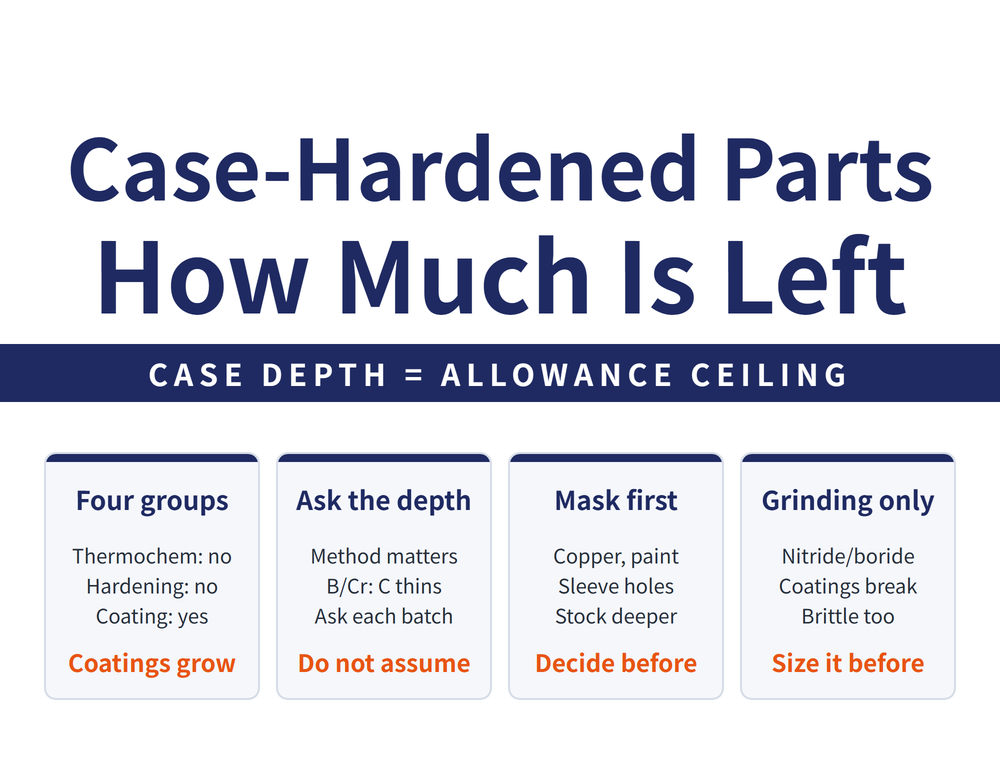
Finishing a surface-hardened part has a ceiling: you can only cut as deep as the case goes. This article sorts surface treatments into four groups by whether they add size, explains how case depth sets the allowance, how to mask the faces you still have to machine, and which treatments leave grinding as the only option.
1. On a hardened part the allowance has a ceiling
On an ordinary part the finishing allowance only has to clear distortion and the previous tool marks. A surface-hardened part adds one limit: everything you remove comes out of the hardened case.
🔑 One rule: case depth is the ceiling on your finishing allowance. Cut past it and the size is right while the hardness is gone — and nothing about the part looks wrong until it wears in service.
For the ordinary allowance, see How Much Machining Allowance to Leave: Six Terms, Four Factors and the Lookup Method. This article only covers the extra limit on hardened parts.
2. Four groups: does this treatment add size?
When a drawing calls for a surface treatment, the first question is not how hard it gets but whether it grows the part — that decides whether the previous operation has to leave room, and on which face:
| Group | Examples | Effect on size |
|---|---|---|
| Thermochemical (changes surface composition) | Carburising, nitriding, carbonitriding, boronising, chromising | Essentially none (distortion counted separately) |
| Surface hardening (composition unchanged) | Induction hardening, flame hardening | Essentially none (distortion counted separately) |
| Surface chemical treatment | Nitriding, sulphurising, phosphating | Slight (phosphating ~5–15 μm) |
| Coating | Hard chrome plating, hardfacing, vapour deposition | 🔴 Clearly adds size, the largest of the four (hard chrome ~0.3–0.5 mm) |
Note: nitriding is listed in both groups; black oxide (bluing) is thinner still, about 0.6–0.8 μm.
📌 There is a second difference between the first two groups and the last two that shows up in later machining. With thermochemical treatments and surface hardening the case blends into the core with no sharp boundary; a coating or film is a layer applied on top, with a clear interface. Cut too deep into a graded case and hardness falls away gradually; cut through a coating and you are straight down to bare material.
🔴 Only the coating group needs size left for it in the previous operation. For the other three the main risk is not growth but distortion — see Heat-Treated Parts Come Back Wrong: Uneven Hardness, Distortion, and the Kind That Cracks Two Days Later.
3. How to ask for case depth, and how to use it
Case depth is not a fixed value. It depends on the method, the material and the time, and two ways of running the same treatment can differ a lot. So this number is something to obtain from the heat treater, not to assume.
| What to ask for | Why machining needs it |
|---|---|
| Case depth (effective hardened depth) | It is the ceiling on the finishing allowance |
| Which method was used | Change the method and both depth and cycle time change |
| Which faces are to be hardened | Unless stated, the whole part goes in — including faces you still have to machine |
📌 A sense of scale (typical ranges): gas nitriding runs at about 480–600 °C for 40–70 hours and produces a case of roughly 0.4–0.6 mm — that is how thin the ceiling on the finishing allowance is. Carburising runs much hotter, at about 850–950 °C. With process conditions this different, case depths differ too — the number for your batch still has to come from the heat treater.
⚠ Boronising and chromising follow one counter-intuitive rule worth knowing: the higher the carbon content of the material, the thinner the case the same treatment produces. Do not apply it directly to carburised or nitrided parts. When the material changes, last batch's case-depth assumption still does not carry over.
🔵 The two film-level treatments can be treated as not affecting the allowance (film thickness: black oxide about 0.6–0.8 μm, phosphate about 5–15 μm; a gas-nitrided case about 0.4–0.6 mm), but they still change surface finish and corrosion behaviour, so acceptance terms are a separate conversation.
4. Mask the faces you still have to machine
Carburising and nitriding treat the whole part; say nothing and everything gets hardened. If a face still has to be reamed, tapped or fitted afterwards, hardening it first makes that job far harder.
| Masking method | Where it suits |
|---|---|
| Copper plating | Large areas, simple shapes |
| Stop-off paint | Local areas, complex shapes |
| Sleeves or sacrificial screws | Holes and threads that still have to fit something |
| Leave stock and cut it off afterwards | The most direct route, if the stock exceeds the case depth |
🔴 The last one is the most used and the most often got wrong: the stock has to be deeper than the case. Otherwise some hardened layer survives the cut, and the reamer or tap still will not bite.
📌 This is decided before the parts are sent out, not when they come back. Which faces stay soft belongs on the drawing and in the process plan — for where heat treatment sits in the sequence, see Planning the Machining Sequence: Stages, Concentration or Dispersion, and Where Heat Treatment Fits.
5. Which ones leave grinding as the only option
Past a certain hardness, whether you can still cut is no longer an allowance question but a question of what the tool material can take:
| Case | How the last operation is done |
|---|---|
| Very hard cases such as nitriding or boronising | Grinding; size and finish must be right before treatment |
| Carburised and quenched, ordinary hardness | Hard turning, hard milling or grinding, by hardness and tolerance |
| Coatings such as hard chrome | Grinding to size; cutting tends to damage the layer and its bond |
🔴 Boronising carries a trade-off worth weighing: the highest hardness of the group, but also the most brittle, and it can spall under impact. It does not suit interrupted cuts or parts that take knocks — ask whether the part will see impact before specifying it.
For finishing hard material by turning instead of grinding, see Hard Turning Guide: Replacing Grinding at HRC 45-65. For how each condition machines, see How Heat Treatment Affects Machinability: Annealing, Quenching, Tempering and Nitriding.
6. Frequently Asked Questions (FAQ)
Q: How much can be taken off a carburised part in finishing?
The ceiling is the case depth, and you need margin below it rather than cutting right to the bottom. Case depth varies with method, material and time, so get the actual figure for that batch from the heat treater instead of reusing the last one — the same treatment run a different way gives a different depth.
Q: Does surface treatment make the part bigger?
It depends on the group. Thermochemical treatments and surface hardening essentially do not add size, and the change you see comes from distortion; black oxide and phosphating are film level and add slightly; coatings such as hard chrome add the most, and size has to be left for them in the previous operation.
Q: How do we keep a hole that still has to be tapped from hardening?
Specify masking before the parts are sent out: copper plating, stop-off paint, or sleeves and sacrificial screws. You can also leave stock and machine it away afterwards, but the stock must be deeper than the case; otherwise hardened material survives the cut and the tap still will not bite.
Q: Can you tell when the case has been cut through?
Not by looking. With the hardened layer gone the size is still correct and the surface still looks normal; it shows up only when the part is loaded in service and wears. This one has to be prevented by calculating the allowance beforehand, not caught by inspection afterwards.
This article is part of Manufacturing Process: The Complete Guide - Set the Datum First, Then Sequence, Allowance and Dry Cutting; that guide shows how the whole topic fits together.
This article is part of Workpiece Materials: The Complete Guide - Name the Metal First, Then Match the Tool; that guide shows how the whole topic fits together.
Published: 2026-09-24 | Last updated: 2026-10-28









