
Choosing Tools by Hardness: HB/HRC/HV and Tool Material
The same carbide end mill that breezes through mild steel can chip on the first pass in hardened steel. This guide helps you decide what to reach for: find which hardness band the workpiece falls into, then settle the tool material and the coating to pair with it. How HB, HRC and HV relate to one another, and what each band opens up, are both here.
1. First, understand the three hardness scales
Hardness is not one number but three measurement systems. Pick the wrong scale and comparison is impossible from the start.
| Scale | Applicable range | Character |
|---|---|---|
| HB (Brinell) | Soft to medium: annealed steel, cast iron, non-ferrous metals | Large indent, stable reading; unsuitable for thin parts and high hardness |
| HRC (Rockwell C) | Medium to high: quenched-and-tempered and hardened steel, about HRC 20–70 | Fast to measure; the most common on the shop floor |
| HV (Vickers) | Full range plus surfaces / thin layers: nitrided cases, coatings | Small indent, fine; suited to thin layers and micro-zones |
Applicable ranges and the HRC 20–70 figure are typical orientations; actual measurement ranges defer to each hardness-tester standard and catalogue.
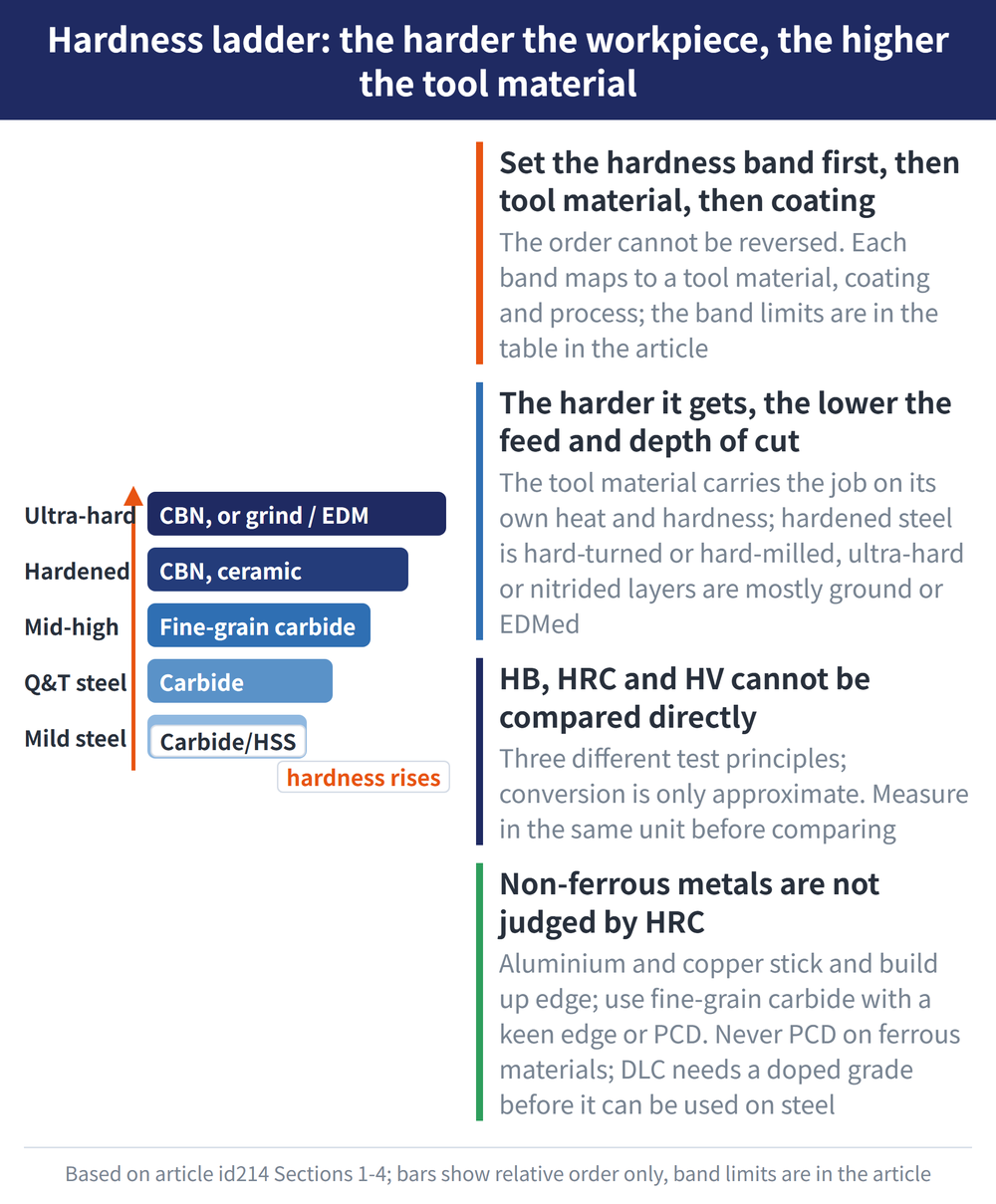
The three scales rest on different measurement principles and cannot be compared directly; to convert, consult the hardness conversion chart, and treat conversions as approximate correspondences, not equivalences.
2. The hardness ladder: how to choose tool material
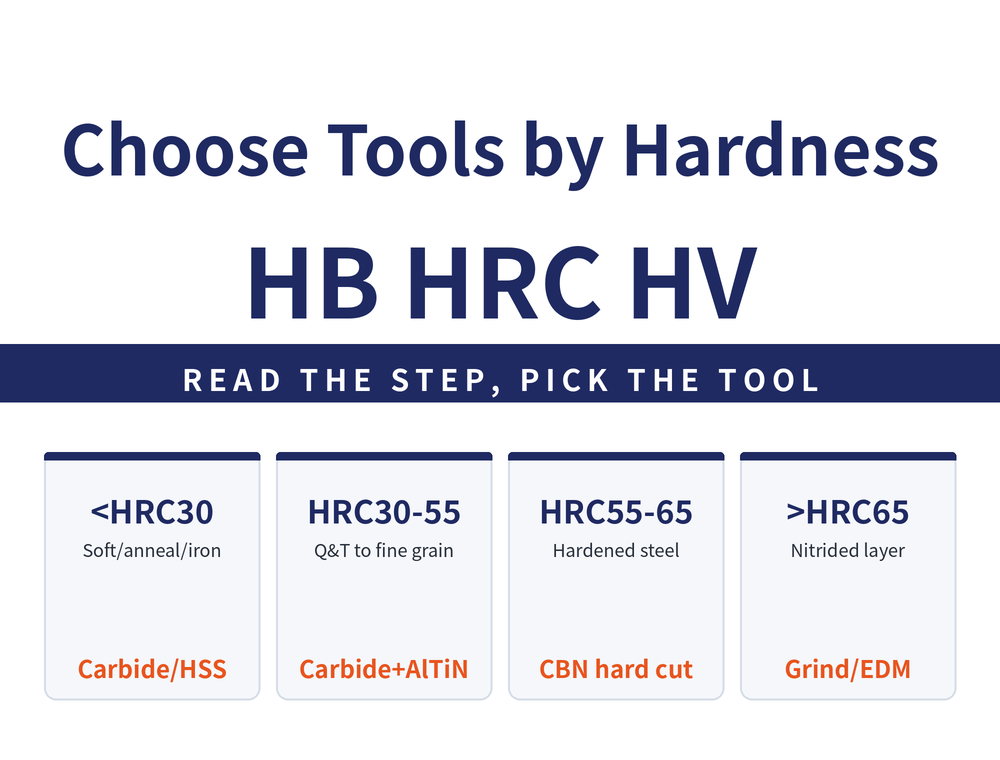
Splitting workpiece hardness into bands and mapping each to tool material, coating and method is the single most practical table for tool selection.
| Hardness range | Tool material | Coating | Method |
|---|---|---|---|
| < HRC 30 (mild / annealed / cast iron) | Carbide P/K grades, HSS also viable | TiN family / AlTiN | General turning, milling, drilling |
| HRC 30–45 (quenched-and-tempered) | Carbide | AlTiN | General cutting |
| HRC 45–55 | Fine-grain carbide | AlTiN | Hard milling possible, keep parameters conservative |
| HRC 55–65 (hardened) | CBN/PCBN, fine-grain carbide (light cuts), some ceramics | AlTiN (on carbide) | Hard turning / milling, low feed, shallow depth |
| > HRC 65 or nitrided surface | CBN, or no cutting | — | Mainly grinding and EDM |
The hardness bands and their tool/coating mapping are typical orientations; defer to tool catalogues and standards. Cutting speed vc and feed per tooth fz are not tabulated here — set them per machine and catalogue.
The higher the hardness, the more you must lower feed, reduce depth of cut and rely on the tool material's own heat resistance and hardness. For the full material-and-coating cross-reference see material and coating selection by workpiece and the cutting tool materials guide. For hard turning and milling of hardened steel see the hardened-steel machining guide.
3. Non-ferrous materials do not go by HRC
Aluminium, copper and other non-ferrous materials are not judged by HRC. Their problem is not hardness but sticking and built-up edge.
The answer is fine-grain carbide with a sharp edge, polycrystalline diamond (PCD) or diamond-like carbon (DLC) coating, winning on sharpness and anti-adhesion.
Key prohibition: PCD must not be used on ferrous materials — at high temperature carbon reacts with iron (graphitisation) and the tool wears rapidly. Ferrous hard materials still rely on CBN, ceramics or carbide. DLC coating is the exception: once doping atoms are added it can machine steel; see How to Use DLC Coating.
4. Tool selection logic in one line
Compress the whole flow into one line: fix the workpiece and its hardness band first → choose the tool material → then match the coating process and material. The order cannot be reversed.
For the difference between PVD and CVD coatings and when to use each, see the PVD vs CVD coating guide; for the overall material-and-coating cross-reference see material and coating selection by workpiece. Hardness shifts with heat-treatment state; for how the delivery state affects machining see how heat treatment affects machinability.
Last updated: 2026-10-21
5. Frequently Asked Questions (FAQ)
Q: Can HB, HRC and HV be converted and compared directly?
No. They rest on different measurement principles, so a conversion table gives only an approximate correspondence, not an equivalence, and conversion error differs across the high-hardness and soft bands; in practice measuring in the same scale before comparing is most reliable.
Q: Above what HRC do you have to use CBN?
As a typical orientation, above about HRC 55 is where CBN/PCBN takes over; between HRC 45–55 fine-grain carbide with AlTiN can still hard-mill, and the actual boundary moves with tool capability and cutting conditions.
Q: Must hardened steel be ground, or can it be turned and milled?
Not necessarily. HRC 55–65 can be hard-turned and hard-milled with CBN or some ceramics at low feed and shallow depth; but above about HRC 65 or on a nitrided surface, grinding and EDM usually remain the main methods.
Q: Can I cut aluminium with a tool meant for steel?
Not advisable. Aluminium is about sticking and built-up edge, needing a sharp edge with fine-grain carbide, PCD or DLC; but PCD cannot cut ferrous materials and DLC needs a doped grade before it can be used on steel, so the two sets of tools are not directly interchangeable.
This article is part of Workpiece Materials: The Complete Guide - Name the Metal First, Then Match the Tool; that guide shows how the whole topic fits together.









