
Regrind or Replace a Tap: Wear Location, Chamfer Taper and Rake Regrinding
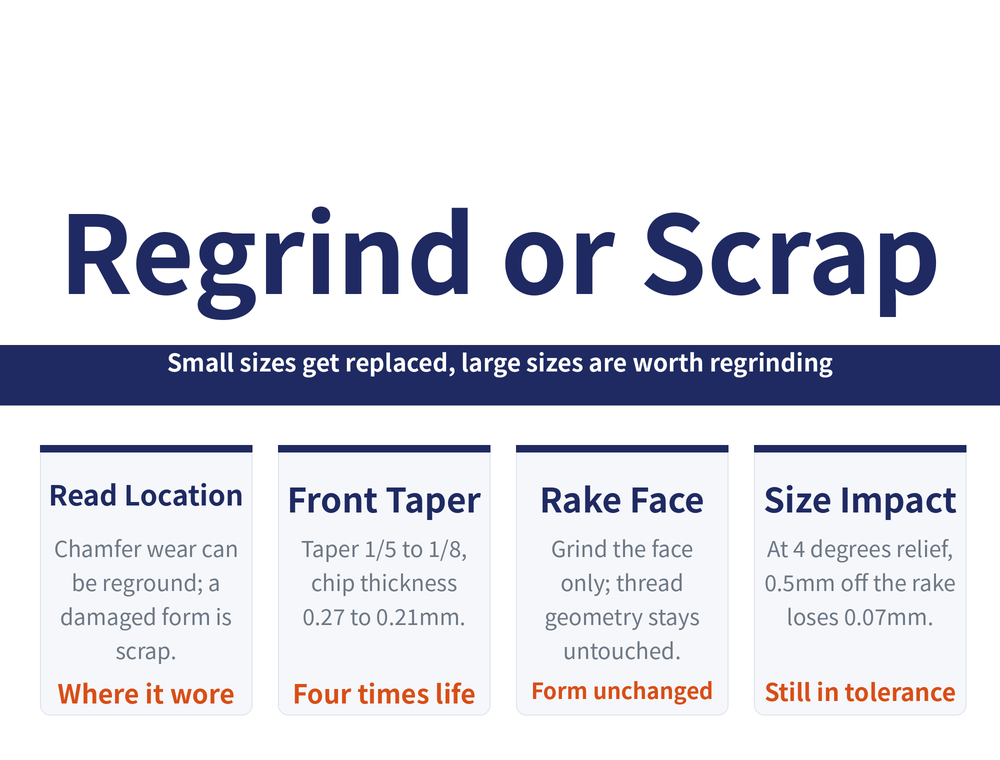
Most shops throw a dull tap away and draw a new one. Yet when the wear sits in the chamfer, grinding the front taper shallower brings the tap back — one textbook case took an M12 tap from about 30 nuts to about 150. This guide covers how to read the wear location, how to regrind the taper and the rake face, whether thread size drifts afterwards, and when to simply replace.
1. Read the wear location first
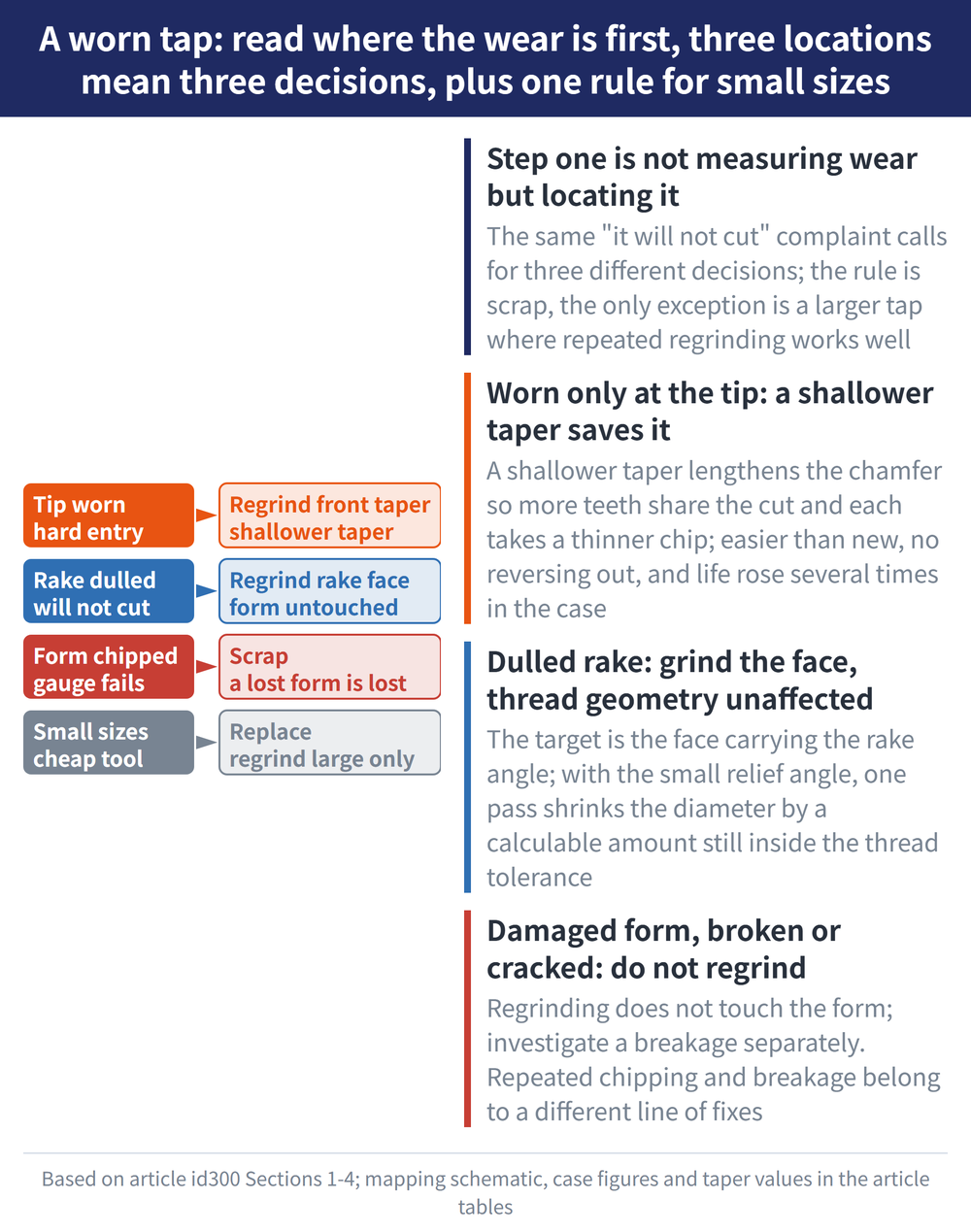
The general rule is that a worn tap is scrapped, not reground — on small sizes the labour and risk of resharpening cost more than a new tool. There is one exception: larger taps, where tooling spend is significant and repeated regrinding works well.
The first step is not measuring how much wear there is, but seeing where it is. Three locations behind the same "it will not cut" complaint call for three different decisions.
| Wear location | What you see | Decision |
|---|---|---|
| Cutting edges at the chamfer tip | Hard entry, torque climbing, thread land still sound | Regrind the front taper (section 2) |
| Rake face of the chamfer dulled | Will not cut, chips break up, thread finish rough | Regrind the rake face (section 3) |
| Thread land form chipped or worn | Thread size out, gauge will not pass | Scrap. Regrinding cannot restore the form |
For the formal part names and their functions see Tap Structure Guide; for how far wear may go before a tap is pulled, see Carbide Tap Guide.
2. Regrinding the front taper: an M12 stainless case
The front taper of a first tap is defined as (D-d)/L, where D is the major diameter, d the small-end diameter of the chamfer and L the chamfer length. The standard value is about 1/5, giving a chip thickness of roughly 0.27mm.
The case is an M12 nut in 1Cr18Ni9Ti stainless: one tap produced only about 30 pieces, and the failure sat at the chamfer tip rather than along the whole flute. Because only the tip was gone, reducing the taper was enough to make those edges sharp again.
| Item | Before | After |
|---|---|---|
| Chamfer small-end diameter d | 10mm | 9.86mm |
| Chamfer length L | 11mm | 21mm |
| Taper (D-d)/L | about 1/5 | about 1/8 |
| Chip thickness | about 0.27mm | about 0.21mm |
| Pieces per tap | about 30 | about 150 |
A shallower taper puts more teeth into the cut, so each tooth takes less and the load case improves. Three practical gains follow: it runs lighter than a new tap, it no longer needs reverse backing out, and it can tap holes below roughly 10mm diameter. The textbook case reports about four times the life.
The table holds measured values from one documented case, not a general specification. The major diameter D is not listed; measure it on the tap itself. Verify your own regrind allowance against the actual size and thread tolerance.
3. Regrinding the rake face without touching the form
The second typical failure is a badly dulled rake face on the chamfer while the thread form itself survives. Here the target is the face that carries the rake angle: grind it back to a sharp rake and the thread geometry is unaffected, which is why this is far safer than reworking the form.
Does the tap shrink each time? It can be calculated. The relieved back angle of a tap is generally 4°~6°. Taking 4°, removing 0.5mm from the rake face reduces the radius by:
x = tan4° × 0.5mm ≈ 0.035mm, so the cutting diameter drops by roughly 0.07mm — still inside the thread tolerance band.
In other words one 0.5mm pass has a controlled effect on the finished thread, which is what makes repeated regrinding of larger taps defensible. Wheel diameter is chosen to suit the tap size: pick a wheel that reaches into the flute without fouling the neighbouring teeth. For rake angle itself, see Tap Cutting Geometry.
4. When not to regrind at all
| Situation | Recommendation |
|---|---|
| Small sizes, tool cheaper than the labour | Replace. This is the general rule |
| Thread land already chipped or worn | Scrap. Regrinding does not touch the form |
| Broken tap or visible cracks | Scrap, and investigate the cause separately |
| Large size worn only at the chamfer | Worth regrinding, and repeatedly |
If the problem is repeated chipping or breakage rather than plain wear, that is a different line of countermeasures — see Tap Chipping and Breakage. If what you want to change is chip flow and torque rather than wear, see Special Tap Edge Geometries.
5. Frequently Asked Questions (FAQ)
Q: Should taps be reground at all?
As a rule no — small taps are scrapped because resharpening costs more than a new tool. The exception is larger taps, where repeated regrinding saves real tooling spend and works well.
Q: Why does a shallower front taper last longer?
A shallower taper lengthens the chamfer so more teeth share the cut and each takes a thinner chip. In the documented case the taper went from about 1/5 to about 1/8 and chip thickness from about 0.27mm to about 0.21mm, lifting output from about 30 to about 150 pieces.
Q: Does regrinding the rake face undersize the thread?
Barely. With a 4° relieved back angle, taking 0.5mm off the rake shrinks the radius about 0.035mm and the diameter about 0.07mm, which stays inside the thread tolerance. Grinding the face does not alter the thread form.
Q: How do I tell wear from a wrong tool choice?
Watch the first tap. Chipping or breakage within the first few holes points to selection, hole size or parameters. Normal early behaviour with torque creeping up after a run of parts is genuine wear, and this article applies.
This article is part of Tool Regrinding: The Complete Guide — Decide Whether to Grind, Then Look Up How, With What, and How to Check; that guide shows how the whole topic fits together.
Published: 2026-08-17|Last updated: 2026-08-17









