
Special Tap Edge Geometries: Spiral Point, Skip-Tooth, Chip-Splitting and One-Pass Forming
Take one straight-flute tap, change the tooth geometry, and you change chip direction, torque and thread form error. This guide covers four edge geometries a shop can grind for itself — spiral point, skip-tooth, chip-splitting and the relieved grinding of a one-pass forming tap — what each one fixes, how it is ground and what to watch.
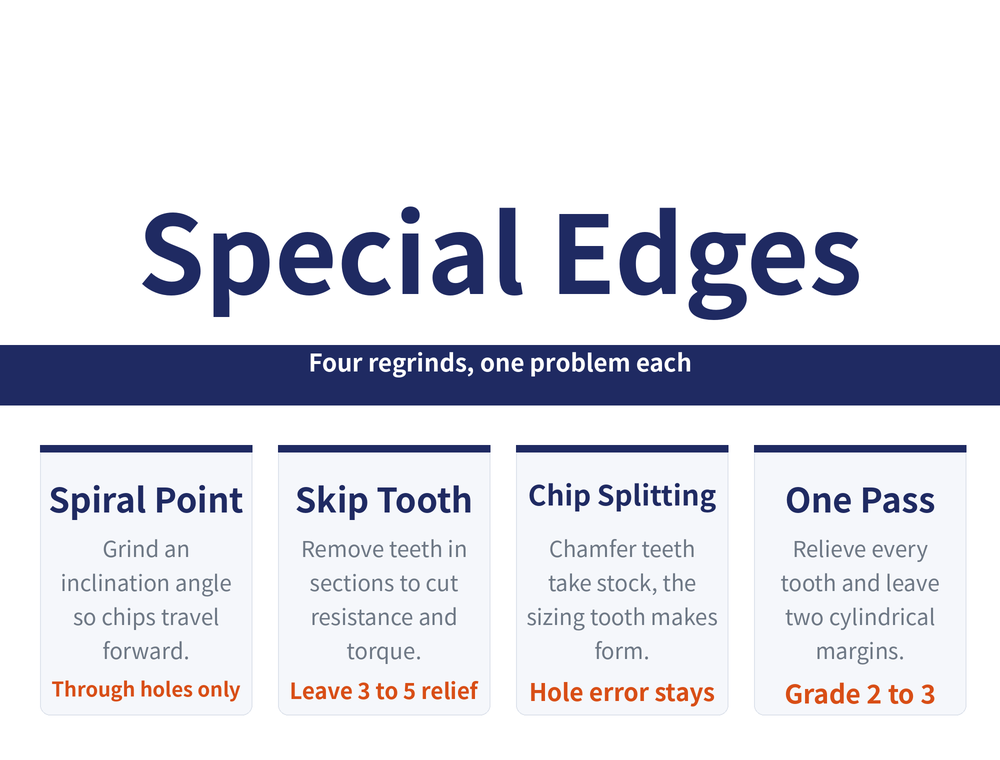
1. Four regrinds, one problem each
This page is not about choosing a catalogue model. It is about the four edge geometries a user can grind onto a standard tap. Decide first which problem you are solving.
| Geometry | Problem solved | Where it fits |
|---|---|---|
| Spiral point (forward chip flow) | Chips packing into the flutes | Through holes, straight-flute taps |
| Skip-tooth | Cutting resistance and torque too high | Pattern varies by workpiece |
| Chip splitting | Load concentrated on the sizing tooth | Where form stability matters |
| One-pass forming | One tap to finish, automation | Carbon and stainless steel holes |
For the flute types already offered off the shelf, see Tap Flute Design Guide.
2. Spiral point: push the chips ahead
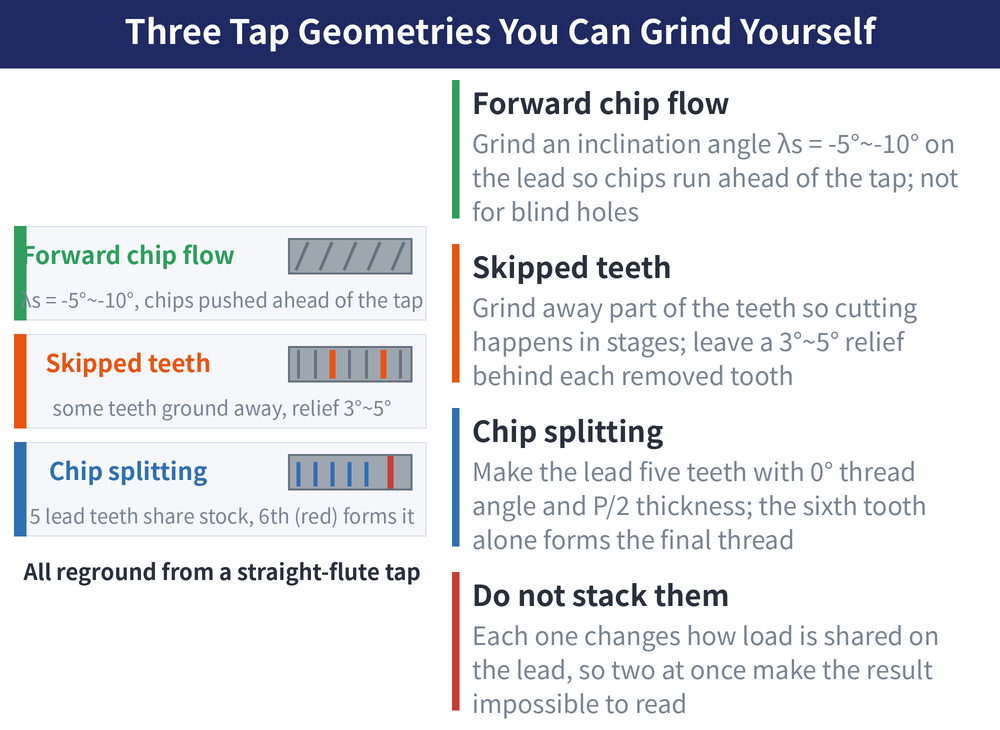
A straight-flute tap in a through hole tends to pack chips into the flute. The fix is to grind an inclination angle λs on the chamfer of -5°~-10°, so chips travel forward in the feed direction instead of backing up.
This is exactly the principle behind a catalogue spiral point tap, applied at the user end. With the right cutting fluid the speed can rise: in the documented case a W18Cr4V tap in steel went from 1.5~5 to 10~15 m/min, using emulsion on steel and kerosene on cast iron.
Those speeds are values from one documented case, not a general recommendation — work to the tool catalogue and your own trial cuts, and see Spiral Point Tap Guide. Do not use this on blind holes: pushing chips forward means pushing them into the hole bottom.
3. Skip-tooth: remove teeth in sections
On an ordinary tap every tooth cuts at once, so resistance and torque are both high. The skip-tooth answer is to remove selected teeth so cutting happens in stages.
There are two places to grind. The last tooth of the chamfer and the first tooth of the thread land go together: the face is ground down level with the thread root and minor diameter, while the back is ground lower to leave a 3°~5° back clearance that holds cutting fluid and cuts chip friction. Then two more teeth are removed at the mid-point of the thread land in the same way. On a four-flute tap the pattern follows the workpiece.
| Workpiece | Pattern |
|---|---|
| Steel | High ductility: remove two teeth at both the junction and the land mid-point, on all four rows |
| Cast iron | Two opposite rows ground on the land, the other two on the chamfer |
| Copper, aluminium and alloys | Soft material: from the last chamfer tooth, remove two teeth every third tooth, six in all, to resist built-up edge |
Ground by hand, dress the wheel edge first, hold the tap across the wheel facing the corner, do the chamfer before the land, keep pressure steady without chatter and cool continuously so the tool does not draw its temper. On a universal tool grinder, layout ink helps control the amount taken. The result is better chip breaking and cooling, lower resistance from staged cutting and a higher usable feed.
4. Chip splitting: let the chamfer take only the stock
On an ordinary tap a single tooth cuts the whole triangular thread form, and the load piles onto the sizing tooth. A chip-splitting tap gives the chamfer five cutting teeth with a 0° form angle and a tooth thickness of half the pitch P. The sixth tooth on the land has its crest removed so its crest thickness matches the cutting teeth, and it alone produces the final form.
Grinding order: cut the form-angle thread first, then a groove to separate chamfer from land; next use a parting tool or a cylindrical wheel to produce the 0° tooth profile on the chamfer and taper it conically, and grind the land tooth height until the major diameter exceeds the pitch diameter.
The gain is that the chamfer teeth simply take stock away in turn from root to crest rather than cutting the triangular form. The sizing tooth removes only the last area, and only its flank near the root is working, so friction drops. Sizing land life goes up, load and form error go down, and hole size error and feed error no longer reach the thread form.
5. Relieved grinding for a one-pass forming tap
A one-pass forming tap has a long chamfer with a small taper, and keeps (2.5~3)P of full sizing form behind it, P being the pitch. Relieved grinding means giving every tooth of the full-thread portion a relieved back angle while leaving two cylindrical thread margins.
| Item | Source value |
|---|---|
| Margin f1 | 0.2~0.5mm |
| Margin f | 0.5~3mm |
| Junction of the two | No sharp corner allowed; remove incomplete rear teeth |
| Materials | Q235 (A3) steel, 20~45 carbon steel, stainless steel |
| Achievable quality | Grade 2~3 accuracy, surface roughness Ra3.2~1.6μm |
It runs smoothly, starts square easily and is productive, which suits semi-automatic and automatic tapping. The chamfer taper angle is not given here; measure an existing tool instead. If the goal is breakage rather than form, see Tap Chipping and Breakage; for the regrind-or-scrap decision, see Regrind or Replace a Tap.
6. Frequently Asked Questions (FAQ)
Q: How does a self-ground spiral point differ from buying one?
The principle is the same — the chamfer inclination angle pushes chips forward. The difference is consistency and cost: buy the catalogue model for production or common sizes, and regrind in-house only for odd sizes or when a straight-flute tap is all you have.
Q: Does skip-tooth grinding leave an incomplete thread?
No. Only selected teeth are removed; the remaining teeth still travel the full helix and complete the form. What matters is leaving a 3°~5° back clearance behind each removed tooth so cutting fluid can get in.
Q: Why is a chip-splitting tap tolerant of hole size error?
Because its chamfer teeth only take stock away in turn, while the final form is produced by the sizing tooth alone. Errors in the drilled hole or the feed stay inside the stock being removed and never transfer to the thread form.
Q: Can several of these be combined on one tap?
Not advisable. Each one redistributes load on the chamfer, and doing two at once makes it hard to tell which is working. Fix the worst problem first, prove it in production, then consider the next.
This article is part of Tool Regrinding: The Complete Guide — Decide Whether to Grind, Then Look Up How, With What, and How to Check; that guide shows how the whole topic fits together.
Published: 2026-08-17|Last updated: 2026-10-31









