
Tapping Setup Guide: Synchronized Feed & Floating Holders
Tapping stability and tool life hinge on matching the holder to the machine feed. A rigid holder suits high-precision synchronized feed; a tension/compression (floating) holder compensates lead error and lowers breakage risk. Thread back-clearance also affects self-guiding and stability. This guide explains holder types, feed systems and matching logic to choose the best tapping setup.
1. Core Function of the Holder
The holder transmits torque, controls axial feed and compensates machining error, directly affecting tapping accuracy, tool life and stability.
2. Holder Types: Rigid, Synchronised and Floating
Tapping holders come in three types by axial compensation: a rigid holder (the “fully fixed” type in the chart below) has none, a synchronised holder keeps a very small float to absorb following error, and a floating holder allows a larger amount of travel. For choosing between them see Tool Holders for Tapping; this article covers the other half: how the machine feeds and which tap back-clearance to match.
3. Self-Guiding and Back-Clearance
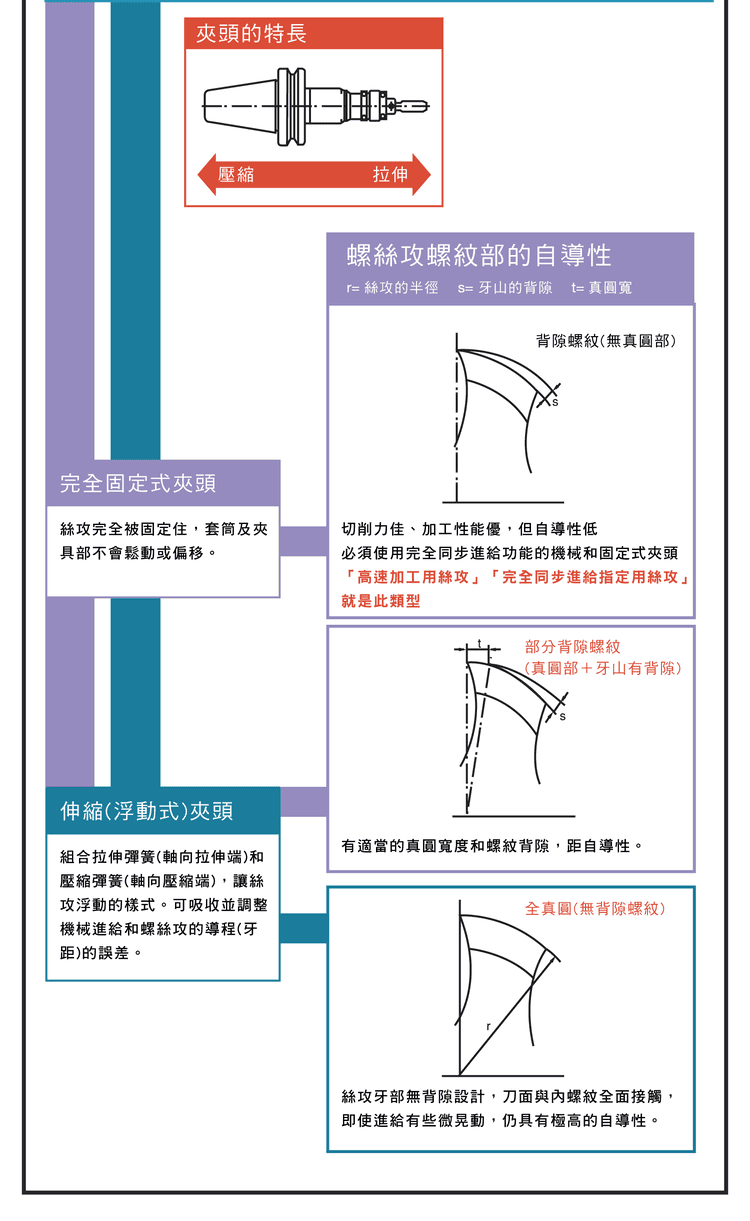
Self-guiding is the thread's ability to lead the tool's feed, affected by back-clearance, land width and tool radius:
| Thread design | Self-guiding & machining |
|---|---|
| No back-clearance | Full contact, highest self-guiding, stable |
| Partial | Moderate guiding, flexible |
| Full back-clearance | Free cutting but lowest self-guiding, needs precise synchronized control |
4. Machine Feed Methods
| Feed method | Traits & use |
|---|---|
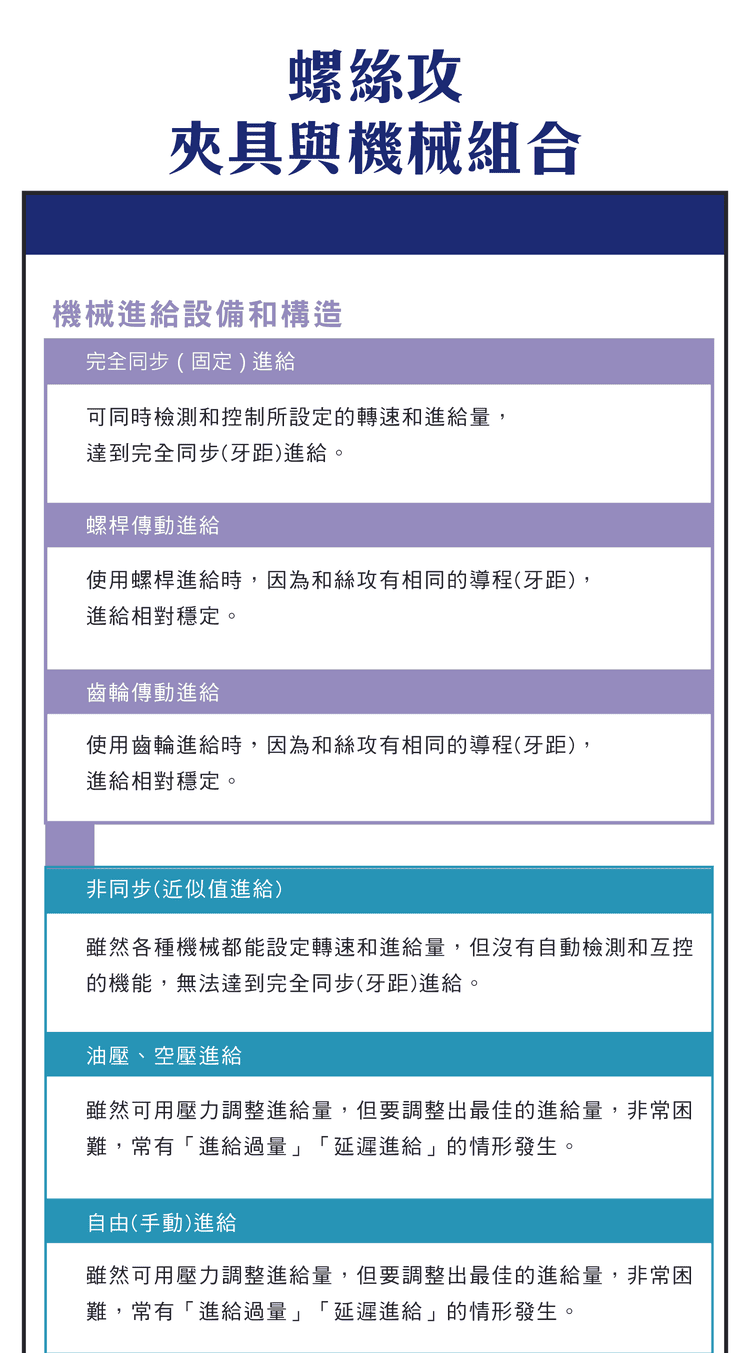
| Fully synchronized (rigid tapping) | Spindle and feed fully synced, feed = pitch; high precision and stability for high-speed tapping, needs CNC rigid-tapping |
| Lead-screw/gear feed | Machine lead matches the thread, steady feed; traditional machine tapping |
| Non-synchronized (hydraulic/pneumatic) | Hard to feed precisely, prone to overcut/lead error; pair with a floating holder |
5. Matching Logic and Advice
High-precision, high-speed tapping uses rigid tapping + a fixed holder; lower-accuracy or non-synchronized feed uses a floating holder to compensate lead error and cut breakage. No-back-clearance threads self-guide well for general work; full back-clearance needs precise synchronized control. Match holder, feed and thread back-clearance together. See Tool Holders for Tapping: Rigid, Synchronised and Floating for details.
For torque see the Tap Torque Guide; for speed see the Tap Cutting Speed Guide; for clearance/angle see the Tap Cutting Geometry Guide; for the tool overview see the Thread Tool Chart.
FAQ
Q: Rigid, synchronised or floating holder?
If the machine cannot do rigid tapping, use a floating holder (it compensates lead error); if it can, a synchronised holder is the usual safe default on machining centres, with a rigid (fixed) holder for maximum efficiency. Full back-clearance taps need fully synchronised feed and a fixed holder.
Q: What is rigid tapping?
Spindle and Z-axis feed are synchronized so that feed per revolution should equal the pitch, but servo lag and tap lead tolerance leave a small mismatch, so it is often paired with a synchronised holder (a very small axial float). It's precise and stable for high-speed tapping but requires CNC rigid-tapping capability and good concentricity.
Q: What does a floating holder compensate?
With tension/compression springs it absorbs the small difference between machine feed and thread lead, avoiding axial pull from mismatched feed, reducing torn threads and breakage — ideal for non-synchronized feed or lower-accuracy machines.
Q: Does back-clearance relate to the holder?
Yes. Full back-clearance threads self-guide poorly and need precise synchronized control (rigid tapping + fixed holder); no back-clearance self-guides well and tolerates general feed. Consider back-clearance when choosing holder and feed.
For the full reading guide on this topic, see Thread Machining: A Complete Reading Guide.
Published: 2026-03-24 | Last updated: 2026-10-10









