
Thin Parts Bow After Grinding: Separate Thermal Distortion from Clamping Distortion
Washers, friction plates and inlaid steel ways measure flat on the chuck and bow the moment you release them. There are two causes and the fixes are opposite: thermal distortion is solved by changing grinding conditions, clamping distortion by changing how the part is held. This shows how to tell them apart, then gives eight holding methods for thin parts and the cooling measures for face grinding.
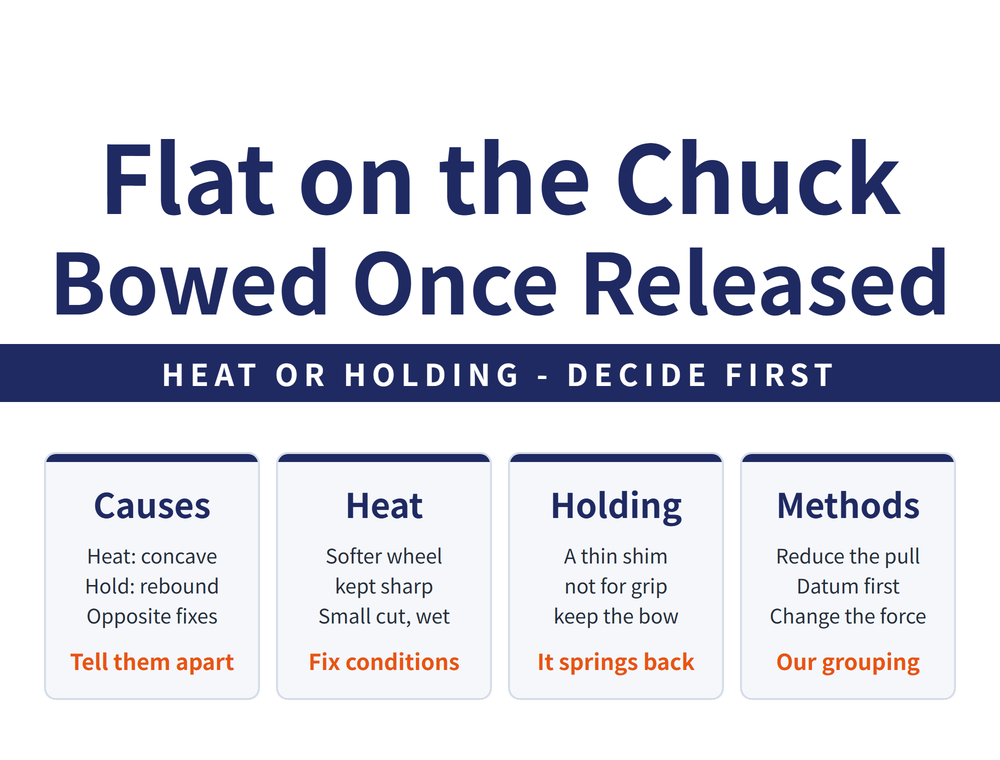
1. Flat on the chuck, bowed once released: which one is it
The classic complaint on thin and slender parts is "it measured flat while grinding and is not flat now". Two causes, and they look different:
| Type | Cause | What you get |
|---|---|---|
| Thermal | The part has little stiffness and heats unevenly during grinding, giving uneven linear expansion | The part is ground concave |
| Clamping | The part was already bowed from the previous operation or heat treatment; the magnetic chuck pulls it flat, and it springs back on release | Returns to its original bowed shape on release |
🔴 These have to be judged separately because the fixes are opposite: thermal means change the grinding conditions, clamping means change the holding. Treating spring-back as burn and chasing it with wheel changes never works — whatever wheel you fit, a part that was pulled flat will spring back.
How to tell: measure once while still held, then again after releasing. A large difference between the two is clamping distortion; both readings out of flat with a low centre points to thermal.
2. Thermal distortion: four grinding conditions
| Do this | Why |
|---|---|
| Use a softer grade of wheel and keep it sharp | A dull wheel generates heat by rubbing, not by cutting |
| Switch to a slotted or segmented wheel | Less contact area, so swarf and fluid can get in |
| Plenty of grinding fluid | A thin part has no thermal mass to buffer with; a gap in cooling shows up as distortion |
| Small depth of cut, faster table traverse | Spreads the same stock over more passes, so heat per pass drops |
How wheels are slotted and what forms suit each machine is covered in Slotted Wheels and Interrupted Grinding: Self-Sharpening, Heat and Slot Patterns by Machine; general ranges for depth and speed are in Grinding Parameters by Material: Stainless, Hardened Steel and Titanium.
3. Clamping distortion: the shim is not there to hold it tighter
The two moves: put a thin elastic shim such as rubber between the part and the magnetic table, or coat the part with heavy grease.
📌 The principle runs against intuition. The soft layer is not there to hold the part more firmly — it is there to stop the magnetic pull from flattening a bowed part. Flatten it and it will spring back. The aim is to stiffen the part so it deforms less while held, so that the ground face is genuinely flat.
4. Eight holding methods, grouped here into three families
| Family | Method | Key point |
|---|---|---|
| Reduce the pull | Elastic shim | A very thin rubber or sponge layer underneath; grind alternate faces |
| Reduce the pull | Magnetic block | Align its insulating layer with the chuck's; height must still hold the part |
| Reduce the pull | Residual magnetism | Hold on residual field only. ⚠ Depth of cut must be small and cooling generous |
| Make a datum first | Shim with pressboard | Work out which way it bows, shim the gap, hold the shimmed side and grind the other |
| Make a datum first | Wax fill | Fill one side flush with white wax, hold that side, grind the other |
| Make a datum first | Lap a datum | Lap one face by hand or machine first, then hold it and grind the other |
| Change force direction | Ring on a step | Thin rings sit loose on a small step and are driven by friction. ⚠ Steady the face with a bamboo strip on start-up |
| Change force direction | Clamp from the side | For long ways; make a datum face, then grind the other |
📌 All eight share one skeleton: get a reliable datum face first, then grind alternate sides. The Family column is our own grouping: decide which family your part is closest to, then pick from that family.
5. Face grinding runs hot: five cooling measures
Vertical-spindle surface grinding is productive, but wheel and work meet over a large contact area, so swarf clearance and cooling are poor and the part is prone to thermal distortion and burn. That is the main reason its finish trails peripheral grinding. Five measures:
| Measure | Principle and cost |
|---|---|
| Coarser grit, softer grade, resin bond | Better self-sharpening, stays keen |
| Plenty of grinding fluid | Better cooling |
| Segmented wheel | Sector segments on a metal flange cut contact area. ⚠ Cost: interrupted cutting, less steady than a solid wheel, so a coarser finish |
| Dress the wheel face to an internal cone | Turns it into line contact |
| Tilt the head slightly when roughing | Less contact area. ⚠ Cost: the ground face comes out slightly concave |
🔴 The cost of tilting can be calculated, and it is larger than people expect. A worked example: with a 350 mm wheel, 150 mm grinding width and the head tilted 30 minutes of arc — the upper limit — the concavity reaches 0.15 mm. So tilting is for roughing only; for finishing the spindle must be square to the table.
6. Grinding marks tell you whether the head is square
| Mark pattern | Verdict |
|---|---|
| Crossed double marks | Head is square to the table ✅ |
| Single, non-crossing marks | Head is not square ❌ |
This is the cheapest check on the floor: just look at the ground surface. If parts are still out after all this, look at the machine itself in Grinding Defects: Tracing Chatter, Burn, Cracks and Size Errors.
7. Frequently Asked Questions (FAQ)
Q: Thin washers bow after grinding. Will a softer wheel help?
Only if it is thermal. If the chuck is pulling an already bowed part flat and it springs back on release, no wheel change will help — the holding has to change. If the ground face is concave, then a softer wheel with generous fluid is the right move.
Q: Why put rubber under a thin part? Does that not reduce grip?
Reducing the pull is the point. The shim stops the magnetic force from flattening a bowed part, because anything flattened springs back. A thin elastic layer lets the part deform less while it is held.
Q: Tilting the head cools better. Why not tilt for finishing too?
Because it grinds the face slightly concave, and by a meaningful amount: a 350 mm wheel over 150 mm width tilted 30 minutes of arc gives 0.15 mm of concavity. Tilt for roughing only; keep the spindle square for finishing.
Q: How do I check quickly whether the head is square?
Look at the grinding marks. Crossed double marks mean the head is square to the table; single, non-crossing marks mean it is not.
This article belongs to the line covered in Grinding Wheels and Machines: The Complete Guide - Reading the Wheel, Mounting It, Dressing It, and Tracing Defects, which shows where to start and where to go next.
Published: 2026-09-17|Updated: 2026-10-22









