
Grinding Parameters by Material: Stainless, Hardened Steel and Titanium
Grinding parameters do not come from a formula the way turning and milling do. They come from a table plus correction on the machine. This gathers four common material groups into one place: the general range for ordinary steel, the three stainless structures, carbide and hardened high-speed steel, and ultra-high-strength steel and titanium — each with wheel speed, work speed, rough and finish depth of cut, and a wheel recommendation.
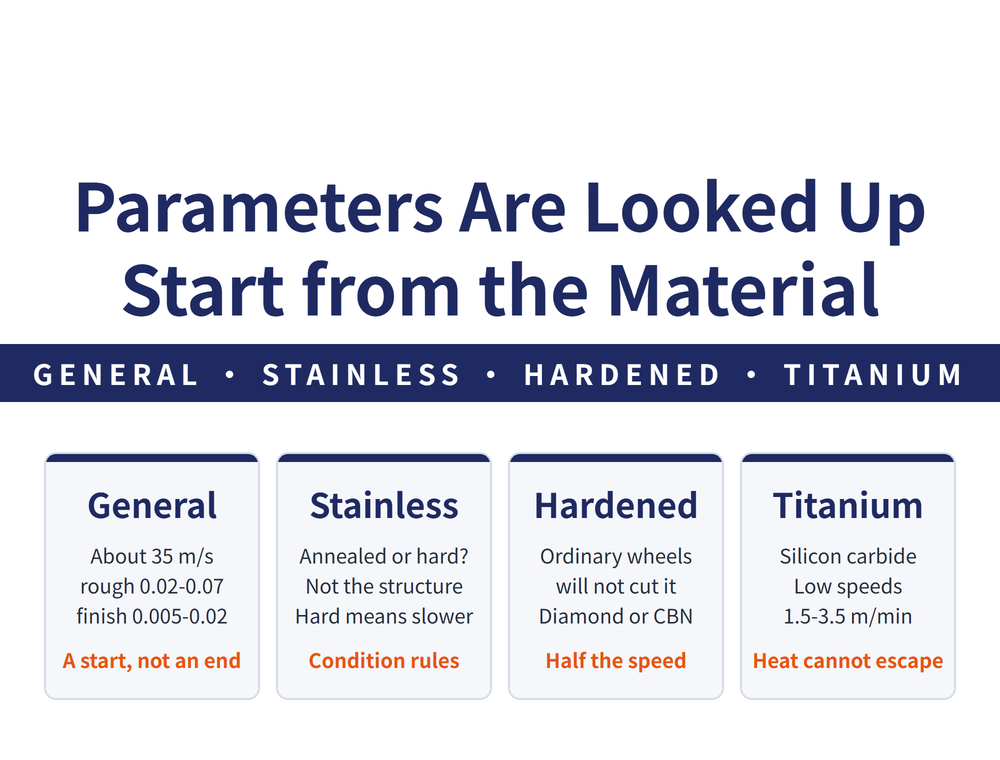
1. Start from the general range, then adjust for material
With no special material requirement, these three sets are the starting point:
| Item | General | High precision / fine finish |
|---|---|---|
| Wheel speed | Ordinary wheels around 35 m/s; internal 20–30, surface 20–35, cylindrical 35 and up | 15–20 m/s |
| Work speed | Cylindrical 15–30, internal 20–50, surface 17–30 m/min | Cylindrical 4–20, internal 7–9, surface 15–20 m/min |
| Depth of cut (infeed) | Rough 0.02–0.07mm; finish 0.005–0.02mm | 0.0025mm or less |
Two corrections that get missed: in cylindrical grinding, the larger the part diameter the lower the work speed; and slender shafts with a length-to-diameter ratio above 30 drop to 5–9 m/min, as do inherently unbalanced parts such as crankshafts. Only a rigid machine justifies working at the top of a range.
Reference values compiled from technical sources. Go by the maximum speed marked on the wheel, the machine specification and your own trial results; never exceed the marked speed.
2. Stainless: three structures, two parameter sets
Stainless is gummy and conducts heat poorly. What matters is not the structure name but whether the part is annealed or hardened — hardened means lower speed and less depth. Ordinary abrasive wheels:
| Structure / condition | Mode | Wheel speed | Work speed | Depth rough / finish |
|---|---|---|---|---|
| Martensitic, annealed | Surface | 18–25 m/s | 15–25 m/min | 0.02–0.05 / ≤0.01mm |
| Martensitic, hardened and tempered | Surface | 16–25 m/s | 14–16 m/min | 0.02–0.025 / ≤0.01mm |
| Austenitic, annealed | Cylindrical | 20–30 m/s | 15–20 m/min | 0.02–0.05 / ≤0.01mm |
| Austenitic, cold drawn | Cylindrical | 20–25 m/s | 14–16 m/min | 0.02–0.04 / ≤0.01mm |
| Ferritic, annealed | Cylindrical | 20–30 m/s | 15–20 m/min | 0.02–0.05 / ≤0.01mm |
| Martensitic and austenitic | Internal | 20–30 m/s (20–25 if hardened) | 20–45 m/min (15–35 if hardened) | 0.01 / ≤0.005mm |
Use white aluminium oxide (WA) or single-crystal grains, 46–60 grit, grade J–L, vitrified bond. A CBN wheel runs on a different set of speeds (the data cover hardened and tempered martensitic grades only): surface 25–35 rough and 20 finish, cylindrical 25–30, internal 25–40 m/s.
3. Carbide and hardened high-speed steel: ordinary wheels will not do it
This group needs superabrasives. With a diamond wheel on tungsten carbide, speed depends on the bond, and dry differs from wet:
| Diamond wheel bond | Dry | Wet |
|---|---|---|
| Metal bond | 12–18 m/s | 15–22 m/s |
| Resin bond | 15–20 m/s | 18–25 m/s |
Depth of cut follows the diamond grit: coarse (70/80–100/120) takes 0.01–0.015mm on a resin bond and 0.01–0.025mm on a metal bond; fine (120/140–200/230) takes 0.005–0.01mm on resin and 0.01–0.015mm on metal. The finer the grit, the less depth it will take — more useful than memorising the figures.
🔴 Carbide grinding runs far slower than ordinary steel (12–25 m/s against 35 m/s). Run it at ordinary-steel habits and you get wheel wear and workpiece cracks together. How to match diamond and CBN wheels is covered in Diamond or CBN Wheels: Abrasive, Bond, Grit, Concentration and Shape Codes.
4. Ultra-high-strength steel: hotter, and it leaves a hardened layer
With ultra-high-strength steel such as 300M the problem is not hardness but high grinding temperature plus a hardened surface layer. The measured comparison makes it clear: ordinary medium-carbon steel measured about 375 °C dry at 35 m/s and 0.04mm depth; 300M still reached about 438 °C even with speed cut to 18 m/s and depth halved to 0.02mm.
The hardened layer is the more interesting part:
| Depth of cut | Hardened layer (wheel 31.4 m/s) | Hardened layer (wheel 15.7 m/s) |
|---|---|---|
| 0.01mm | 10 μm | 18 μm |
| 0.02mm | 20 μm | 20 μm |
| 0.03mm | 20 μm | 22 μm |
🔴 Slower is not automatically safer — at 0.01mm depth, halving the wheel speed took the hardened layer from 10 μm to 18 μm. Suggested CBN ranges for surface grinding (above 50HRC): 28–40 m/s wet and 20 m/s dry; work speed 15–38 m/min; depth 0.025–0.05mm rough and ≤0.01mm finish.
5. Titanium: silicon carbide grains, and speeds across the board are low
Titanium conducts heat poorly and is chemically active, so its parameters sit a step below steel — and alpha-beta and beta grades take different numbers:
| Mode | Wheel speed (ordinary grain) | Work speed | Depth rough / finish |
|---|---|---|---|
| Surface | alpha-beta 15–20 / beta 15–18 m/s | Rough 15–20 / finish 8–14 m/min | 0.02–0.025 / ≤0.01mm |
| Cylindrical | alpha-beta 16–25 / beta 15–20 m/s | alpha-beta 15–30 / beta 15–25 m/min | 0.02–0.025 / ≤0.01mm |
| Internal | alpha-beta 18–25 / beta 18–22 m/s | alpha-beta 20–35 / beta 15–25 m/min | 0.01 / ≤0.005mm |
| Centreless | alpha-beta 20–25 / beta 18–25 m/s | Through-feed 1.5–3.5 m/min | 0.02–0.025 / ≤0.01mm |
Use silicon carbide grains (C, GC), 46–80 grit, grade H–K, vitrified bond. With CBN the wheel speed rises to 30–40 m/s, while surface and cylindrical work speeds come down. For belt grinding titanium: GC or zirconia alumina 50–80 grit for roughing, GC 100–240 for finishing, resin bond, belt speed 5–13 m/s.
6. How to use these tables: three rules
1. A table is a starting point, not an answer. Take the middle of the range, run a trial, then correct by spark, sound and measurement.
2. Change depth before speed. Burn or cracks respond to less depth most directly; changing speed also changes finish and wheel wear.
3. Condition matters more than material name. The same stainless takes two different parameter sets annealed and hardened.
If the parameters are right and it still goes wrong, work back from the defect in Grinding Defects: Tracing Chatter, Burn, Cracks and Size Errors; for the fluid side see Choosing a Grinding Fluid: Oil or Water Based, Five Types and EP Additives. For why each section recommends the wheel it does, and how to judge a wheel yourself for another material or job, see Choosing Grinding Wheel Grit, Grade, Bond and Structure: Workpiece First, Then the Job, Then the Defect.
7. Frequently Asked Questions (FAQ)
Q: What wheel speed should stainless be ground at?
Roughly 16–30 m/s with ordinary abrasive wheels, depending on mode and condition: 25–30 when annealed, dropping to 16–25 once hardened, tempered or cold drawn. The deciding factor is current hardness, not the structure name.
Q: Can tungsten carbide be ground with an ordinary aluminium oxide wheel?
It is very inefficient; use a diamond wheel. Speed also has to come down to 12–25 m/s depending on bond and whether you run dry or wet — not the 35 m/s used on ordinary steel.
Q: Does lowering wheel speed prevent a hardened layer?
Not necessarily. On ultra-high-strength steel at 0.01mm depth, dropping the wheel from 31.4 to 15.7 m/s increased the hardened layer from 10 μm to 18 μm. Speed has to be judged together with depth.
Q: Why are titanium parameters lower than for steel?
Titanium conducts heat poorly and is chemically active, so heat concentrates in the grinding zone. Wheel speeds therefore sit around 15–25 m/s, and centreless through-feed is only 1.5–3.5 m/min.
This article belongs to the line covered in Grinding Wheels and Machines: The Complete Guide - Reading the Wheel, Mounting It, Dressing It, and Tracing Defects, which shows where to start and where to go next.
Published: 2026-09-17|Updated: 2026-10-24









