
Tool Holder Balance: G2.5 / G6.3 and High RPM
A tool holder's dynamic balance sets the vibration, runout and spindle life in high-rpm machining. The faster it spins, the more any small unbalance is amplified by centrifugal force (which rises with the square of speed), degrading finish, shortening tool life and wearing spindle bearings. Balance quality is expressed as a "G value" (per ISO 21940)—the smaller the number, the better the balance—commonly G6.3 (general) and G2.5 (high-speed, high-precision); the higher the rpm, the stricter the grade needed. This guide explains why balance matters, the G value and residual unbalance, recommended grades by rpm, and how to achieve good tool holder balance.
1. Why a tool holder needs dynamic balance
Any slight asymmetry in a holder's mass distribution (unbalance) produces centrifugal force when it spins fast, throwing the tool tip off-centre. The key point is that centrifugal force rises with the square of speed—double the rpm and the force is four times greater. So an unbalance you can ignore at low speed becomes clear vibration and runout at high rpm, with four consequences: worse surface finish, shorter tool life, faster spindle-bearing wear and unstable accuracy. The higher the rpm, the less you can skip balancing.
2. What is the G value (balance quality grade)
Balance quality is given as a "G value" (per ISO 21940, formerly ISO 1940). It represents the permissible residual unbalance—the smaller the number, the better the balance. Common grades:
| Balance grade | Position | Typical use |
|---|---|---|
| G6.3 | General purpose | General-speed machining |
| G2.5 | High-speed, high-precision | Common requirement for high-rpm holders |
| G1.0 | Stricter | Ultra-high-speed, precision |
| G0.4 | Very strict | Ultra-precision / ultra-high-speed spindles |
The permissible residual unbalance (U) can be estimated with a reference formula: U (g·mm) ≈ 9549 × G × m ÷ n (m = holder mass in kg, n = rpm). The formula shows that for the same G grade, the higher the rpm n, the smaller the permissible unbalance U—which is why high-speed holders demand a stricter grade. Actual values follow a balancing-machine measurement.
3. Recommended balance grade by rpm
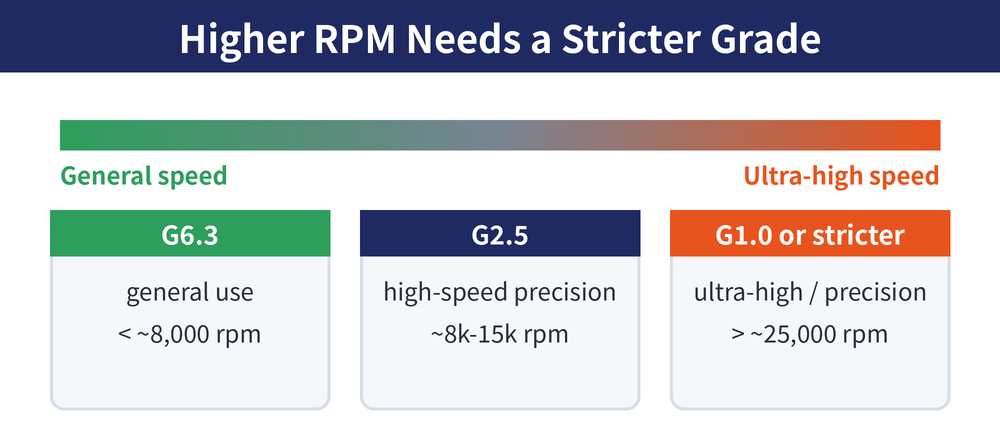
The higher the rpm, the stricter the grade needed. Common reference guidance:
| Spindle rpm (ref.) | Suggested balance grade |
|---|---|
| approx. < 8,000 rpm | G6.3 usually adequate |
| approx. 8,000–15,000 rpm | G2.5 recommended |
| approx. 15,000–25,000 rpm | G2.5–G1.0 |
| approx. > 25,000 rpm | G1.0 or stricter |
The table is rough guidance; actual needs vary with holder mass, overhang, spindle spec and the job—always follow a real balancing measurement and the spindle maker's advice.
4. What affects balance and how to improve it
| Factor | Notes and countermeasure |
|---|---|
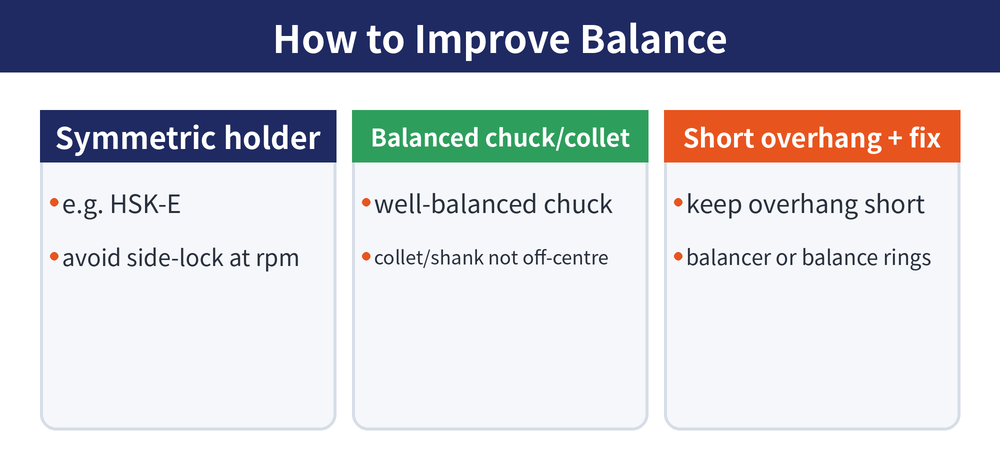
| Holder symmetry | Symmetric holders (e.g. HSK-E) balance well; side-lock is offset by its screw and is unfavourable at high rpm—avoid it there |
| Chuck and collet | Use a well-balanced chuck; an off-centre collet, nut or shank also ruins overall balance |
| Overhang | The longer the overhang and the more mass sits outboard, the greater the unbalance effect—keep it short where rigidity allows |
| Balance correction | Measure and correct on a balancing machine, or choose a holder with adjustable balance rings / screws |
| Balance as an assembly | Balance is of the whole "holder + chuck + collet + tool"; changing the tool or overhang changes it, so treat it as a set |
A note on HSK-A: its shank has two drive slots of different depths, grooves of different widths and a notch on one side only. That is how the standard defines it, so an HSK-A holder is inherently unbalanced. Some manufacturers add balancing holes or flats to the shank, and the 2023 edition of ISO 12164 added an AB form, a balanced version of form A. When choosing HSK-A for high-speed work, check whether the holder has this feature.
Further reading: BT vs HSK Spindle Taper, Face Milling Surface Finish, End Mill Length vs Deflection.
5. How to Read a Catalogue Balance Marking
The marking rests on a standard, but the buyer has almost no way to check it. A balancing machine can resolve 0.1 g·mm in theory, yet its reliable value is only 1.0 g·mm; a 0.6 kg BT30 holder rated G2.5 / 30,000 rpm needs its unbalance below 0.5 g·mm, which is already below what can be measured reliably (manufacturer reference values). A marking that also states a verifiable limit, such as "G2.5 / 25,000 rpm or 1 g·mm under", is therefore the more honest one.
DIN 69888 on a spec sheet is a different yardstick. DIN 69888 does not use the ISO G grades; it limits the bearing load caused by unbalance to 1% of the bearing's dynamic load capacity and states residual unbalance directly in g·mm. When a spec lists both a G value and DIN 69888, read them as two separate criteria; one cannot stand in for the other.
FAQ
Q: What is the difference between G2.5 and G6.3?
Both are ISO 21940 balance-quality grades; a smaller number is better balanced. G6.3 is general purpose; G2.5 is stricter and is the common requirement for high-rpm, high-precision holders. At the same rpm and mass, G2.5 permits about half the residual unbalance of G6.3, so high-speed work usually calls for G2.5 or stricter.
Q: Why is balancing essential at high rpm?
Because centrifugal force rises with the square of speed—double the rpm and it becomes four times greater. An unbalance you could ignore at low speed is amplified into clear vibration and runout at high rpm, degrading finish, shortening tool life and accelerating spindle-bearing wear. So the higher the rpm, the stricter the balance requirement.
Q: How do I achieve good tool holder balance?
Prefer a symmetric holder (e.g. HSK-E) and a well-balanced chuck, keep the overhang short, and make sure the collet and shank are not seated off-centre; avoid offset side-lock for high-speed work. Correct on a balancing machine if needed, or use a holder with adjustable balance rings/screws. Remember balance is a property of the whole assembly (holder + chuck + tool).
Q: Is the catalogue G value for the whole assembly or the tool?
A catalogue G value is usually for the holder body at a stated rpm, but in practice the "holder + chuck + collet + tool" spins as one. Changing the tool, the tool's stick-out or seating it off-centre all change the assembly balance, so the real balance is what you measure once assembled at the working rpm. As for a high grade engraved on the holder, the buyer can hardly verify it, so a marking that also states a verifiable limit (such as "or 1 g·mm under") is the more honest one.
This article is part of Tool Holders: The Complete Guide - One End Meets the Spindle, the Other Holds the Cutter; that guide shows how the whole topic fits together.
Published: 2026-07-21 | Last updated: 2026-10-22









