End Mill Length vs Deflection
An end mill's length and bending resistance directly affect machining stability and tool life. The longer the overhang, the more deflection rises—by a multiple—sharply reducing breakage life: doubling the length can increase deflection by 8×, greatly raising the fatigue-failure risk. Controlling length, improving rigidity and optimizing cutting conditions effectively reduces vibration and tool breakage.
The Length–Deflection Relationship
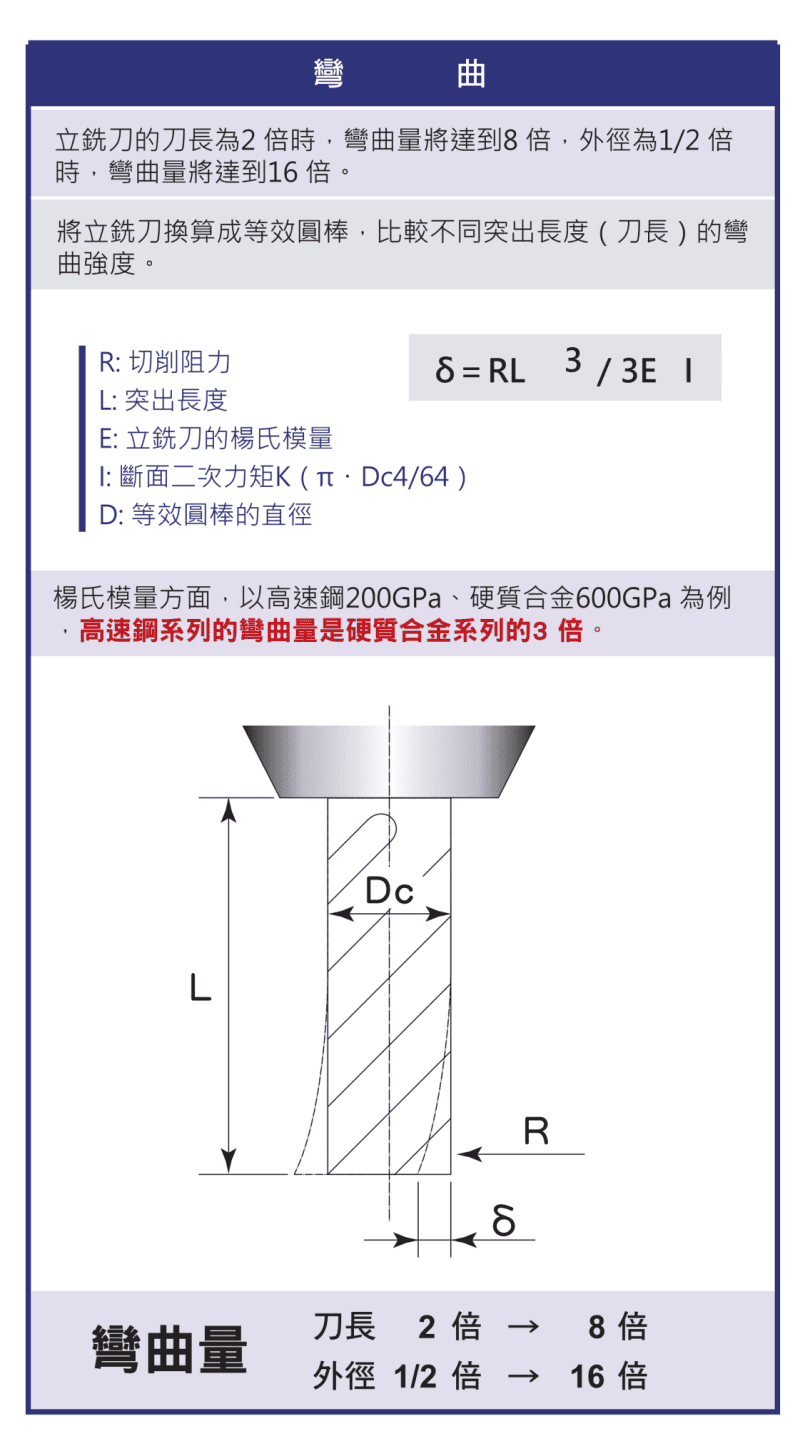
Modeling the end mill as an equivalent cylinder, deflection is:
δ = R × L³ ÷ (3EI)
| Item | Description |
|---|---|
| R | cutting resistance |
| L | tool overhang length |
| E | Young's modulus of the end mill |
| I | second moment of area (I = π × Dc⁴ ÷ 64, where Dc is the equivalent cylinder diameter) |
Key point: deflection is cubically proportional to length (L³).
Effect of Length on Deflection & Life
| Item |
|---|
| 2× length → about 8× deflection |
| Half the diameter → about 16× deflection |
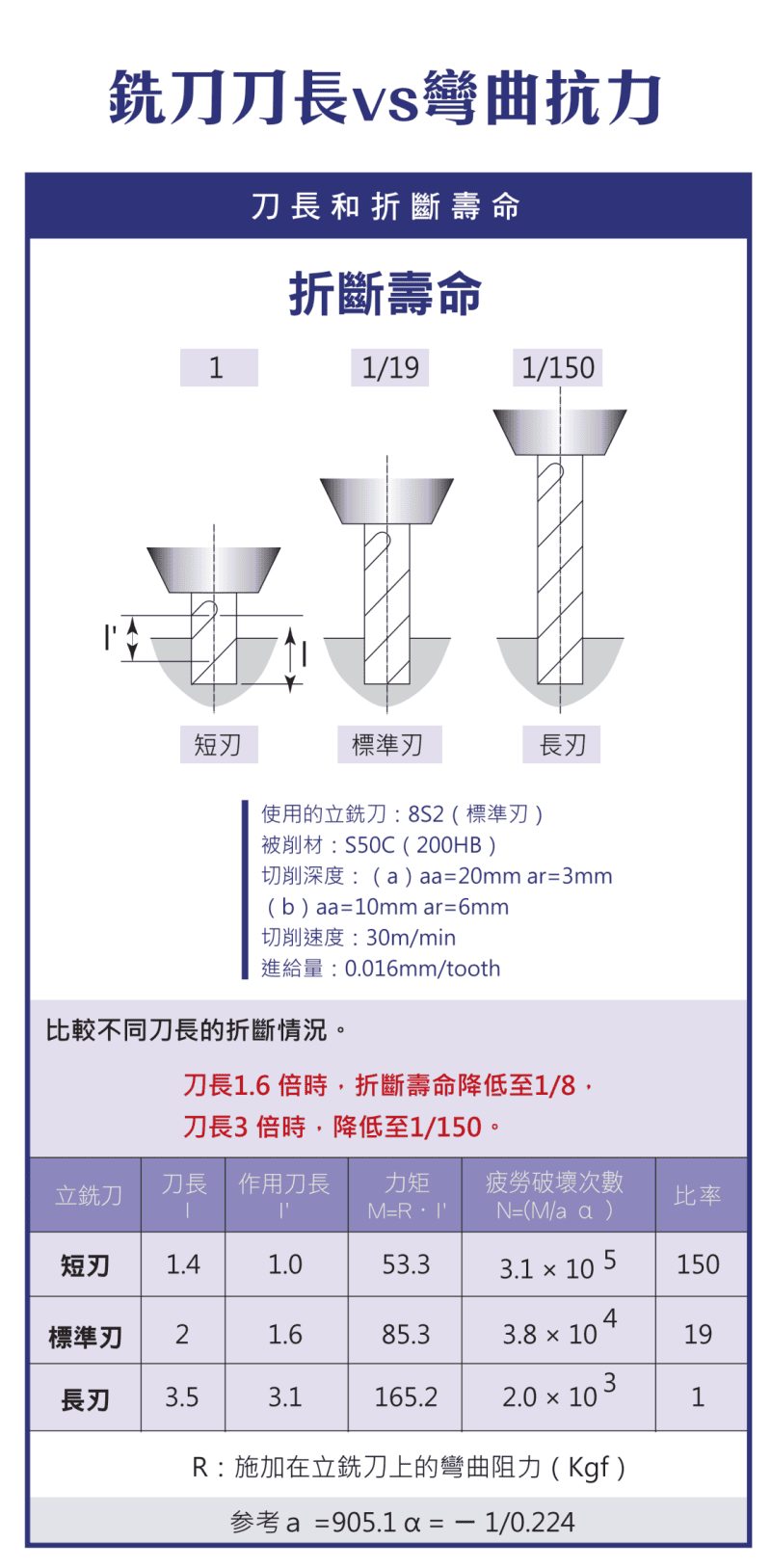
| Breakage life: 1.6× length → about 1/8; 3× length → about 1/150 |
Manufacturer test (end mill 8S2 standard flute, workpiece S50C 200HB, cutting speed 30 m/min, feed 0.016 mm/tooth), breakage-life comparison:
| End mill | Length I | Effective length I' | Moment M=R·I' | Fatigue cycles N | Ratio |
|---|---|---|---|---|---|
| Short flute | 1.4 | 1.0 | 53.3 | 3.1×10⁵ | 150 |
| Standard flute | 2 | 1.6 | 85.3 | 3.8×10⁴ | 19 |
| Long flute | 3.5 | 3.1 | 165.2 | 2.0×10³ | 1 |
Cutting Length & Fatigue Failure
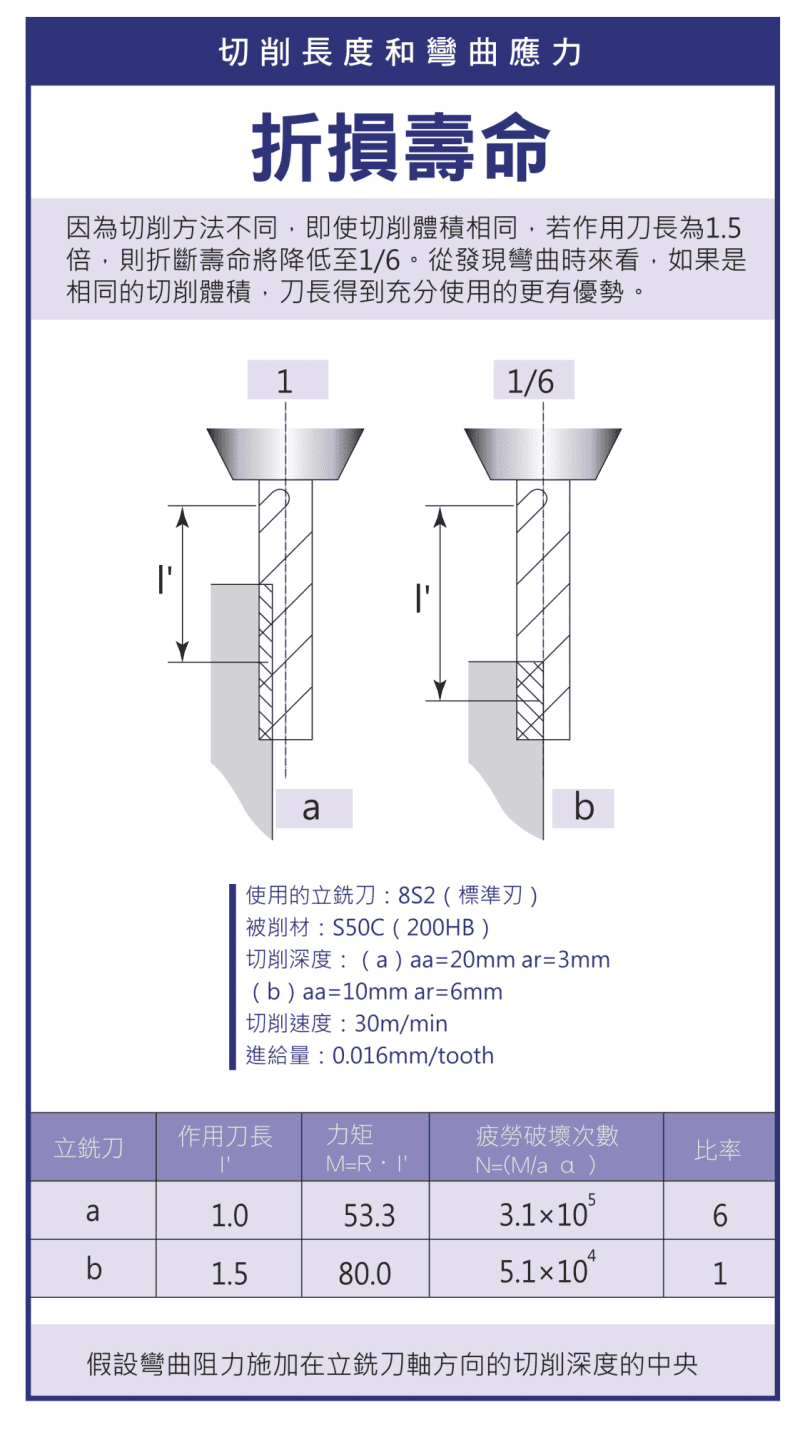
For the same cutting volume, a longer effective length raises bending stress and sharply lowers breakage life—e.g. a 1.5× effective length drops breakage life to about 1/6. In other words, for the same cutting volume, fully using the flute (shorter overhang) is advantageous.
| Case | Effective length I' | Moment M=R·I' | Fatigue cycles N | Ratio |
|---|---|---|---|---|
| a | 1.0 | 53.3 | 3.1×10⁵ | 6 |
| b | 1.5 | 80.0 | 5.1×10⁴ | 1 |
Effect of Material on Deflection
Young's modulus: HSS about 200 GPa, carbide about 600 GPa. Under the same conditions, HSS deflects about 3× as much as carbide—carbide is stiffer.
Tips for Machining Stability
| Item | Description |
|---|---|
| Tool selection | prefer a short tool length; increase tool diameter. |
| Cutting conditions | reduce cutting load; control depth of cut. |
| Equipment & holding | increase clamping rigidity; minimize tool overhang. |
The effective holding length at the collet end also affects deflection—see Collet Damage & Deformation.
Practical Length-Control Principles
| Item |
|---|
| Keep tool overhang as short as possible |
| Avoid excessively long overhang machining |
| Reduce parameters when machining with long tools |
FAQ
Why does a longer tool break more easily?
Deflection is cubically proportional to length (δ∝L³), so 2× length gives about 8× deflection; breakage life drops accordingly (1.6× length → about 1/8, 3× → about 1/150).
How much does diameter affect deflection?
Deflection is inversely proportional to the fourth power of diameter—halving the diameter gives about 16× deflection. Increasing tool diameter is one of the most effective ways to add rigidity.
Which is stiffer, HSS or carbide?
Carbide's Young's modulus is about 600 GPa vs HSS about 200 GPa; under the same conditions HSS deflects about 3× as much, so carbide is stiffer.
How do I reduce tool deflection and breakage?
Prefer a short tool length, increase tool diameter, improve clamping rigidity and minimize overhang; reduce cutting load and parameters when long-overhang machining is unavoidable.
This article is part of End Mills: The Complete Guide - Know the Cutter, Choose It, Set the Conditions; Toolpaths Are Another Line; that guide shows how the whole topic fits together.