
Is Magnesium Alloy Easy to Machine: Five Myths and What Actually Matters
Magnesium alloy is in fact easy to machine: low cutting force, good thermal conductivity, fast heat dissipation, high speeds and heavy feeds, and tool life longer than when cutting aluminium. What needs attention is not the workpiece but the chips. Ingots and cast parts do not burn below their melting point; what burns is powder, ribbon and foil, the high surface area forms, and machining is exactly what produces them. This article works through the five myths customers raise most and says where the effort really belongs.
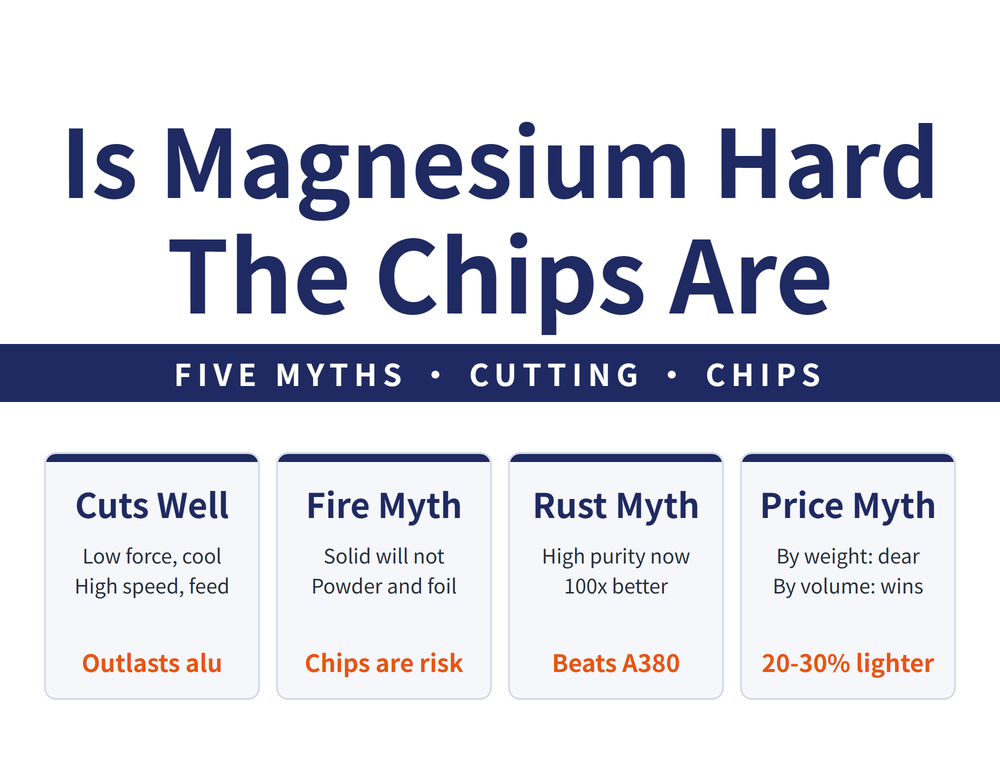
1. The Conclusion First: Magnesium Alloy Machines Well
This gets buried under the misconceptions. In fact magnesium has very good machinability and can be cut at high speed with heavy feed.
| Property | What it gives you |
|---|---|
| Low cutting force | Light load on the machine, relatively relaxed clamping demands |
| Good conductivity, fast heat loss | Temperature does not build up in the cutting zone |
| The two together | Tool life several times longer than when cutting aluminium alloy, with fewer stoppages for tool changes |
Extended to capacity: producing the same number of magnesium alloy parts needs fewer machines and less floor area than the equivalent in aluminium, which in turn reduces investment and production headcount.
2. 🔴 Myth One: Magnesium Is a Flammable Metal
Of all the myths this is the most serious and the most exaggerated. The impression mostly comes from magnesium powder being used in pyrotechnics.
Magnesium ingots, die castings and extruded sections do not burn until the temperature rises to their melting point. What does burn readily is powder, ribbon and foil, the high surface area forms.
For a machine shop, read that backwards: the workpiece is not the risk, the chips are. Cutting turns solid stock into fine chips, which is precisely the high surface area form. So safety in magnesium machining is not about whether you dare cut it, it is about how the chips and dust are collected, cleared and stored.
That also supports the parameter direction above: cutting thicker, larger chips at heavy feed is safer than grinding out fine powder at light feed. For why too small a feed causes rubbing and fine debris, see [Drill Chip Formation Guide: Types of Chips and Machining Optimization].
3. Myth Two: Magnesium Corrodes Easily
This impression is stuck on old grades. In the 1980s it was found that impurity elements such as Fe, Ni and Cu, and the ratio of Fe to Mn, have a very large effect on corrosion resistance, which led to the high purity die casting alloy AZ91D.
Its corrosion resistance is more than 100 times better than the earlier AZ91A, AZ91B and AZ91C, and in salt spray resistance most die casting magnesium grades now exceed A380 aluminium alloy.
One thing is the same as aluminium though: surface pretreatment, generally chemical, is still needed before painting to raise corrosion protection. For how grade designations are read, see [Reading Aluminium and Titanium Designations: The A.A. Four-Digit System, JIS Codes and ASTM Grades].
4. Myths Three and Four: Scarcity and Formability
| Myth | Reality |
|---|---|
| Magnesium is scarce | In the crust it is the most widely distributed metallic element after aluminium, iron, calcium, sodium and potassium; in seawater it ranks third after chlorine and sodium |
| Magnesium is hard to form | At room temperature its hexagonal close packed structure has only one active slip system, hence the impression; but at elevated temperature under compressive stress its plasticity is high, allowing extrusion, forging and rolling, and its casting behaviour beats most aluminium alloys |
The formability item deserves particular note: it holds only at room temperature. State the condition and the conclusion reverses completely, which is the shape a great many material myths take.
5. Myth Five: Magnesium Is Expensive (Depends How You Count)
Price genuinely constrains magnesium adoption, but expensive has two arithmetics:
| Basis | Result |
|---|---|
| Price by weight, cost per kilogram | Overseas it may well cost more than aluminium alloy |
| Price by volume, cost to make the same part | A different matter entirely; substituted at equal volume, magnesium saves about one third of the weight |
What substitution actually delivers: replacing an aluminium part with magnesium generally cuts weight by 20 to 30%. Parts are made by volume, not by weight, so price by volume is the only meaningful basis of comparison.
🔑 That unit price against real cost of use reasoning is the same logic as tool purchasing, where comparing on the wrong basis produces the opposite conclusion. See [Machining Cost Structure: Tooling Is Only 3%, So Where Is the Real 15%].
6. So What Should the Machining End Watch
| Item | Direction |
|---|---|
| Parameters | High speed and heavy feed are available; low force and fast heat loss are the advantage |
| Chip management | The real focus. Avoid generating fine powder; clear and store chips promptly |
| Tool life | Longer than in aluminium, so reassess change intervals rather than carrying aluminium settings over |
| Surface finishing | Pretreatment before painting is required as with aluminium and must be scheduled in |
🔑 Parameter direction: wrought, cast and die-cast magnesium take the same recommended cutting speed and feed at the same depth of cut; what differs is only the recommended carbide grade. Comparing the same set of reference values, carbide tools run at roughly 2 to 2.5 times the cutting speed of high-speed steel. As depth of cut increases, speed comes down and feed goes up: heavy cuts rely on feed, not spindle speed. Take actual values from the tool catalogue; for the speed conversion see [End Mill Cutting Conditions Guide].
⚠ Choose cutting fluid by flash point, not cooling power: use a high-flash-point mineral-oil cutting oil; water-based fluid promotes chip self-ignition and should not be used. Grinding is stricter still: use no water or water-soluble fluid when grinding or handling grinding swarf.
In one line: the difficulty with magnesium alloy is not whether you can cut it, it is what you do with the pile that is left afterwards.
7. Frequently Asked Questions (FAQ)
Q: Should cutting fluid be used on magnesium alloy?
Magnesium conducts heat well and sheds it fast, so cooling demand is lower than for difficult materials. But fluid selection involves the risk of magnesium reacting with water, so confirm against the alloy grade in use and the supplier's guidance rather than carrying over an aluminium formulation.
Q: Can tools used for aluminium be used on magnesium?
Cutting force is lower than in aluminium and the load on the tool is lighter, so in most cases yes. The parameters should not simply be copied across though, since magnesium can be pushed harder and reusing aluminium settings wastes that advantage.
Q: Why would a customer switch an aluminium part to magnesium?
Mainly weight. Substituted at equal volume magnesium saves about a third of the weight, and actual substitution generally lightens the part by 20 to 30%, which has direct value in mobile devices and transport products.
Q: How does AZ91D differ from the older AZ91C?
In purity. With Fe, Ni and Cu impurities and the Fe to Mn ratio controlled, AZ91D has corrosion resistance more than 100 times better than AZ91A, B and C, which is why the impression of magnesium corroding easily is out of date.
The ratios and multiples given here are general material characteristics; actual values vary with alloy grade, process and service environment. Disposal of magnesium chips involves public safety and must follow local regulation and the supplier's safety data sheet.
Last updated: 2026-10-26









