Coolant-through tool holders deliver coolant directly to the cutting zone, which matters most for deep-hole drilling, high-speed milling, and chip evacuation. But having a coolant hole doesn't mean you have through-tool delivery. This guide explains the three delivery architectures - through tools, through collets, and jet through - their respective pairing requirements, and the most common selection mistake.
1. Why Use a Coolant-Through Tool Holder
Compared with flood coolant applied from outside, a coolant-through (internal-cooling) holder routes coolant through internal channels to a point near the cutting edge, carrying away heat and helping chip evacuation far more effectively - especially critical for deep-hole drilling, long-overhang milling, and difficult-to-machine materials. If coolant never actually reaches the cutting zone, its effectiveness drops sharply, which is exactly why "does the holder have a coolant hole" and "does coolant actually reach the tool tip" are two different questions.
Choosing the clamping end: see Collet System Comparison and Selection.
2. Three Delivery Architectures - Coolant Takes a Completely Different Path in Each
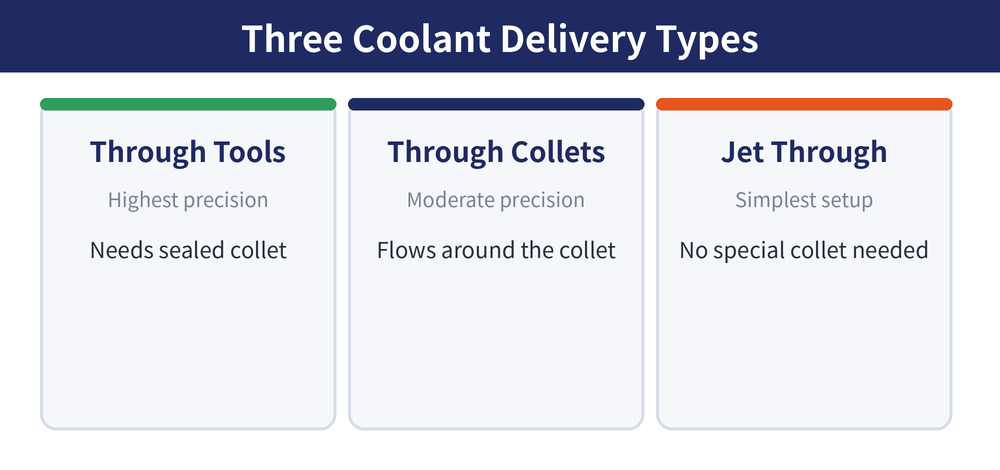
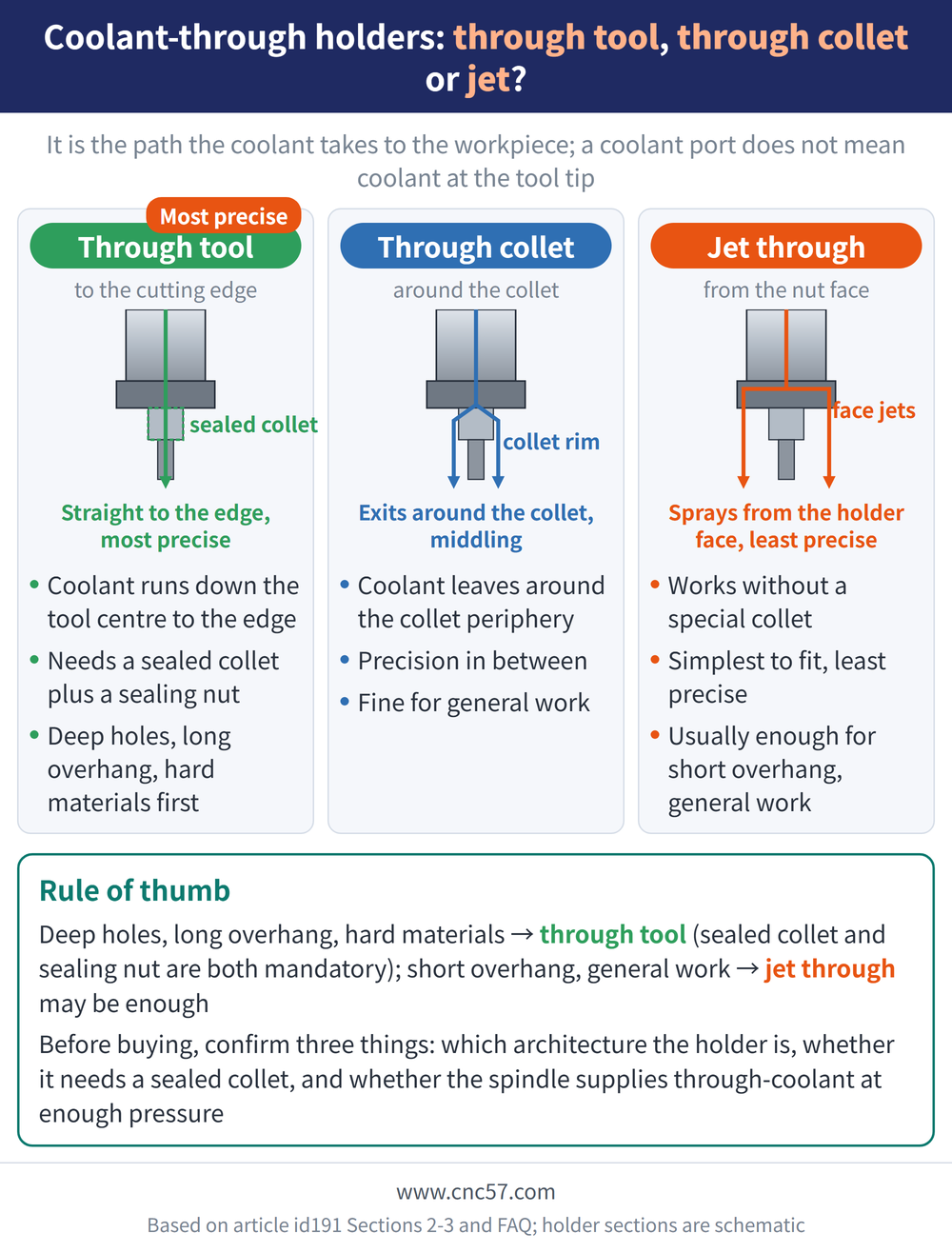
Industry tool holder catalogs repeatedly use the same classification for coolant delivery. These three types aren't just different names for the same thing - coolant takes a completely different path to the workpiece in each:
| Type | Description | Precision |
|---|---|---|
| Through tools | Coolant reaches the cutting edge directly; typically requires a dedicated coolant-through collet with sealing nut | Highest precision |
| Through collets | Coolant flows out around the collet | Moderate precision |
| Jet through | Coolant sprays directly from the holder's end face; no special collet required | Lower precision |
Jet through is the simplest and needs no special collet, but delivers less precisely; through collets sit in between; through tools is the most precise but only works when paired with a specific coolant-through collet and sealing nut - catalogs repeatedly emphasize this pairing requirement. A common selection mistake is assuming that "the holder body has a coolant hole" automatically means "through-tool delivery" - fitting a standard (non-sealed) collet can result in no through-tool coolant delivery at all, which is the most frequently misunderstood point in practice.
ER collet torque: see ER Collet Specification and Torque.
3. Selection and Compatibility Checklist
| Item to Confirm | Notes |
|---|---|
| The holder's coolant architecture | Confirm whether it's through-tools, through-collets, or jet-through - the three differ significantly in effect |
| Whether a sealed collet is required | Through-tools designs require a dedicated sealed (CL-type) collet and sealing nut - neither is optional |
| Machine support for coolant-through | Confirm the spindle itself has internal coolant supply capability, including sufficient pressure |
| Process requirements | Prioritize through-tools for deep-hole drilling, long-overhang milling, or hard-to-machine materials; jet through may be sufficient for general short-overhang work |
Start by clearly identifying your process requirements (deep hole, long overhang, or difficult material), then match against the holder's delivery architecture and collet pairing requirements - this avoids buying a holder with "a coolant hole" that never delivers the expected cooling because the collet doesn't match.
Holder clamping methods compared: see Tool Holder Clamping Methods Compared.
FAQ
Q1: If a holder has a coolant hole, will a standard collet give me through-tool coolant?
Not necessarily. Through-tools delivery requires a dedicated sealed collet and sealing nut to work correctly. Fitting a standard (unsealed) collet often lets coolant leak out around the collet instead of reaching the tip - the holder has the coolant hole by design, but you don't actually get through-tool delivery in practice.
Q2: What's the difference between jet-through and through-tools, and which should I choose?
Jet-through sprays coolant directly from the holder's end face and needs no special collet, making it simple to set up but less precise. Through-tools delivers coolant directly to the cutting edge for the highest precision, but requires a dedicated sealed collet. Choose through-tools for deep holes, long overhangs, or difficult materials; jet-through is usually sufficient for general short-overhang work where precise coolant targeting isn't critical.
Q3: What does a coolant-through holder require from the machine?
The machine spindle itself must have internal coolant supply capability, including adequate pressure and flow, for a coolant-through holder to work as intended. If the machine lacks an internal coolant supply system, the holder's coolant-through feature simply can't be used regardless of its design - confirm machine specifications before selecting.
Q4: Can I switch a single holder between through-collet and through-tool delivery?
It depends on the holder's design. Most holders have a fixed delivery architecture set at the design stage (e.g. built specifically for through-collet or jet-through delivery) - not every collet can redirect the coolant path. Whether switching is actually possible should be confirmed against the holder and collet manufacturer's specified pairings rather than assumed.