Turning Machining Formulas: Speed, Feed & Surface Roughness
Core turning calculations cover cutting power (Pc), cutting speed (Vc), feed (f), machining time (Tc) and surface roughness (h). These formulas quickly assess machine load, efficiency and surface quality. This guide organises the general formulas and their factors to help optimise cutting conditions and reduce tool wear.
1. Why These Calculations Matter
They assess machining load, predict efficiency and control surface quality, and are used for tool selection, cutting-parameter setting and cost control. Mastering them balances efficiency against tool life.
2. General Formulas
| Item | General formula | Symbols |
|---|---|---|
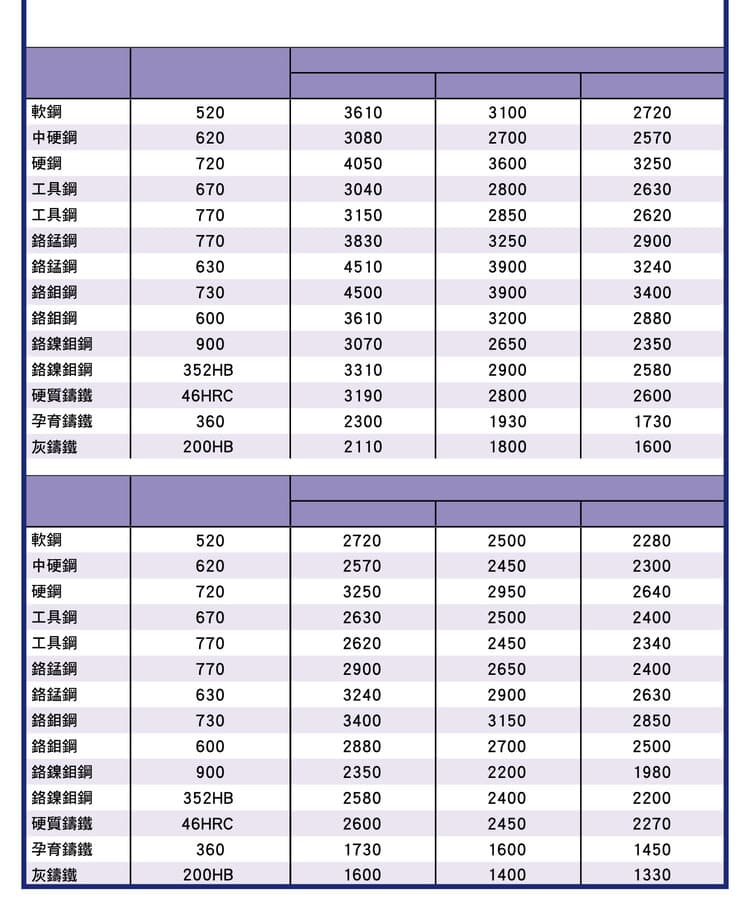
| Cutting speed Vc | Vc = π·Dm·n / 1000 (m/min) | Dm dia mm, n rpm |
| Spindle speed n | n = 1000·Vc / (π·Dm) (rpm) | from target Vc |
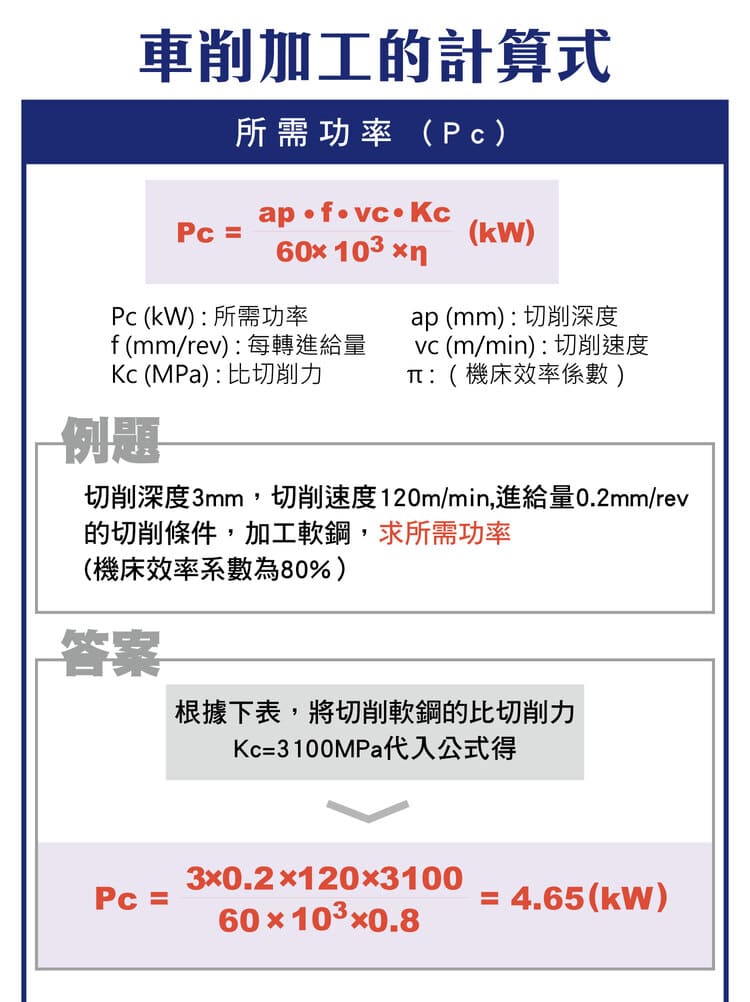
| Cutting power Pc | Pc = ap·f·vc·Kc / (60×10⁶) (kW) | ap mm, f mm/rev, Kc N/mm² |
| Machining time Tc | Tc = lm / (f·n) (min) | lm length mm |
| Theoretical roughness h | h ≈ f² / (8·R) (mm) | R nose radius mm |
These are general reference formulas; actual speeds/feeds should follow the tool catalogue and the Turning Cutting Conditions Guide, not applied blindly.
3. Specific Cutting Force (Kc)
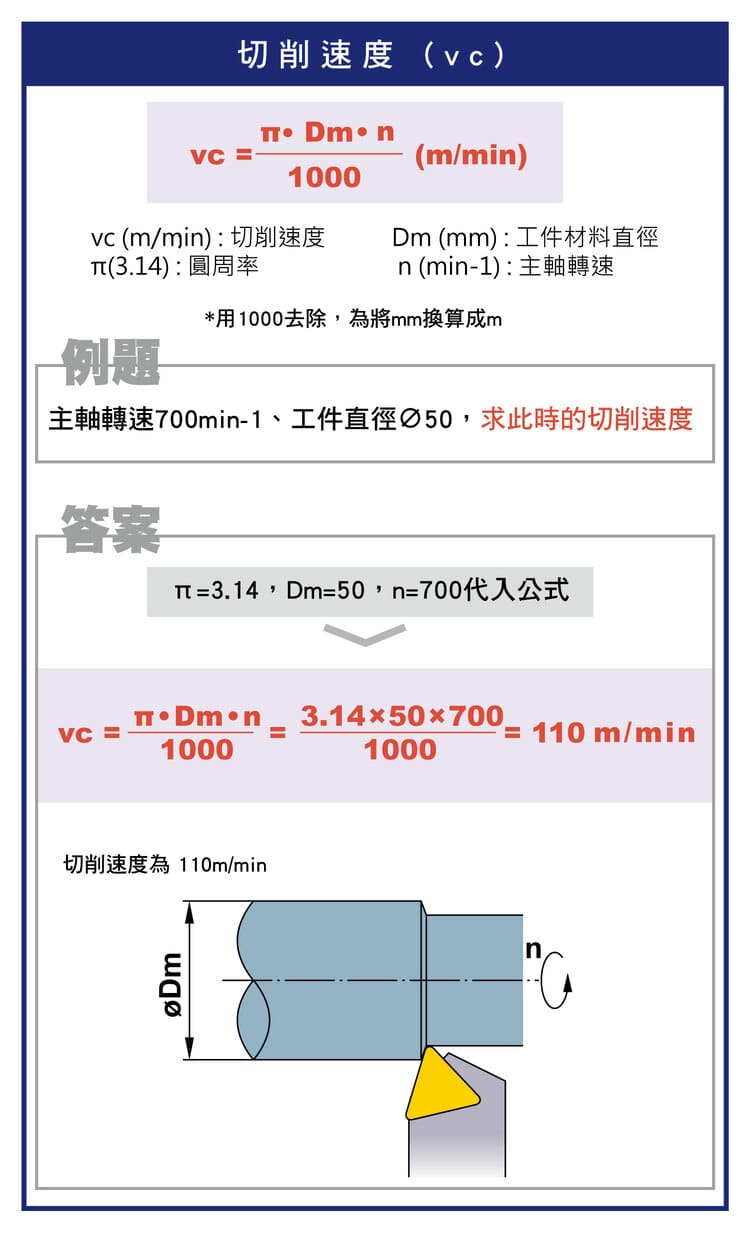
Different materials have different cutting resistance; harder material means higher Kc and greater power demand. Typical reference ranges (vary with grade and chip thickness):
| Material | Kc typical ref (N/mm²) |
|---|---|
| Mild steel | ~2500–2900 |
| Medium-carbon steel | ~2900–3300 |
| Alloy steel | ~3000–4500 |
| Cast iron | ~1300–2100 |
The table gives practical Kc values from tool-maker cutting data (matching the maker chart in this section and the power example that uses Kc = 3100 MPa for mild steel); they already include real chip thickness effects. Typical ranges — follow the catalogue or standard. Note this is not the same figure as kc1.1: kc1.1 is the reference value at 1 mm chip thickness and 0° rake (steel about 1350–1900, grey cast iron about 1150–1350). Actual kc rises as chip thickness falls (kc = kc1.1 / hmc, mc about 0.2–0.28; roughly 1.7–1.8x at h = 0.1 mm). Much smaller figures seen elsewhere are usually kc1.1, not errors.
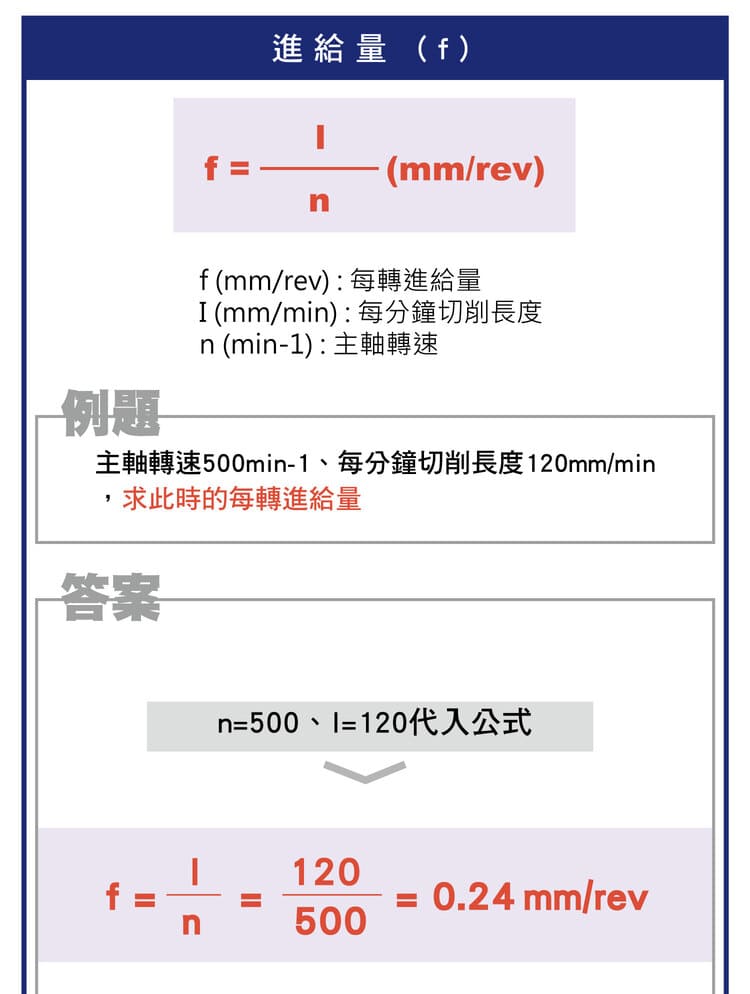
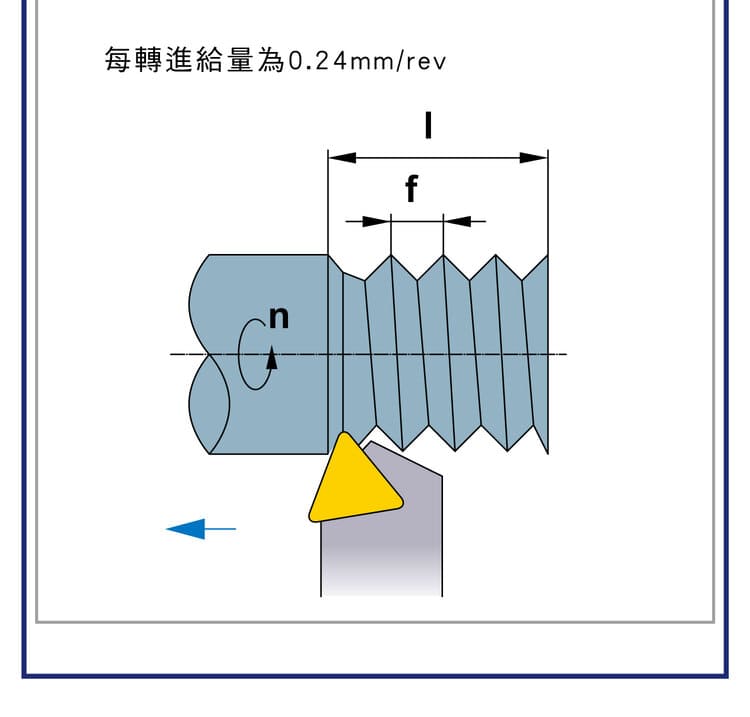
4. Cutting Speed (Vc) and Feed (f)
Cutting speed is the relative speed of tool and workpiece, set by diameter (Dm) and speed (n), used to set a sensible rpm and control tool life. Feed is the advance per revolution, affecting roughness and load: more feed raises efficiency but lowers surface quality.
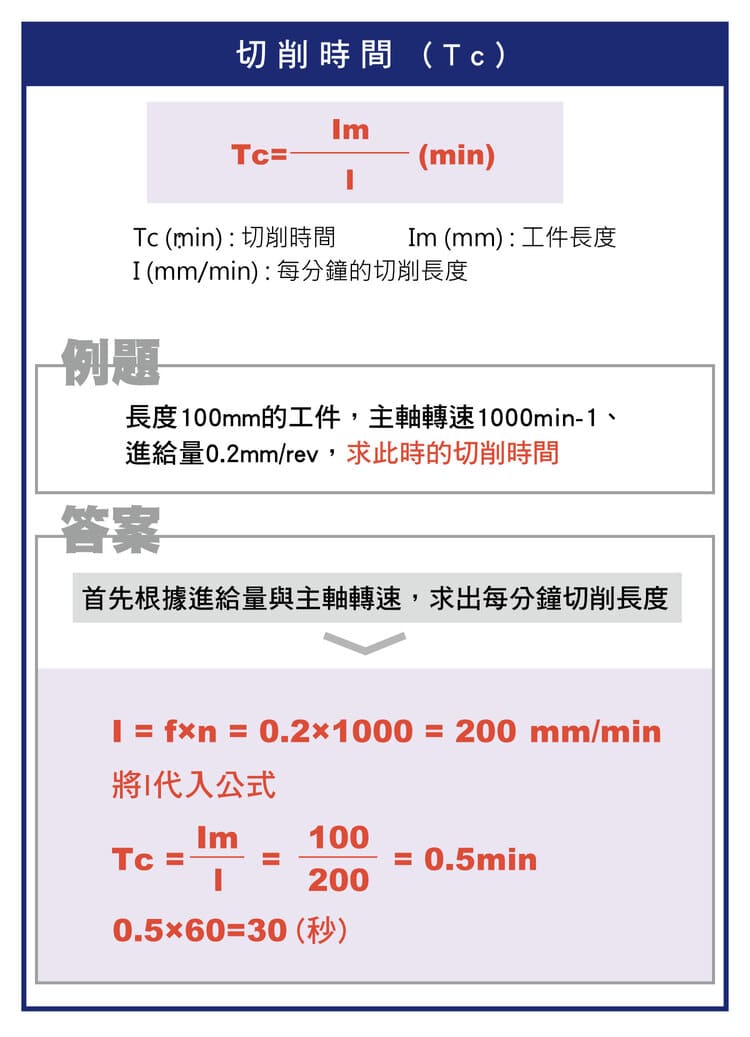
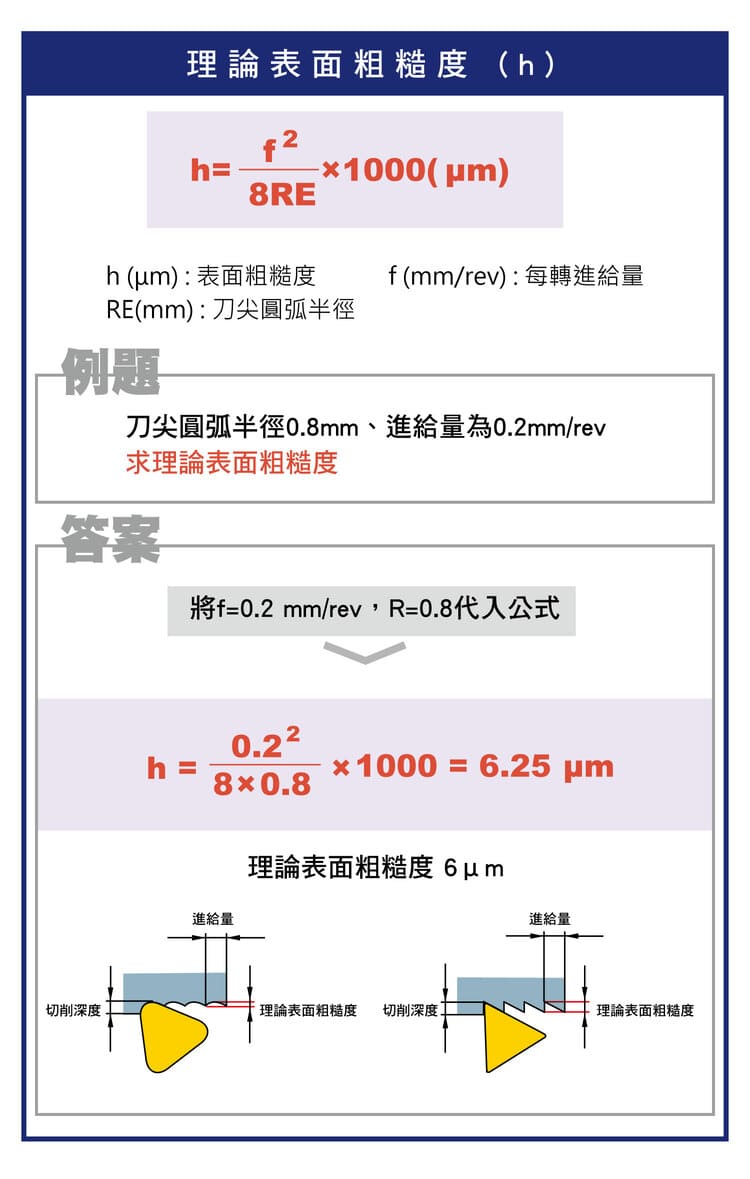
5. Machining Time (Tc) and Roughness (h)
Machining time is the time to finish a cut, set by length and feed rate, used for time estimation and scheduling. Theoretical roughness depends on feed (f) and nose radius (R): more feed → worse roughness, larger radius → better roughness.
6. Example and Parameter Adjustment
If machining time is too long, parameters are often too conservative — raise feed or depth moderately, while checking that power stays within the machine's capacity and roughness still meets the requirement. Power calculation shows whether the machine is overloaded.
7. Engineering Key Points
The key control parameters are cutting speed vc, feed f and depth ap; the optimisation goals are stable machining, longer tool life and higher productivity. For nose radius and angle effects see the Turning Tool Nose Radius Guide and Turning Tool Rake & Clearance Guide.
For the full reading guide on this topic, see Turning Toolpaths: The Complete Guide.
FAQ
Q: How to convert speed and rpm?
Use Vc = π·Dm·n/1000, or invert n = 1000·Vc/(π·Dm). Since turning diameter changes, a larger diameter has higher surface speed at the same rpm, so finishing small diameters often needs higher rpm to hold Vc.
Q: How to reduce surface roughness?
Theoretical roughness h≈f²/(8R), so smaller feed f or larger nose radius R improves it. Finishing uses small feed and larger R, but too large an R raises radial force and can cause chatter, so balance with rigidity.
Q: How to pick Kc?
Kc varies with material and chip thickness; the values here are typical references. For accurate power, use the tool maker's Kc data for that material and feed rather than a single value.
Q: Power exceeds the machine — now what?
Pc is proportional to ap, f and vc, so reduce depth or feed, or cut in passes. A sharper (positive-rake) insert also lowers cutting force, but keep edge strength and stability in mind.
For the full reading guides on this topic, see Surface Finish: A Complete Reading Guide and Machining Calculation Reading Guide.