Managing Cutting Fluid and Consumables: Mixing, Daily Checks and Protection
Buying the cutting fluid is only the start; what actually drives tool life and part quality is how it is managed afterwards. Get concentration, pH, bacteria and tramp oil wrong and no amount of money spent on the fluid will help. This article covers what to watch when mixing, which items to check daily, and health protection for anyone handling it.
1. Why Consumable Management Is a Blind Spot
There is a great deal of technical material about the cutting tool itself and very little about how the consumables are managed. Yet the situation on the floor is often this: the tool is right, the parameters are right, and quality is still unstable — because the fluid has degraded and nobody is watching it.
2. Mixing Water-Miscible Cutting Fluid
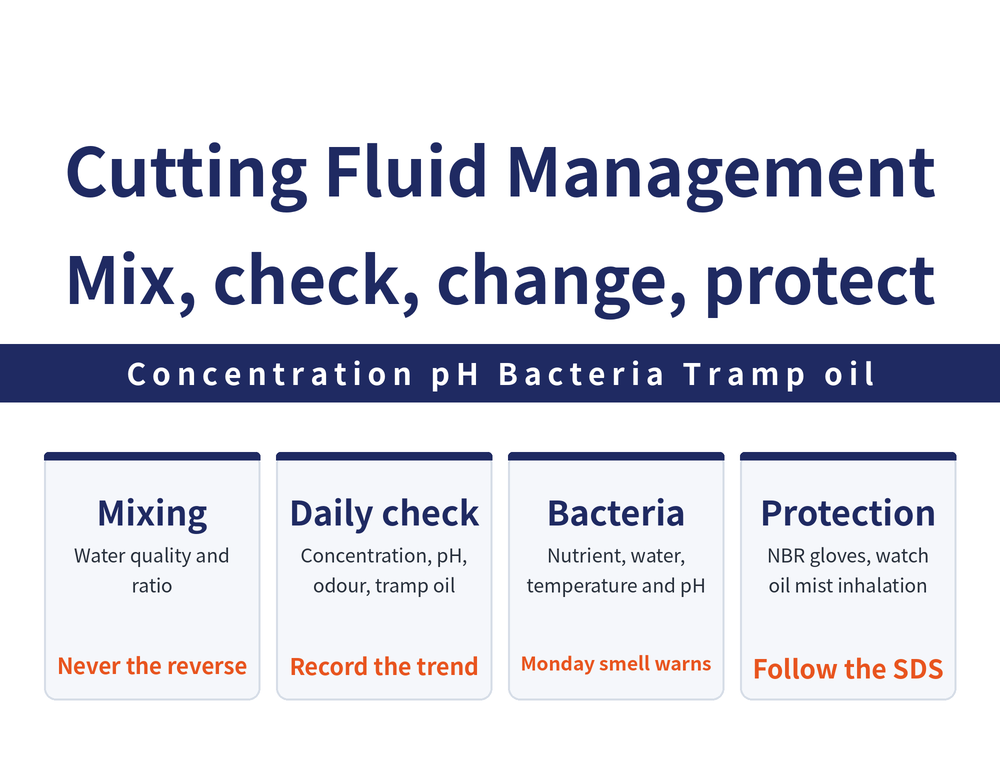
Two variables decide whether mixing succeeds: water quality and ratio.
Water quality is routinely underestimated. Water that is too hard destabilises the emulsion and produces soap scum; impurities in the water become a nutrient source for bacteria. Where it is practical, using treated water beats fixing the problem afterwards.
The ratio follows the maker's recommendation; products differ widely and figures cannot be transferred between them. The correct order when mixing is concentrate into water, never water into concentrate — reversing it affects how evenly the emulsion forms.
3. What to Check Daily
| Item | What it indicates |
|---|---|
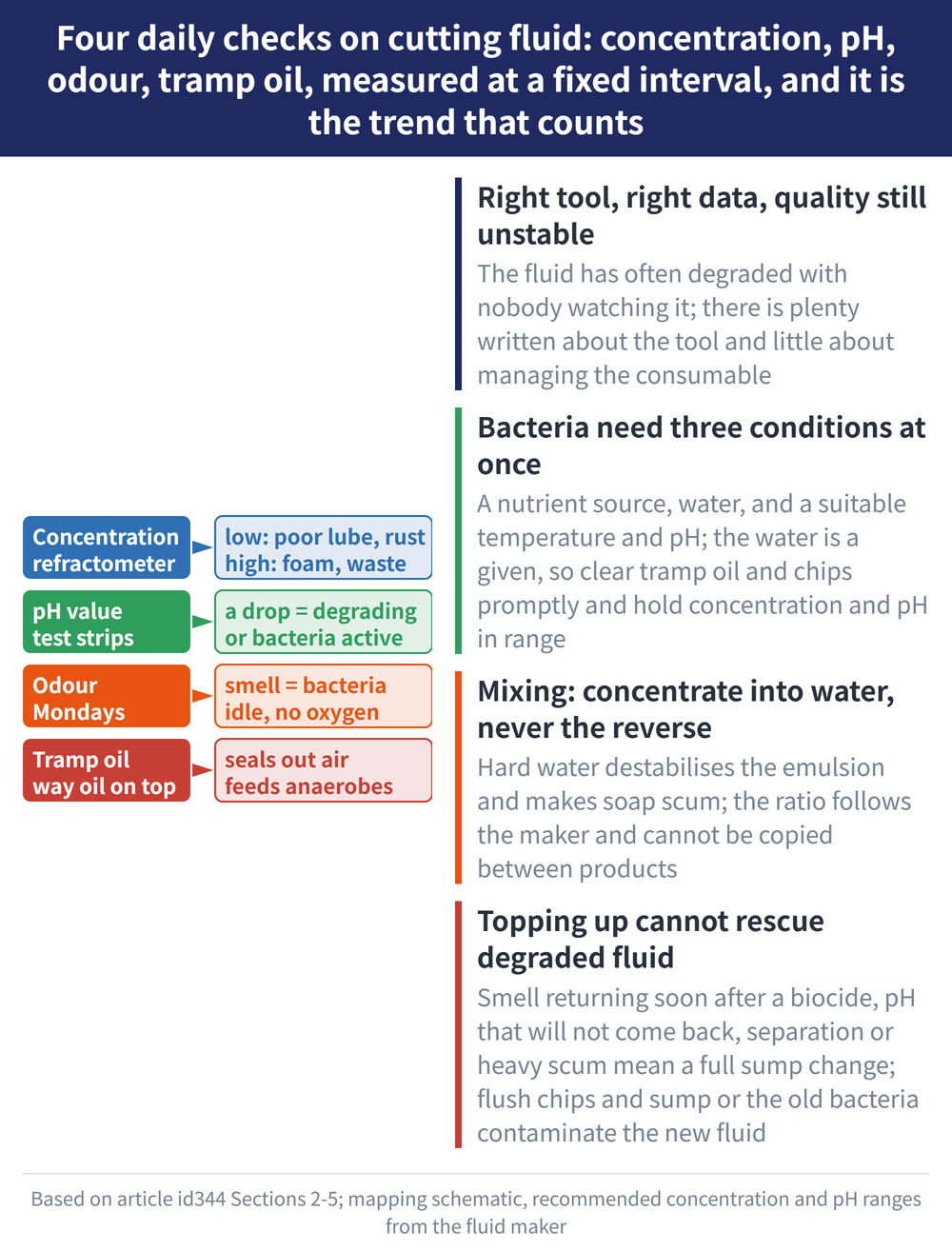
| Concentration | Too low means poor lubrication and rust protection; too high foams and wastes money |
| pH value | A clear drop usually means degradation or bacteria becoming active |
| Odour | A smell appearing is the most direct sign of bacterial growth |
| Tramp oil | Way oil on the surface seals out air and encourages anaerobic bacteria |
Concentration is easiest to read with a refractometer; pH needs only test strips. What matters is measuring at a fixed interval and keeping the records — as with accuracy checks, the trend matters more than any single reading.
4. Why Bacteria Grow
Heavy bacterial growth needs three conditions at once: a nutrient source, water, and a suitable temperature and pH.
The water is a given, so the two you can control are the others — clear tramp oil and chips promptly (removing the nutrient source), and hold concentration and pH in the recommended range (making the environment unsuitable).
A smell on Monday morning is the classic signal. Over the weekend the machine is off, the pump does not circulate, and the fluid stands still and short of oxygen — exactly the conditions anaerobic bacteria need. Seeing this means the fluid is already on the edge of degradation.
5. When to Change the Whole Sump
Topping up maintains concentration; it cannot rescue fluid that has already degraded. Change the whole sump when any of these appear: the smell returning shortly after a biocide addition, pH that will not come back into range, or visible separation and heavy soap scum.
When changing, flushing out the chips and the sump itself is the key step — bacteria surviving in old residue will contaminate the new fluid straight away, wasting the change.
On fluid types and selection see Choosing a Cutting Fluid. Waste fluid must not be discharged directly and should be handed to a licensed waste disposal contractor.
6. Health Protection
According to the safety data sheet (SDS) for CPC Kuokuang brand cutting oil, handling cutting fluid involves two categories of risk:
Skin — prolonged contact defats the skin and may cause dermatitis. Nitrile rubber (NBR) gloves are recommended, and oily gloves should not be used to wipe the face.
Oil mist — high-speed machining generates mist, and long-term inhalation is bad for the respiratory tract. The permissible concentration listed in that SDS is 5 mg/m³. In practice, improved local exhaust and better sealing of the machine enclosure are the most effective measures.
7. Frequently Asked Questions (FAQ)
Q: When mixing, do I add water to the concentrate?
The other way round. Add concentrate into water; reversing it affects how evenly the emulsion forms. The ratio follows the maker's recommendation and cannot be taken from another product.
Q: Why does the fluid smell on Monday morning?
Over the weekend the pump does not circulate, so the fluid stands still and short of oxygen — the conditions anaerobic bacteria need. It means the fluid is already on the edge of degradation.
Q: Does tramp oil need removing?
Yes. Way oil floating on the surface seals out air and encourages anaerobic bacteria, and it is also a nutrient source for them.
Q: What gloves should be worn when handling cutting fluid?
The CPC Kuokuang cutting oil SDS recommends nitrile rubber (NBR) gloves. Prolonged contact defats the skin and may cause dermatitis.
This article is part of CNC Machining Fundamentals: The Complete Guide - Know the Machine and Shop, Then Read the Drawing; that guide shows how the whole topic fits together.