
Reading a File: Section, Cut and Grade
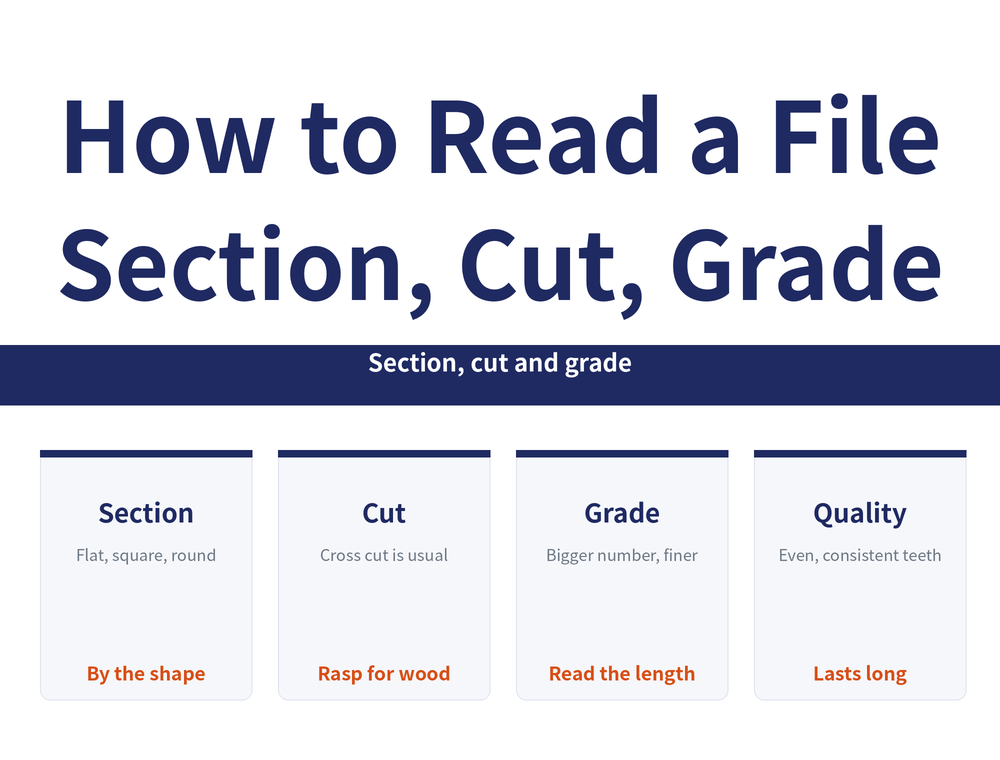
A file looks simple, but choosing well means three things: cross-section, cut and grade. The grade has a counter-intuitive twist: at the same Cut-1, a shorter file actually has finer teeth. This guide makes it clear so you do not buy on the label alone.
1. Section First (Match the Shape You Are Filing)
Files come in a set of standard sections per DIN 7261 (flat, square, round, triangular, half-round), chosen by the shape you are filing:
| Where you file | Section to pick |
|---|---|
| Flat surface | Flat file |
| Bore, radius | Round, half-round |
| Slot, internal corner | Square, triangular |
2. Cut: Single, Cross and Rasp
| Cut | What it is | Used for |
|---|---|---|
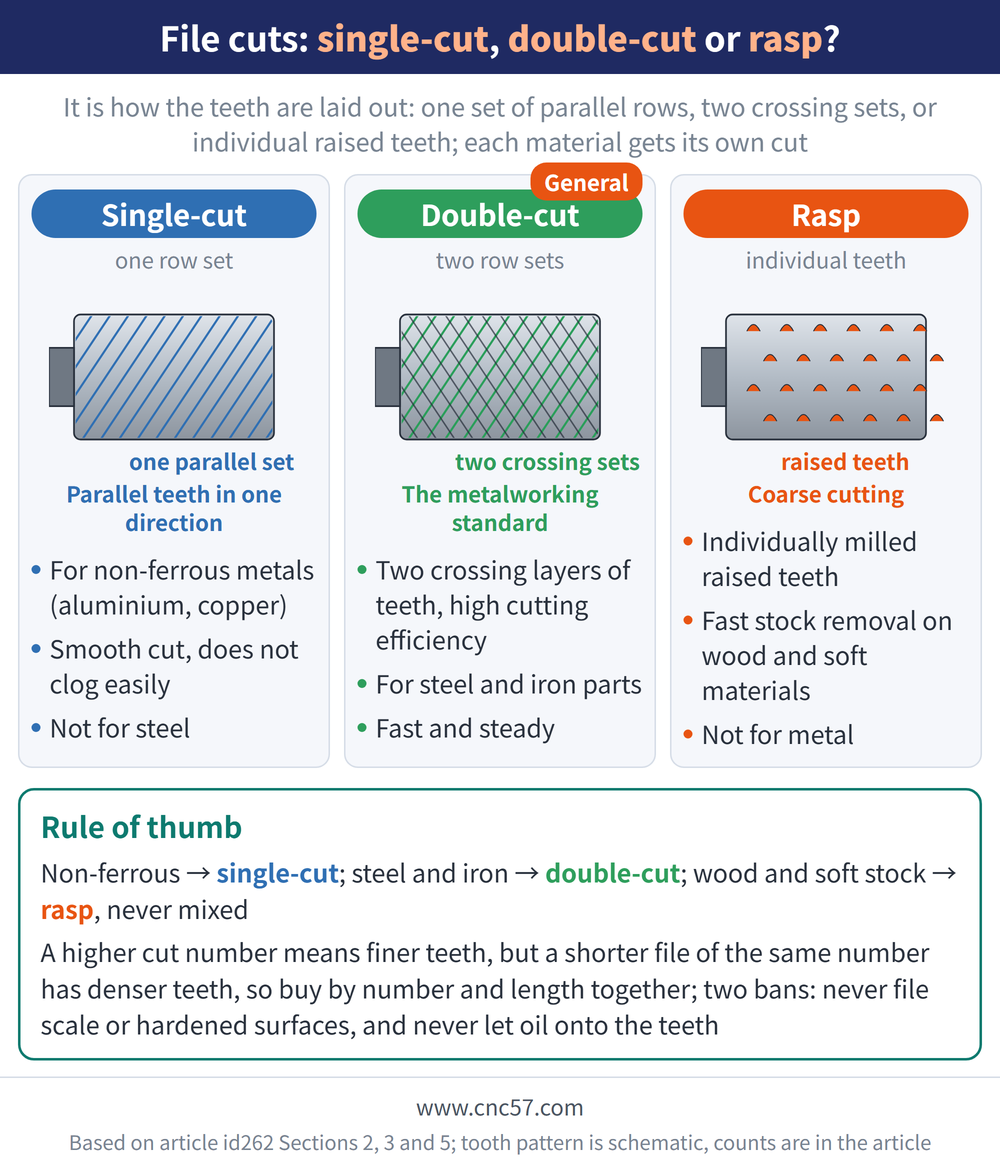
| Single cut | Parallel teeth in one direction | Less common |
| Cross cut | Two crossing layers of teeth, cuts efficiently | The usual general cut for metalwork |
| Rasp cut | Individually milled separate teeth, coarse | Fast removal on wood and soft material |
Metalwork mostly uses the cross cut (two crossing layers cut fast and steady); the rasp is too coarse and stays for wood and soft material.
3. Grade: Bigger Number, Finer Teeth — But Read the Length
The cut number means the bigger the number, the finer the teeth, counted as teeth per centimetre. But note the twist: at the same Cut-1, a shorter file has finer teeth:
| File length | Grade | Teeth / cm |
|---|---|---|
| 250 mm | Cut-1 | 9 / cm |
| 100 mm | Cut-1 | 17 / cm |
Why? The grade describes the feel of coarseness, not an absolute tooth count. A short file has a short stroke, and teeth as sparse as a long file would cut discontinuously and feel unsteady, so it needs denser teeth for the same feel. Do not buy on Cut-1/Cut-2 alone; read it together with the length.
4. Telling a Good File
A good file shows three things: even hardness, consistent teeth from tang to tip, and precise tooth geometry. A good file keeps a high removal rate and a good surface even after long use, which is how you judge whether the pricier one is worth it. For matching the filed surface grade to the drawing, see the Ra and Rz guide.
5. Using the File: Four Rules and a Selection Chart
The sections above cover how to read the file itself. This one covers how to use it once you have it. Two of the four rules are prohibitions, and breaking either one writes off the file:
| Rule | Detail |
|---|---|
| Match the cut to the material | Single cut for non-ferrous, cross cut for steel and iron, and never mix them |
| Match the grade to allowance and accuracy | See the chart below |
| Never file scale or hardened faces | An ordinary file must not be used on stock carrying mill scale, or on a hardened surface |
| Keep the file free of oil | Oil on the teeth makes the file skate instead of cut; clean it with kerosene or a degreaser before reuse |
For matching grade to allowance, use this chart. Read all three columns together — choose a coarse file on allowance alone and the accuracy column may put it out of reach:
| File | Allowance mm | Size accuracy mm | Roughness Ra μm |
|---|---|---|---|
| Coarse | 0.5~2 | 0.2~0.5 | 100~25 |
| Medium | 0.2~0.5 | 0.05~0.2 | 12.5~6.3 |
| Fine | 0.05~0.2 | 0.01~0.05 | 6.3~3.2 |
The chart is compiled from the bench-work practice rules in the mainland Chinese industry standard series JB/T 9168.13. No corresponding mandatory standard is in force in Taiwan, and the values are the reference ranges given there, not a universal specification. That source calls the cuts "single-cut" and "double-cut", which are the same thing as the single and cross cut named earlier in this article.
6. Frequently Asked Questions (FAQ)
Q: How do I choose the cut?
Metalwork uses the cross cut (two crossing layers, fast and steady); wood and soft material use the rasp (separate teeth, fast but coarse).
Q: What are Cut-1 and Cut-2 — bigger means coarser?
The opposite: bigger number, finer teeth. And at the same Cut-1 a short file is denser (100 mm has 17 teeth/cm, 250 mm only 9), so read it with the length.
Q: How do I pick the section?
By the shape you are filing: flat file for a face, round or half-round for bores and radii, square or triangular for slots and corners (per DIN 7261).
Q: How do I judge file quality?
Even hardness, consistent teeth from tang to tip, precise geometry; a good file keeps a high removal rate and good surface after long use.
This article is part of Tool Regrinding: The Complete Guide — Decide Whether to Grind, Then Look Up How, With What, and How to Check; that guide shows how the whole topic fits together.
This article is part of Deburring and Surface Finishing: The Complete Guide - Which Tool, Which Material, and What to Do in Volume; that guide shows how the whole topic fits together.
Published: 2026-08-11 | Last updated: 2026-08-11