
Regrinding Gear Tools: Three Routes to a Hob's Rake Face and the Cylindrical-Grinder Method for Shaper Cutters
Gear hobs and shaper cutters are reground on the rake face only, and the difficulty is that on a hob that face is a helical surface. What do you do without a hob grinder? There are three routes — a master cam, a two-cone wheel profile, and a copying attachment — each with its own scope and price. Shaper cutters can simply go on a cylindrical grinder. This guide covers the principle behind each route, the threshold that triggers wheel reprofiling, and the one recorded set of before-and-after numbers.
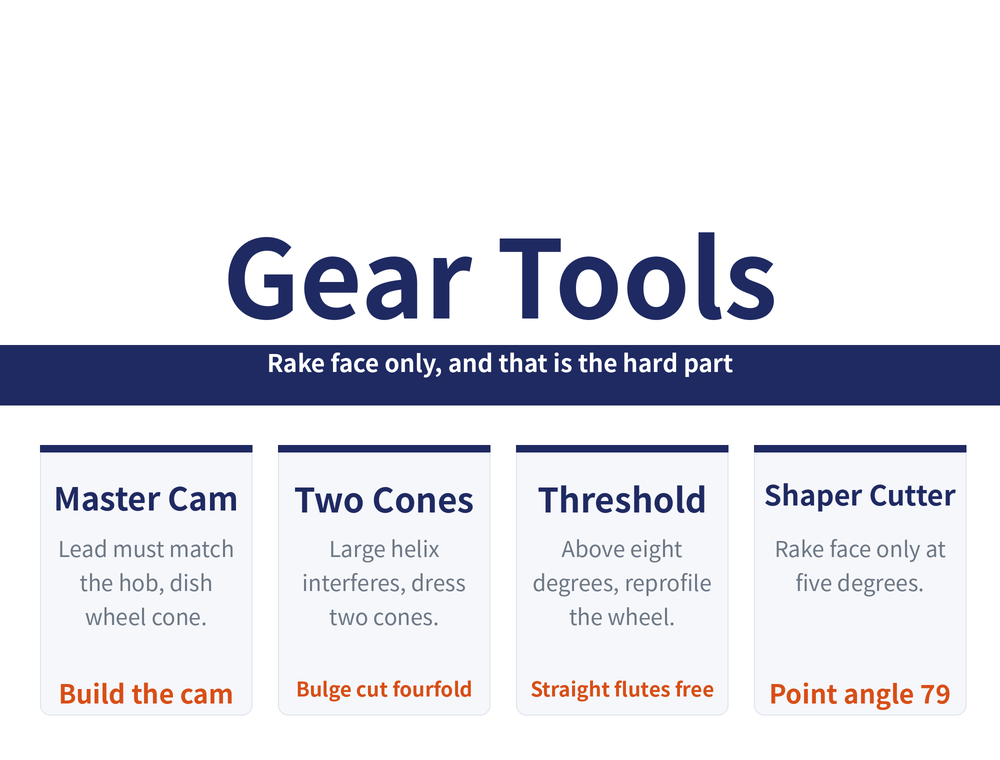
1. Rake face only — and that is exactly the problem
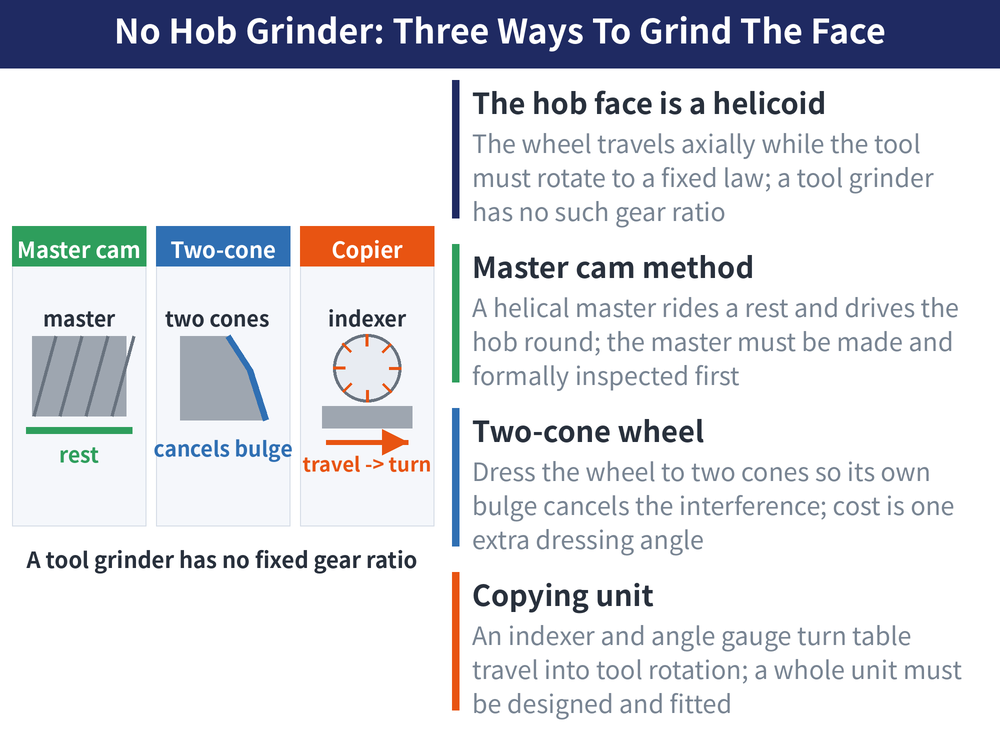
Both gear hobs and shaper cutters are reground on the rake face alone; the flank and the tooth form were relieved at manufacture and must not be touched. But a hob's rake face is a helical surface: the wheel travels along the tool axis while the tool rotates to a fixed law, and only the two motions together make that surface. An ordinary tool grinder has no strict ratio between table travel and tool rotation, so it cannot generate a true helical surface. All three routes exist to supply that missing link.
2. The three routes and what each costs
| Route | How it works | What it costs |
|---|---|---|
| Master cam | A helical cylinder rides the rest and turns the hob | Make the cam, then have it inspected |
| Two-cone wheel | Dress the wheel to two cones; its bulge cancels the interference bulge | Next to nothing — one extra dressing angle |
| Copying attachment | Indexer plus angle guide converts table travel into rotation | A whole unit to design and fit |
The master cam must match the hob in lead and hand — the diameter may differ — and must be longer than the working length so its face still bears on the rest as the wheel withdraws. Material 45 steel, heat treated to 260–290HB. It suits ordinary gear hobs, spline hobs, sprocket hobs and pointed-tooth hobs, and it is the answer for a shop with no hob grinder and for sizes no dedicated fixture will take: large helix angles, shank-type worm hobs, small-diameter hobs. On accuracy the only claim is "to drawing", with no figure.
3. Above 8° of helix, the wheel profile must be crowned
Grinding a straight-flute hob, a straight-line cone on the wheel gives a flat rake face. Grinding a helical-flute hob with that same straight profile leaves the face convex, and the larger the helix angle the worse the convexity. The threshold: above a helix angle of 8°, the wheel's working profile must be reprofiled — crowned slightly, dressing by hand against measurements of the rake face's straightness until the ground face comes out straight enough.
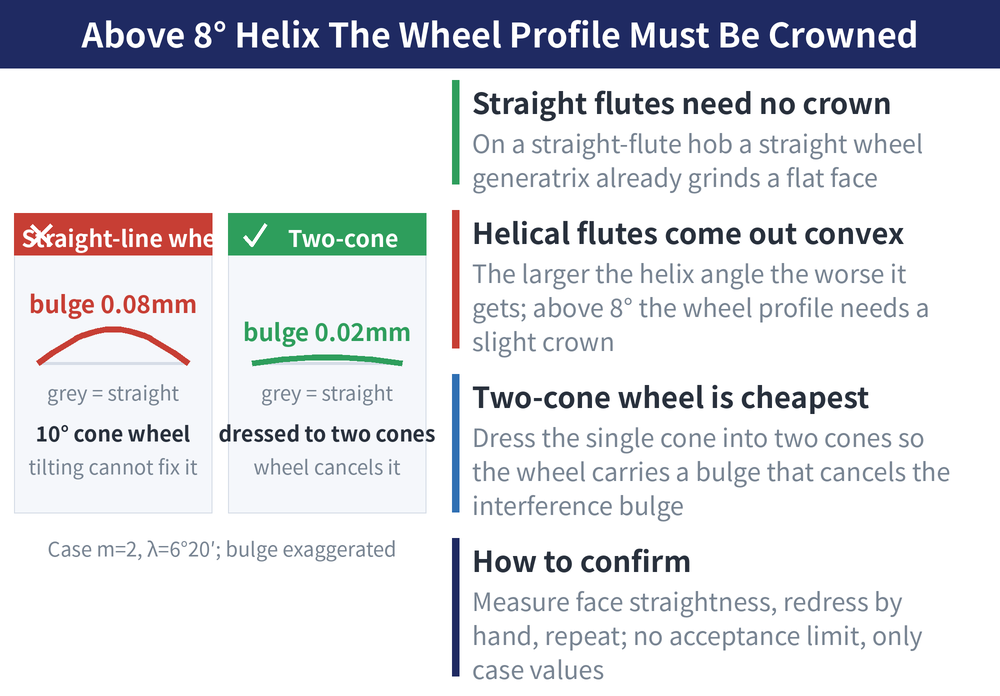
The two-cone wheel is that idea made concrete: dress the single cone into two, so the wheel carries a bulge of its own to cancel the bulge interference creates; adjusting the dressing angle changes the size of the bulge and where it contacts. The one quantified comparison: grinding a worm hob of m=2mm with a 6°20′ lead angle, a 10° cone wheel left about 0.08mm of convexity no matter how the head was swung; the two-cone profile brought it down to 0.02mm.
4. Hob grinding accuracy: where to look for each error
One shop's before-and-after figures are on record. All four fixes are clean it, then adjust it — not buy a new machine:
| Error | Before → standard → after | Where to look |
|---|---|---|
| Cumulative flute pitch | 95 → 40 → 25–35μm | Grease on index plate and spindle; vee slideway fit |
| Rake face off-radial | 210 → 32 → 10–30μm | Dressing gear; the ground face must pass through the axis |
| Face-to-bore parallelism | 270 → 40 → 20–35μm | Clean centres, set the straightedge to lead, test bar within 20μm |
| Surface finish | Ra3.2 → Ra0.8μm | F70/K dish wheel; cut strokes and feed for finishing |
That last row is worth copying down: roughing at 25–30 strokes a minute to avoid burning, finishing dropped to 15–20 strokes with circumferential feed at 0.01–0.02mm, then one or two spark-out cycles. These are single-source measured values; prove them on your own machine.
5. Shaper cutters: a cylindrical grinder will do
A shaper cutter is also ground on the rake face only, at a 5° rake. The method works on a stationary cylindrical grinder: swing the workhead to α=5°, grip the bore in the outside jaws of an 80mm self-centring chuck with the cutter's back face flat against the jaw datum, swing the wheelhead clockwise until the wheel's left edge sits on the rake face, take a trial pass and measure — if the rake reads 5°, the setup is right.
| Point | What to do |
|---|---|
| No coolant | Coolant dulls the wheel fast; so keep passes short to avoid burning |
| Speed and feed | Slow work rotation, slow table traverse, intermittent feed judged on the spark |
| Wheel edge | Dress with a diamond when it darkens and widens past 1.5mm |
| Acceptance | Point angle by universal bevel protractor should read 79° |
Shaper cutters also tend to creep axially while grinding, so keep correcting for it. The wheel is recorded as "grit F60 F80, hardness K, dish-type white aluminium oxide wheel"; a character appears to be missing between the two grit numbers, so nothing is filled in. For wheel diameter, see Which Wheel Grinds Which Tool.
6. Frequently Asked Questions (FAQ)
Q: No hob grinder — which route first?
Start from the helix angle. Straight flutes and modest helix angles grind straight on an ordinary tool grinder with the cone face of a dish wheel, no extra kit. Only above 8° does interference need handling, and there the two-cone wheel is the cheapest fix — one more dressing angle. A master cam pays off only when you grind many hobs of one size; the copying attachment is the heavy investment, for steady long-term output.
Q: How do I confirm the face came out convex?
The method measures the straightness of the ground face and then hand-dresses the wheel profile against that measurement, repeating until the face is straight enough — working back from the result rather than calculating an angle up front. No acceptance limit for convexity is given; the only figures are the case where 0.08mm failed and 0.02mm passed, which is a reference point, not a specification.
Q: What changes with a carbide hob?
Rake is set in three bands by purpose: 0° for high-speed cutting of soft flanks up to 45HRC, -12° for skiving 40–58HRC, and -20° to -30° for skiving 55–63HRC. Mounting is tight too: arbor runout within 5μm, and within 6μm across both hubs once clamped. The wheel is diamond, grit 240, resin bond, 75% concentration.
Q: Can hobs be ground wet?
Ordinary tool grinders mostly run dry, because the coolant sprays everywhere and the operator has to index by hand. But carbide conducts heat poorly, so dry grinding is slow and invites cracks and chipping. For small-module carbide hobs one recorded case fits an acrylic enclosure with a small pump for coolant, which more than doubles output.
This article is part of Tool Regrinding: The Complete Guide — Decide Whether to Grind, Then Look Up How, With What, and How to Check; that guide shows how the whole topic fits together.
Published: 2026-08-18|Last updated: 2026-08-18