Choosing the Plunge: Helical, Ramp, Arc — and Whether You Need a Centre-Cutting End Mill
Where and how the cutter enters the material decides whether the tool gets hurt — and which end mill you should buy. This guide covers how to pick the plunge by part shape, and a question often asked wrong: do you actually need a centre-cutting end mill?
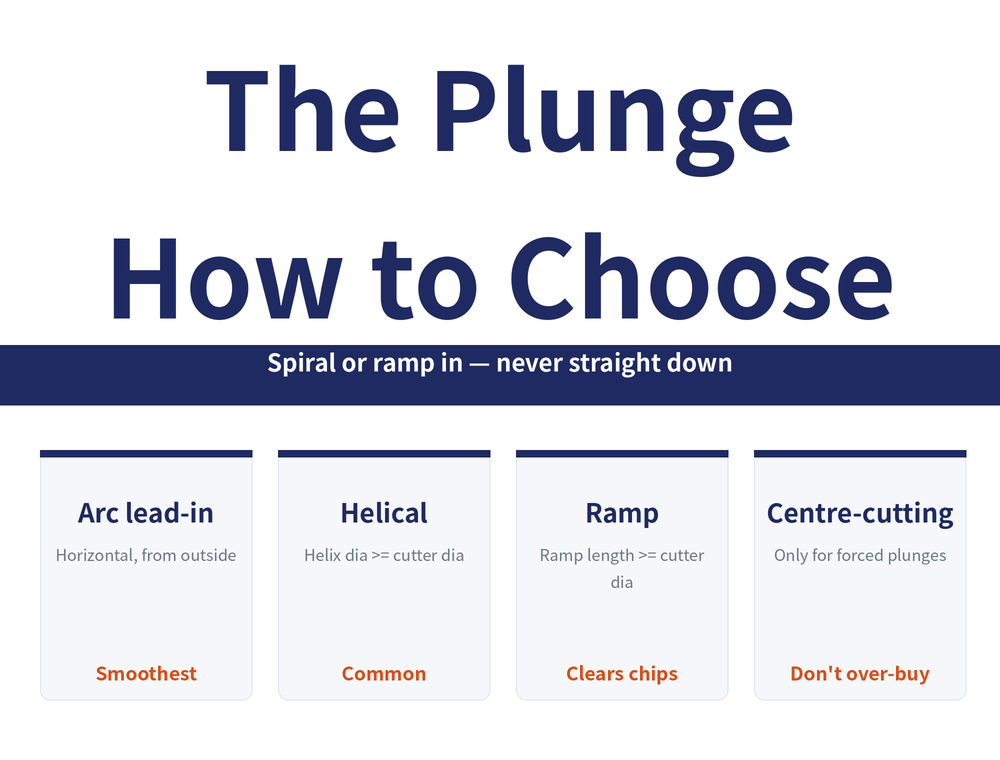 = cutter dia; Common); Ramp (Ramp length >= cutter dia; Clears chips); Centre-cutting (Only for forced plunges; Don't over-buy)">
1. Remember This First: Don't Plunge Straight Down
The single most important rule for plunging: avoid driving the cutter straight down into the blank along its axis. The reason is to protect the whole tool system — not just the cutter, but the holder and spindle too. Plunging straight down asks the very centre of the tip, where speed is zero, to cut — the worst possible loading, and the fastest way to break an edge. The proper way is to enter from the side at an angle or in a curve (helical, ramp, arc), using the side edge rather than the tip. This one rule is the starting point for everything below.
2. Pick the Plunge by Part Shape
| Part shape | Suggested plunge |
|---|---|
| A boss, or an open-mouthed pocket | Enter from outside the part, e.g. with a horizontal arc |
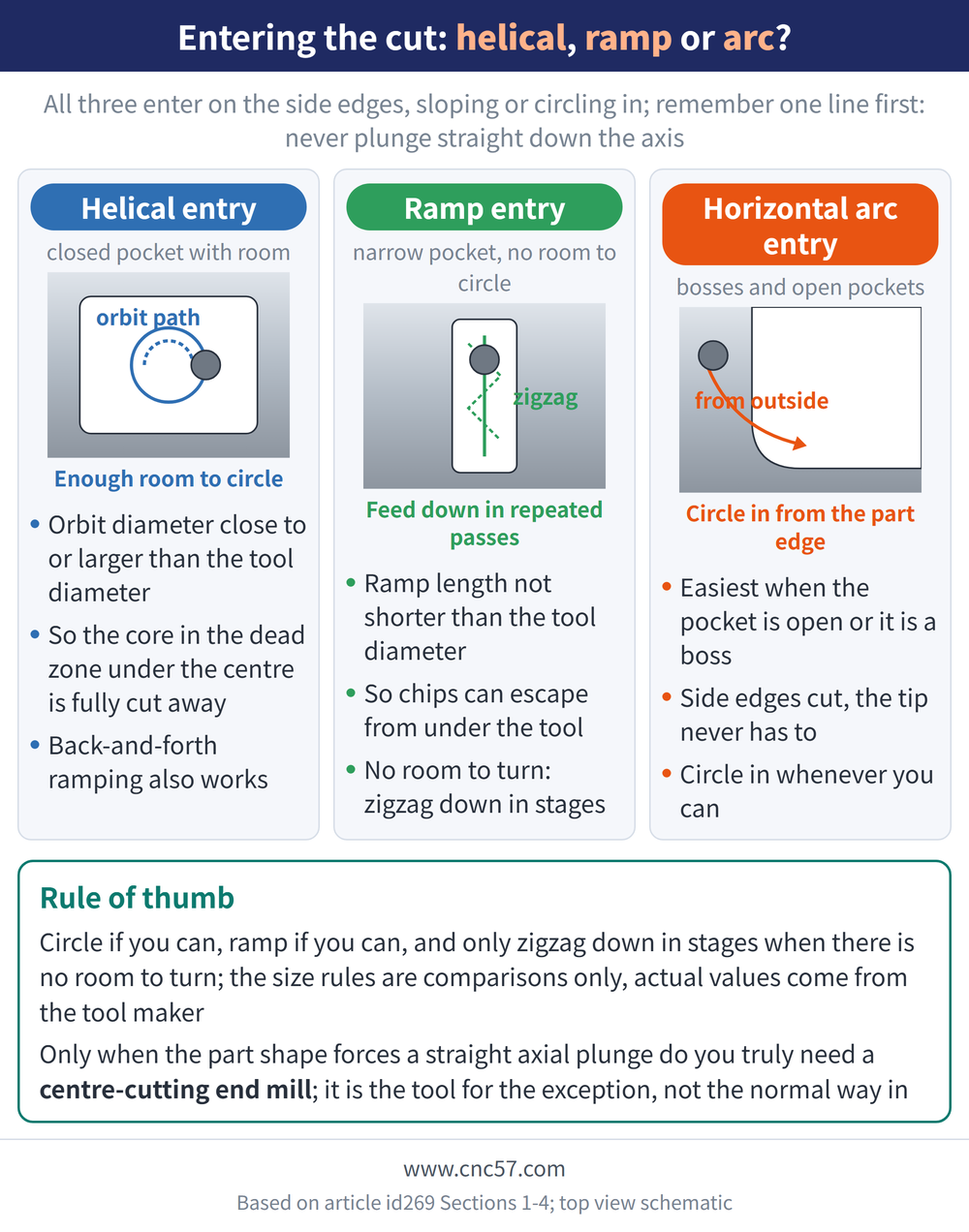
| A closed pocket with room to turn | Helical entry, or a back-and-forth ramp |
| A long, narrow closed pocket with no room to turn | Ramp down, or a zig-zag of repeated ramps, stepping down to depth |
The idea: spiral in if you can, ramp in if you can't — only zig-zag down in stages when the tool truly can't turn. For how the overall path is routed after plunging, see the roughing toolpath strategy.
3. Two Sizing Rules for the Plunge
How big should the plunge path be? The source gives relationships (not fixed numbers — the real figures depend on the tool):
| Plunge | Sizing rule | Why |
|---|---|---|
| Helical | Helix diameter should be near or larger than the cutter diameter | So the uncut core under the tool's central blind zone is fully removed |
| Ramp | Ramp length should be no less than the cutter diameter | So chips clear out from under the tool |
⚠ These are relationships only ("no less than", "near or larger"), not percentages or multiples. Use the maker's data for real values — don't invent a number.
4. So Do You Need a Centre-Cutting End Mill?
This is the question asked most often at the counter, and bought wrong most often. Put the above together and it's clear: a normal plunge (helical, ramp, arc) uses the side edge and doesn't need the tip to cut past centre. So —
Only when the part shape forces a straight axial plunge (say a narrow, deep closed pocket with no room to turn, no ramp length, and no way to pre-drill a start hole) do you truly need a centre-cutting end mill. Put another way, a centre-cutting mill is a tool for the exception, not the normal choice for plunging. When a customer asks whether to buy centre-cutting, first ask whether they really must plunge straight down — usually the answer is no.
5. Frequently Asked Questions (FAQ)
Q: Why can't I just plunge the cutter straight down?
To protect the whole tool system (cutter, holder, spindle). In an axial plunge the very tip centre has zero speed yet must cut — the worst loading and the fastest way to chip an edge. Enter on the side edge with a helical, ramp or arc move instead.
Q: How should I plunge into a closed pocket?
With room to turn, use a helical entry or a back-and-forth ramp; for a narrow, deep pocket where the tool can't turn, ramp down or zig-zag in stages to depth.
Q: How big should a helical or ramp plunge be?
The helix diameter should be near or larger than the cutter diameter so the central core is fully cut; a ramp should be no less than the cutter diameter so chips clear. These are relationships — use the maker's data for actual values.
Q: Do I really need a centre-cutting end mill?
Usually no. A normal plunge uses the side edge. You only need centre-cutting when the part forces a straight axial plunge (narrow and deep, no room to helix or ramp, and no pre-drilled start hole) — it's a tool for the exception.
This article is part of Milling Toolpaths: The Complete Guide - Roughing Strategy, Where to Plunge, and Choosing a Finishing Pattern; that guide shows how the whole topic fits together.
Published: 2026-08-12 | Last updated: 2026-08-12