
High-Speed Roughing Toolpaths: Layers, Climb vs Conventional, Trochoidal, Re-roughing
With the cutter chosen, next is how to route the path. High-speed roughing wants a steady cutting load from start to finish. This guide covers layer cutting, climb vs conventional, loop passes, trochoidal, and re-roughing — and when to use each.
1. The Big Rule: Keep the Load Steady
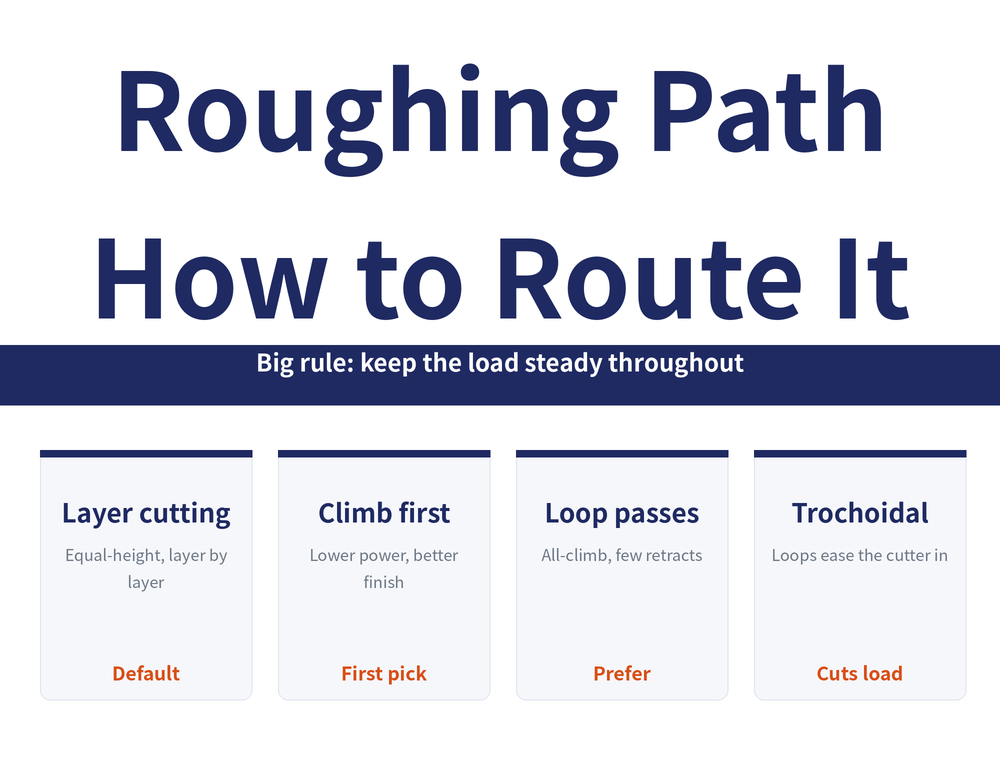
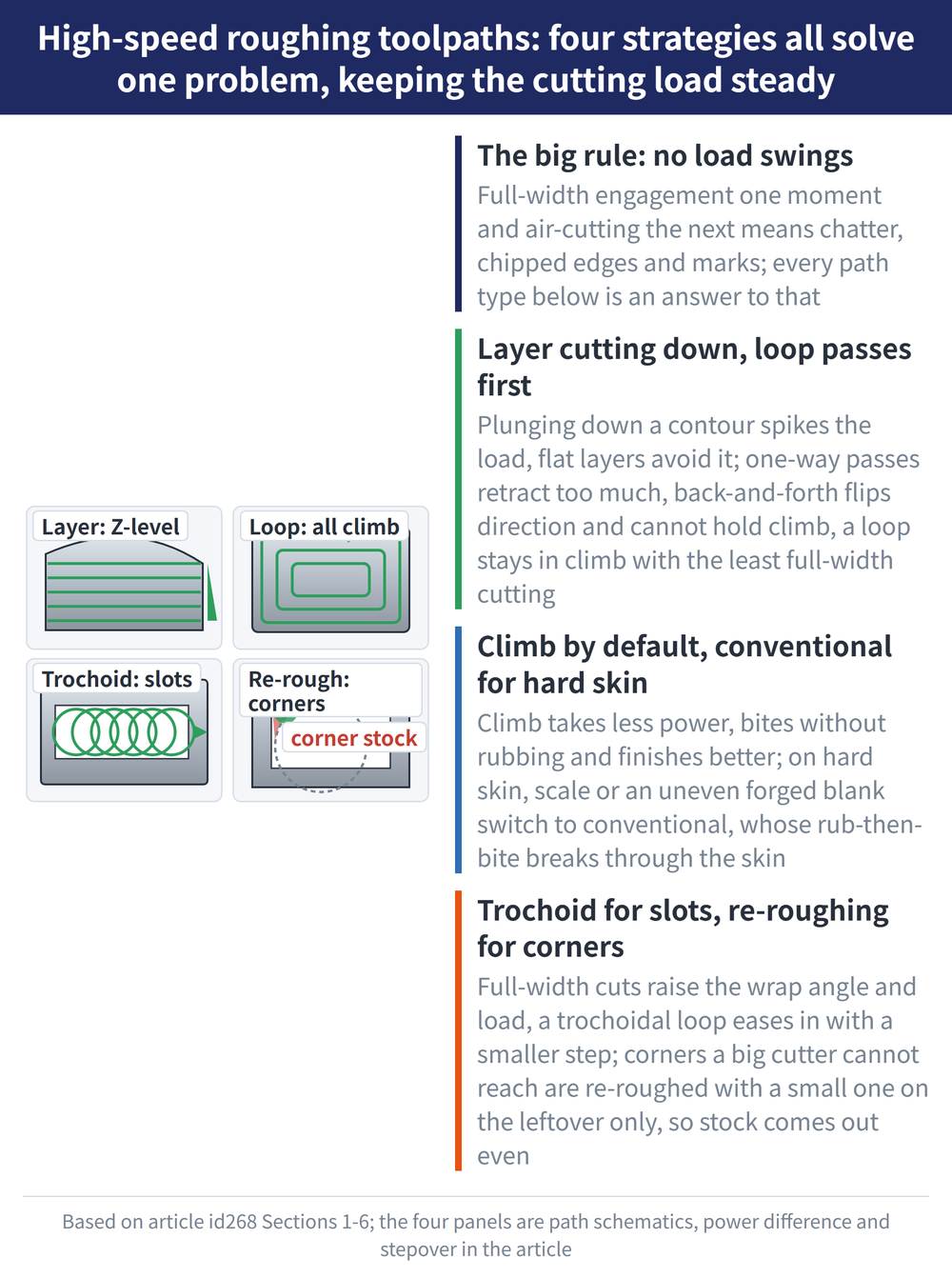
The enemy in high-speed roughing is a load that jumps around — full-width engagement one moment, air-cutting the next. Sudden load swings cause chatter, chipped edges and marks on the surface. Every path type below is one answer to the same question: how to keep the cutting load steady from start to finish. Hold that rule and the choices become easy.
2. Layer Cutting: Equal-Height, Layer by Layer
Layer cutting (equal-height roughing) is the default in CAM: cut horizontally, one level at a time, working down. On curved parts this holds a steady load — plunging straight down a contour causes load spikes, and stepping down in flat layers avoids them. Pick it as the roughing default.
3. Climb or Conventional: Usually Climb
Climb milling has the cutter rotation and feed in the same direction; conventional is opposite. High-speed roughing usually uses climb:
| Climb | Conventional | |
|---|---|---|
| Power | 5–15% lower than conventional, same conditions | Higher |
| Entry | Chip is thickest at first contact, no rubbing | Tooth rubs a moment before it bites — friction heat, work-hardening |
| Surface | Good chip flow, better finish, steadier size | Worse |
Exception: when the surface has hard skin, scale or an uneven face (e.g. a forged blank), switch to conventional — its "rub then bite" behaviour is better at breaking through uneven hard skin first.
4. Pass Pattern: Prefer Loop (Spiral) Passes
Three options — one-way, back-and-forth, and loop (spiral):
| Pattern | Problem / benefit |
|---|---|
| One-way | Lifts and returns to start each pass — lots of retracts |
| Back-and-forth | Direction flips at each turn and can't stay in climb the whole time — not advised |
| Loop / spiral | Stays in climb throughout and keeps full-width engagement to a minimum — first pick |
5. Trochoidal: For Slots and Full-Width Cuts
In a narrow slot, or right at entry, the cutter engages full width (its whole diameter is in the material). The wrap angle grows, the cut width rises and the tool load spikes — hard on the tool and hard to feed. Switch to trochoidal: the cutter follows a looping path that eases in, so the effective step shrinks and the wrap angle and load drop. Wherever you hit a narrow slot or a full-width cut, go trochoidal.
6. Re-roughing: Clean the Corners the Big Cutter Missed
A large cutter is efficient but can't reach small corners, so it leaves uneven stock there. Re-roughing means: rough with the big cutter, then treat the leftover as the new blank and run a second, small-cutter path that only cleans the corner stock — no need to re-run the whole job with a small tool. Stock is left more even across all faces, so finishing starts clean. Keep the cut continuous with few retracts to reduce impact. This is also why "big cutter to rough, small cutter for corners" needs a full set of diameters on hand. For how to even up the corners and shallow faces after roughing, see semi-finishing and corner clearing.
7. Frequently Asked Questions (FAQ)
Q: Climb or conventional for high-speed roughing?
Usually climb: 5–15% less power than conventional, better chip flow, better finish and steadier size. The exception is hard skin, scale or an uneven forged surface — use conventional to break through the hard skin first.
Q: Why prefer loop (spiral) passes?
A loop pass stays in climb the whole time and keeps full-width engagement to a minimum. One-way passes retract too much; back-and-forth flips direction and can't hold climb — so both lose to the loop.
Q: When should I use a trochoidal path?
In narrow slots, or at entry where the cut goes full-width (the whole diameter engages). The wrap angle and tool load spike there; a trochoidal loop eases the cutter in and brings the load back down.
Q: What is re-roughing for?
A large cutter can't reach small corners and leaves uneven stock there. Re-roughing uses the leftover as the new blank and runs a small cutter to clean just the corners, so stock is even everywhere and finishing starts clean.
This article is part of Milling Toolpaths: The Complete Guide - Roughing Strategy, Where to Plunge, and Choosing a Finishing Pattern; that guide shows how the whole topic fits together.
Published: 2026-08-12 | Last updated: 2026-08-12