Semi-Finishing and Corner Clearing: Cleaning Up After the Big Cutter Roughs
After roughing, corners and shallow faces are left with uneven stock; finishing straight onto that swings the load and hurts the tool and surface. This guide covers evening up the stock before finishing — rest machining, pencil passes, and why you keep a set of cutters from large to small.
1. Why You Can't Finish Straight After Roughing
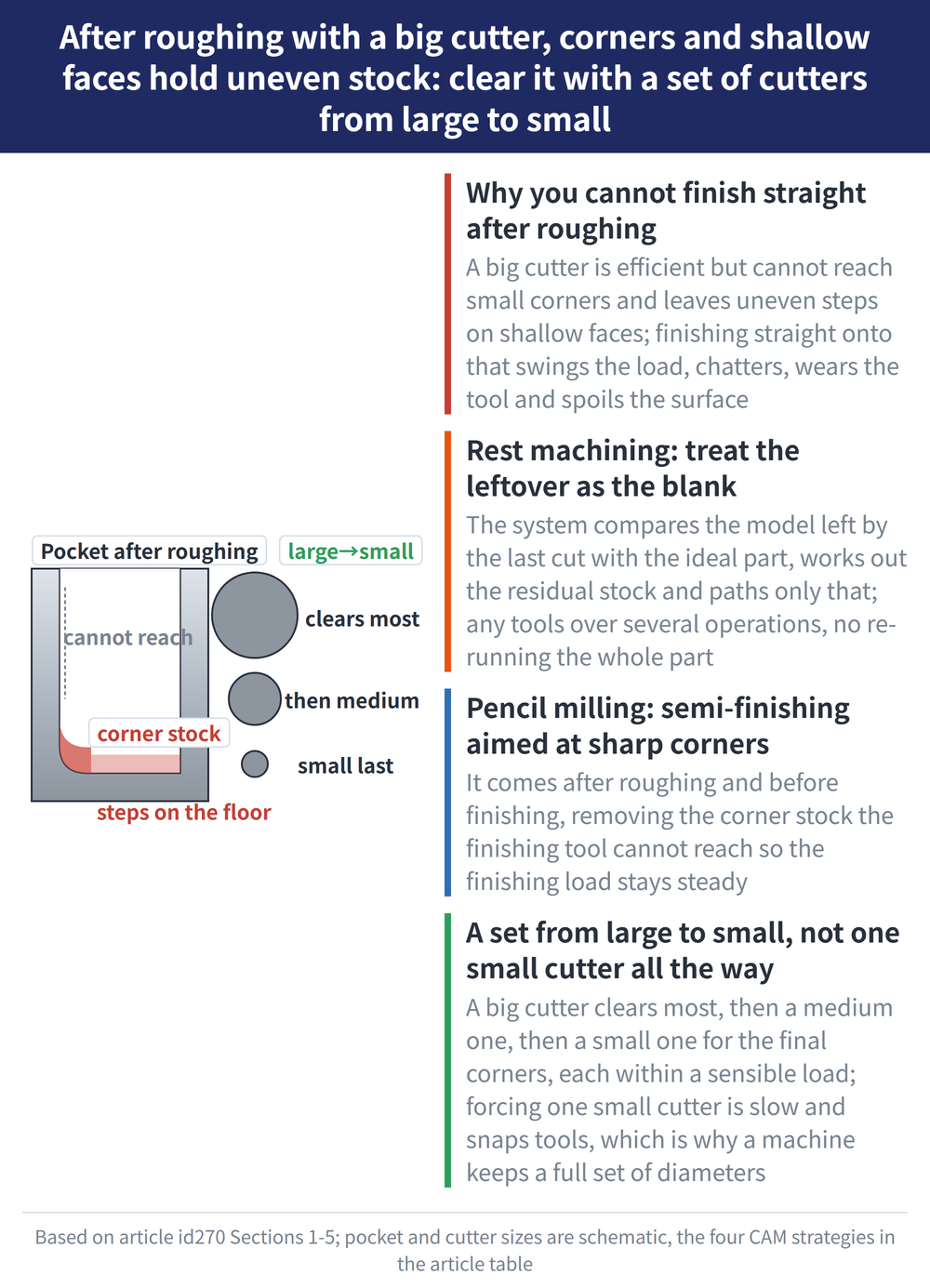
Roughing uses a big cutter — efficient, but it can't reach small corners and it leaves uneven step stock on shallow faces. Finish straight onto that and the tool takes a big bite then a small one; the load swings, causing chatter, shorter tool life and a poor surface. So there's a middle step — semi-finishing — that clears the extra, uneven stock in the corners and on shallow faces first, so the finishing tool sees a steady load from start to finish. (For the roughing toolpaths themselves, see the roughing toolpath strategy.)
2. Rest Machining: Treat the Leftover as the Blank
The core idea: each pass builds on the previous one's result. The system compares the actual model left by the last cut against the ideal finished model, works out the "residual stock" not yet removed, and generates a path for just that stock — this is rest machining. Because it targets only the leftover, this stage can use any tools across several operations until all stock above the set amount is gone. The benefit: no re-running the whole part, just topping up where needed.
3. Pencil Milling: Semi-Finishing Aimed at Sharp Corners
Pencil milling acts like traditional corner clearing, but the timing differs: traditional corner clearing usually comes after finishing, while pencil milling is a semi-finishing step after roughing. Its job is to remove the excess stock in sharp corners that the finishing tool can't reach, paving the way for finishing. If the part has internal corners and grooves, do the pencil pass before finishing so the finishing load stays steady.
(There's also "stock machining", similar to pencil milling — the difference is that pencil milling targets only sharp corners, while stock machining clears the excess across all surfaces before finishing.)
4. Key Idea: A Set From Large to Small — Not One Small Cutter All the Way
Corner clearing and rest machining follow an important rule: use several cutters, working from large to small in stages, shrinking the leftover step by step until you reach the required size — don't clean it all with one small cutter. A big cutter clears most of it, then a medium one, then a small one for the final corners. Each tool then works within a sensible load, and it's efficient. Forcing one small cutter to do it all is slow and snaps tools. This is why a machine keeps a full set of diameters on hand — the customer needs not one cutter but a set.
5. Four Common Corner-Clearing Strategies in CAM
After finishing, corners left uncut because the tool was too large need a smaller cutter. CAM commonly offers four corner-clearing strategies — you just need to know what each is for:
| Strategy | Type | Used for |
|---|---|---|
| Corner area clearance | Roughing | Clear the bulk of corner stock first, evening up stock for later finishing |
| Corner finishing | Finishing | Auto-finds sharp corners with heavy stock and generates matching paths |
| Multi-pencil corner finishing | Finishing | Best for clearing corners on largely flat parts; smoother paths |
| Pencil corner finishing | Finishing | A single path along the corner line, simplest settings; used for rough-clearing cast blanks or the final corner pass |
Common point: the first two use a "reference tool" (the tool from the previous operation) to judge how much stock is left in the corner — the larger that reference diameter, the more corner stock remains, so the system computes more passes to clear it.
6. Frequently Asked Questions (FAQ)
Q: Why semi-finish after roughing?
A big cutter can't reach small corners and leaves uneven stock on shallow faces. Finishing straight onto that swings the load — chatter, tool wear, poor surface. Semi-finishing evens up the stock first so the finishing tool sees a steady load throughout.
Q: What is rest machining?
It treats the residual stock left by the last cut as the new blank and generates a path for just that uncut material. Because it targets only the leftover, any tools across several operations can clear it — no need to re-run the whole part.
Q: How does pencil milling differ from ordinary corner clearing?
Timing. Traditional corner clearing usually comes after finishing; pencil milling is a semi-finishing step after roughing and before finishing, aimed at clearing excess stock in sharp corners so the finishing load stays steady.
Q: Why use a whole set of cutters for corner clearing?
The rule is to work large-to-small in stages, shrinking the leftover step by step, rather than forcing one small cutter to do it all (slow, breaks tools). A big cutter clears most, a small one finishes the corners, each at a sensible load — so you keep a set of diameters.
This article is part of Milling Toolpaths: The Complete Guide - Roughing Strategy, Where to Plunge, and Choosing a Finishing Pattern; that guide shows how the whole topic fits together.
Published: 2026-08-12 | Last updated: 2026-08-12