
Which Hole Tool: Hole Saw or Carbide Hole Cutter
To make a round hole in sheet or tube wall, there are two tools: the hole saw and the carbide hole cutter. They look alike and both centre on a pilot drill, but one saws the material out and the other cuts it out, suiting quite different materials. This guide lets you tell them apart by material first.
1. The Core Difference: Sawn vs Cut
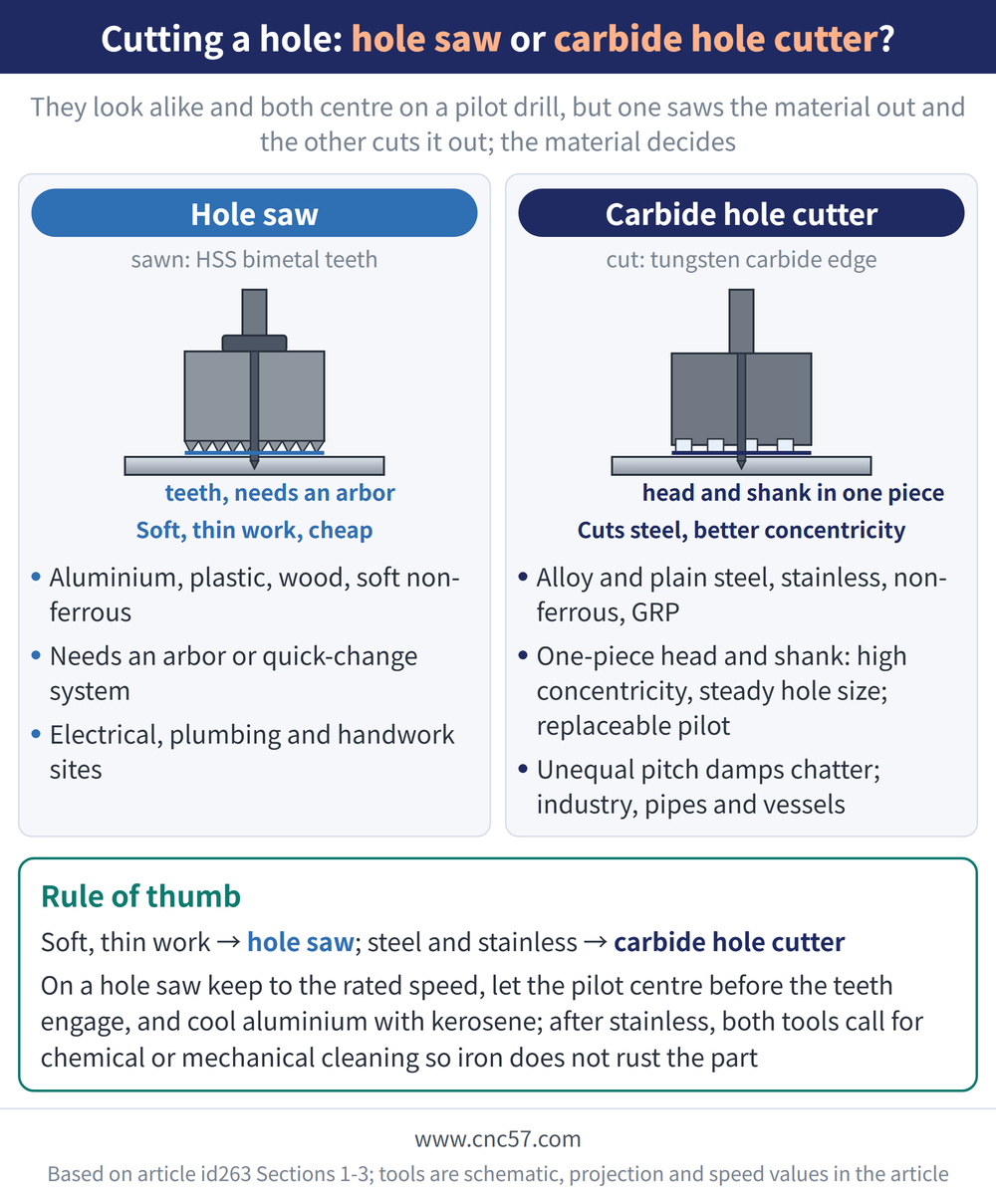
| Aspect | Hole saw (sawn) | Carbide hole cutter (cut) |
|---|---|---|
| Method | Material is sawn out | Material is cut out |
| Edge | HSS bimetal (teeth are cobalt HSS, M42) | Tungsten carbide edge |
| Materials | Aluminium, plastic, wood, soft non-ferrous | Alloy/plain steel, stainless, non-ferrous, GRP |
| Build | Needs an arbor or quick-change | Head and shank in one piece, higher concentricity |
| Setting | Electrical, plumbing, handwork | Industry (pipes, vessels) |
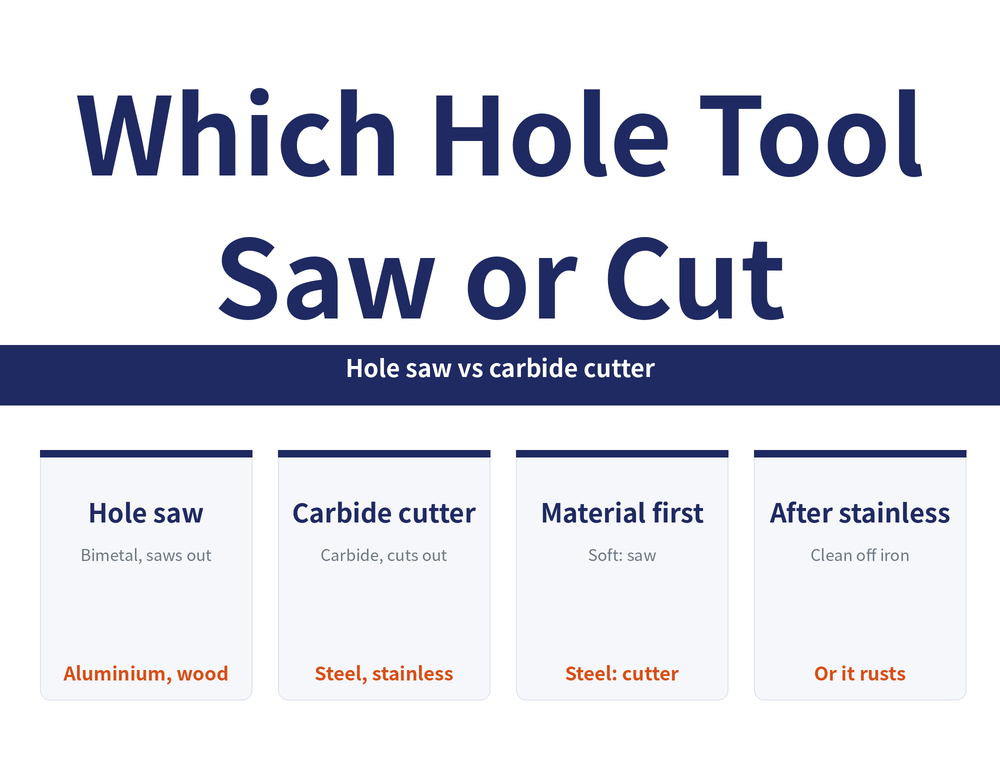
The first cut of selection is here: look at the material first — soft, thin work uses a hole saw (cheap, good on soft); steel and stainless use a carbide hole cutter (cuts them, better concentricity).
2. The Carbide Hole Cutter: Strengths and Use
Three strengths: head and shank in one piece, so concentricity is high and the hole size is steady; a sharp carbide edge; and a replaceable pilot drill, so wear does not scrap the whole tool. It uses an unequal pitch to damp chatter — irregular spacing staggers when each tooth enters, so it does not resonate (the same idea as unequal-pitch milling; see face-mill pitch selection).
Use: on a low-power machine the speed can rise about 30%; on tubes and curves where the edge cuts intermittently, up to 100% to stop chatter and tooth breakage (maker figures). On sheet, leave a clear exit, support outside the cutting area, and press low and even. After stainless, clean chemically or mechanically (pickling/polishing) to avoid iron rusting. A dull tool can be professionally resharpened to extend life.
3. Using a Hole Saw (Five Points)
| Point | What to do |
|---|---|
| Speed | Keep to the rated speed; even with an extension bar, do not exceed it, or it is unsafe |
| Pilot projection | The pilot drill should project at least 3 mm (1/8") past the teeth to centre before sawing |
| Cooling | Cutting oil on metal; use kerosene on aluminium |
| Rust | Clear the swarf; stainless needs extra chemical or mechanical cleaning |
| Anti-chipping | Load the teeth evenly, no sideways wobble |
4. Frequently Asked Questions (FAQ)
Q: How do I choose hole saw vs carbide cutter?
Material first: aluminium, plastic, wood and thin soft work use a hole saw; steel, stainless and non-ferrous use a carbide hole cutter (it cuts them, with better concentricity).
Q: How far should the pilot drill project?
On a hole saw, at least 3 mm (1/8") past the teeth, so it centres before the teeth engage.
Q: What to watch when cutting aluminium?
Use kerosene instead of cutting oil for cooling; cutting oil is for other metals.
Q: What after cutting stainless?
Clear the iron swarf and clean chemically or mechanically (pickling or polishing), or residual iron causes rust.
This article is part of Deburring and Surface Finishing: The Complete Guide - Which Tool, Which Material, and What to Do in Volume; that guide shows how the whole topic fits together.
Published: 2026-08-11 | Last updated: 2026-08-11