Spindle taper is the first gate to whether a tool holder even fits your machine. This guide covers the 7:24 steep tapers (BT, ISO, SK, NT, CAT), HSK hollow short tapers, Capto/PSC polygon interfaces, and Morse tapers (MT) - their standards, features, and typical uses - plus how to identify what your own spindle uses.
1. Why There Are So Many Spindle Taper Types
A tool holder locks into the machine through the spindle taper interface, but the machine tool industry never settled on a single global standard - different countries and machine builders each developed their own taper specifications. Industry estimates put the number of spindle interface types in circulation at over 35, which is exactly why a holder that fits one machine often won't fit another. The 7:24 steep taper is the oldest and most widespread of the family: it was introduced in the 1920s and wasn't standardized by DIN until 1974, after which national/organizational variants such as BT, ISO, SK, NT and CAT gradually emerged. The first step in selection is always confirming which major family your machine belongs to.
2. The Five 7:24 Steep Taper Standards Compared
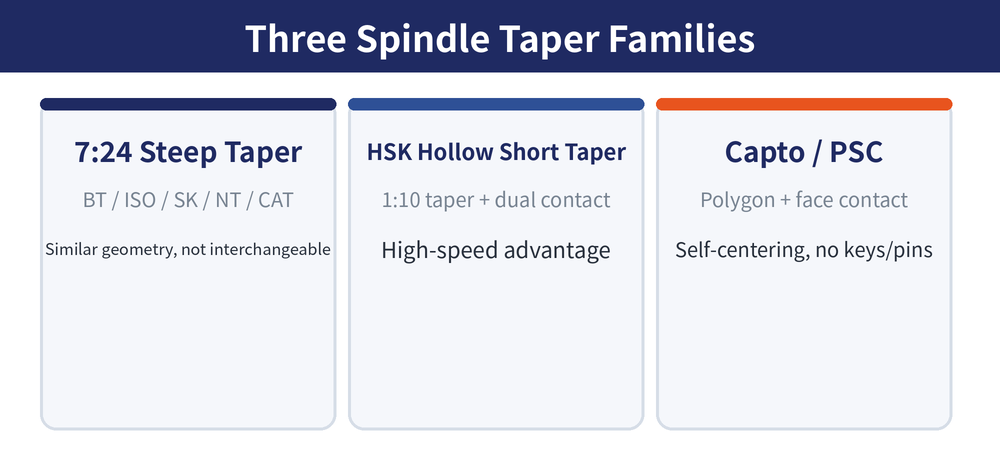
BT, ISO, SK, NT and CAT all belong to the same 7:24 steep taper family with similar geometry, but flange dimensions, pull stud specs, and drive-key layouts differ by region and standard - they are not interchangeable. Always confirm against your machine's actual spindle specification.
| Standard | Typical Sizes | Governing Standard | Characteristics |
|---|---|---|---|
| BT (MAS-BT) | BT30/40/50 | JIS B 6339 (equivalent to DIN ISO 7388-2) | Japanese standard, symmetric balanced design, most common on CNC machines; dual-contact BTP30/BTP40 variants also exist |
| ISO | ISO 30/40/50 | ISO 7388-1 series | Internationally common; geometry close to BT but flange and pull stud specs differ |
| SK (Steilkegel) | SK 30/40/50 | DIN 69871 / DIN ISO 7388-1 | Common on European machine tools (German for "steep taper") |
| NT (NBT) | NT30/40/50 | JIS, older specification | No ATC drive keyway; mostly found on conventional/manual mills |
| CAT (V-Flange) | CAT40/CAT50 | ASME B5.50 | US standard, common on American-built machines |
All five share the same 7:24 taper angle and look similar, but flange diameter, pull stud thread, and drive keyway location are not interchangeable - the fact that a holder physically slides in does not mean it truly seats correctly. Always confirm against the machine nameplate or OEM manual rather than judging by eye.
3. HSK: The Hollow Short Taper for High Speed
HSK (German: Hohlschaft Kegel, "hollow shank taper") takes a completely different design path from the 7:24 steep tapers: it uses only a 1:10 taper with a hollow shank, locating via simultaneous dual contact at the taper face and the flange face, per DIN 69893. HSK comes in several sub-types - HSK-A/C are the general-purpose versions, while HSK-E/F add further precision refinements for high-speed machining. Catalog data shows that at comparable sizes, HSK-E series holders typically allow noticeably higher spindle speeds than traditional 7:24 steep tapers (one catalog lists HSK-E32 up to 50,000 rpm versus roughly 25,000 rpm for the equivalent steep-taper size) - directly consistent with HSK's "hollow, short taper, dual contact" design intent. The more a machine is built for high-speed spindles, the more likely it uses HSK. For a detailed BT vs. HSK comparison, see BT vs HSK Spindle Taper Comparison.
4. Capto/PSC Polygon Interfaces and Morse Taper (MT)
| System | Standard | Interface Type | Typical Use |
|---|---|---|---|
| Capto/PSC (polygon quick-change) | ISO 26623-1 | Non-circular polygon taper plus face contact; self-centering, transmits torque without keys or pins | Mill-turn machines, modular tooling systems; common sizes C3-C8 |
| Morse Taper (MT) | No single international standard number; a customary series (MT1-MT6) | Self-locking round taper, held by friction alone | Drilling, lathe tailstocks, some manual/older equipment |
Capto/PSC self-centers purely from its polygon shape, transmitting torque without any keys or pins, so the interface has, in theory, no play to begin with - one reason mill-turn machines favor it; see Mill-Turn Tool Holder Interfaces: HSK-T and PSC. Morse taper is the opposite - a pure friction self-locking design with no pull stud or bolt assist, suited to low-torque, infrequent-changeover applications like drilling, but not to high-speed or heavy-torque milling.
5. Identifying Your Machine's Taper and Selection Tips
| Method | Notes |
|---|---|
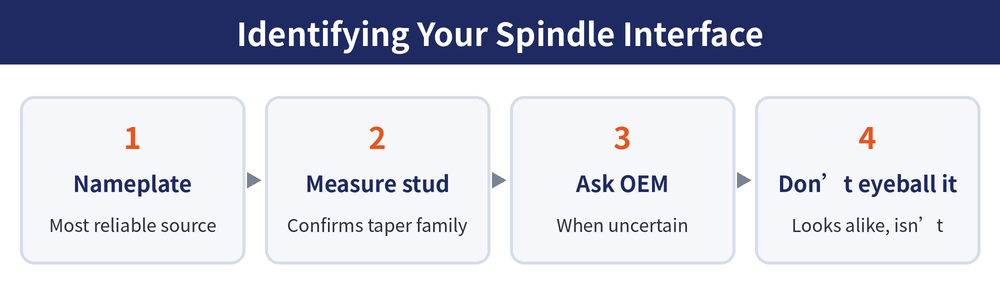
| Check the machine nameplate/OEM manual | Most reliable; nameplates usually state the spindle taper (e.g. BT40, HSK-A63) |
| Measure the pull stud | Pull stud thread and shape vary by standard and can help confirm the type |
| Confirm with the machine builder or dealer | Fastest way to resolve uncertainty and avoid ordering a holder that won't fit |
| Don't judge by "looks similar" | BT/ISO/SK/NT/CAT look alike but are not interchangeable - always confirm the standard designation |
General guidance: BT/ISO are most common on standard CNC mills and machining centers; European-built machines may use SK; older or manual machines may be NT; American-built equipment is often CAT; if the machine is built for high-speed, high-precision work or the nameplate specifies HSK, match that HSK variant directly; Capto/PSC comes up mainly on mill-turn or highly modular tooling setups.
Collet choice: see Collet System Comparison.
FAQ
Q1: Can BT and ISO tapers be used interchangeably?
Not recommended. BT (JIS B 6339) and ISO (ISO 7388-1) share the same 7:24 taper angle, but flange diameter and pull stud specs belong to different standard families. Even if a holder physically fits, it is not guaranteed to meet the required positioning accuracy and clamping force - always go by what the machine manufacturer specifies, and don't mix the two.
Q2: Why do some machines use HSK instead of BT?
HSK's hollow short taper plus dual-face contact design typically allows noticeably higher spindle speeds than a traditional 7:24 steep taper at the same size (catalogs commonly list HSK-E series up to 50,000 rpm). Its shorter, lighter shank also reduces the load on the tool changer arm, which is why high-speed machines tend to favor HSK.
Q3: Is NT taper obsolete?
NT (NBT) is an older Japanese specification without an ATC drive keyway, mostly found on conventional mills or manual equipment. It is not mainstream on current CNC machining centers, though some older machines or specific applications still use it - always confirm your machine's actual interface before selecting tooling.
Q4: How is Capto/PSC fundamentally different from a regular tapered holder?
Standard 7:24 and HSK interfaces both locate on a round conical surface. Capto/PSC instead uses a non-circular polygon taper, self-centering by its shape alone and transmitting axial force through face contact - torque transmission does not rely on keys or pins, so in theory precision degrades less over time. It is used mainly in mill-turn and modular tooling systems, and is uncommon on general-purpose milling machines.