How Hard Does a Vacuum Chuck Hold: Vacuum Level Chart and Holding Force Calculation
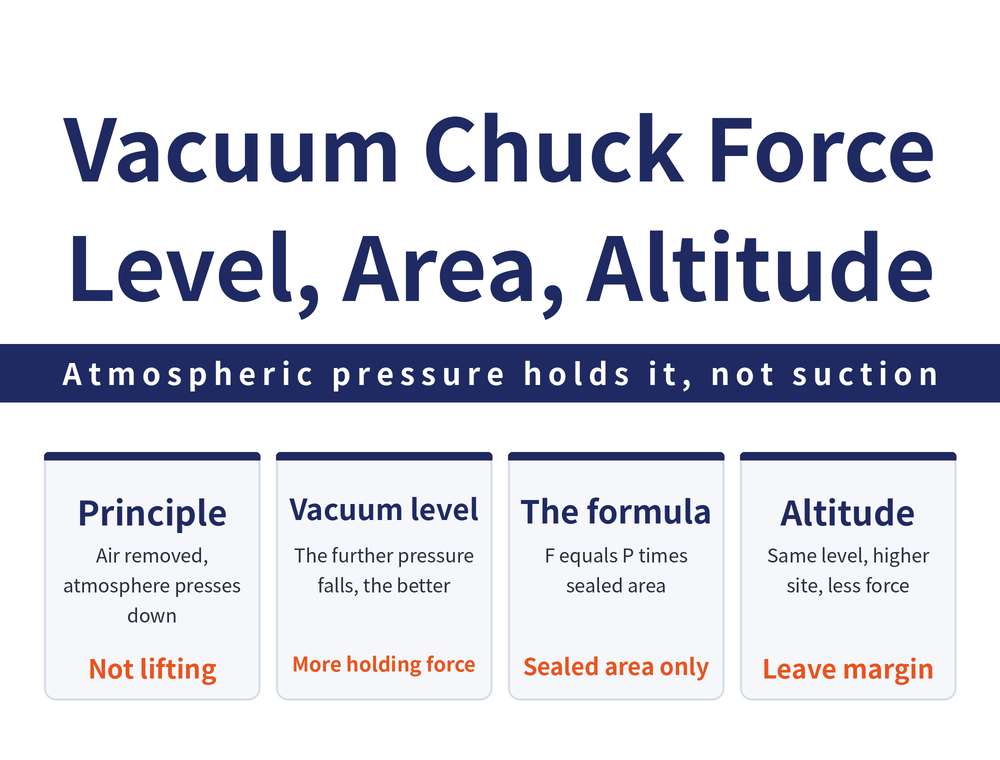
A vacuum chuck does not suck the part up. It removes the air under the contact face so that outside atmospheric pressure presses the part onto the chuck plate. How hard it holds comes down to two numbers: vacuum level and effective area. This guide gives the vacuum level conversion chart (%Vacuum, kPa, mbar, Torr and three negative-value notations) and includes an F = P × A worked example.
1. What Actually Holds the Part Is Atmospheric Pressure
A vacuum chuck is a fixture that clamps the workpiece using atmospheric pressure. Taking one atmosphere at sea level as the reference, a vacuum pump draws air out of the sealed volume and the pressure inside falls. The further it falls, the higher the vacuum level and the greater the holding force on the part.
This is why the word "suction" misleads. The pump generates no clamping force of its own; it only removes the counter-pressure on the underside of the part, and the outside atmosphere does the pressing. The same picture explains the limitation: the contact face must be close-fitting and sealing elements are required, because any leak collapses the pressure difference. Vacuum is one of five physical effects used to produce clamping force, alongside the inclined wedge, magnetism, spring force and fluid pressure.
2. Vacuum Level Chart: Seven Ways to Write the Same Number
What trips people up on the floor is usually not the principle but the units. The same vacuum level may appear in a catalogue as %Vacuum, kPa, mbar or Torr, or as a negative value in -kPa, -mmHg or -inHg. The chart below is referenced to sea-level atmospheric pressure of 1013 mbar.
| %Vacuum | kPa | mbar | Torr | -kPa | -mmHg | -inHg |
|---|---|---|---|---|---|---|
| 100 | 0 | 0 | 0 | 101.3 | 760 | 30 |
| 90 | 10 | 100 | 75 | 90 | 675 | 27 |
| 80 | 20 | 200 | 150 | 80 | 600 | 24 |
| 70 | 30 | 300 | 225 | 70 | 525 | 21 |
| 60 | 40 | 400 | 300 | 60 | 450 | 18 |
| 50 | 50 | 500 | 375 | 50 | 375 | 15 |
| 40 | 60 | 600 | 450 | 40 | 300 | 12 |
| 30 | 70 | 700 | 525 | 30 | 225 | 9 |
| 20 | 80 | 800 | 600 | 20 | 150 | 6 |
| 10 | 90 | 900 | 675 | 10 | 75 | 3 |
| 0 | 101.3 | 1013 | 760 | 0 | 0 | 0 |
Note that %Vacuum and kPa run in opposite directions: at 0% vacuum the pressure inside is one atmosphere, 101.3 kPa.
3. Calculating Holding Force: F = P × A
F = P × A (F: holding force; P: pressure converted from the vacuum level; A: effective sealed area)
The formula takes two inputs. Note that A means the effective area enclosed by the seal, not the outline dimensions of the chuck plate; the grooves and the seal strip itself do not count. Higher vacuum and larger effective area both raise the force, and they multiply — doubling the area does the same as doubling the pressure difference.
4. Holding Force Worked Example
Chuck size 40 cm × 60 cm, area A = 40 × 60 = 2400 cm²; a vacuum level of 85% is taken as 0.85 N/cm²; holding force F = 0.85 N/cm² × 2400 cm² = 2040 N.
The unit conversion in this example has not been independently re-verified; check the units before applying it. The step that treats a vacuum level of 85% as 0.85 N/cm² is a simplification, so check it as well.
To apply it to your own chuck, work in this order: use the chart in section 2 to confirm what your vacuum level is in kPa, convert that to pressure per square centimetre yourself, multiply by the real effective sealed area, and keep a safety margin.
5. At the Same Vacuum Level, Higher Altitude Holds Less
The chart is referenced to one atmosphere at sea level. If the plant sits at a higher altitude, the holding force at the same vacuum level is smaller. The reason is the same as in section 1: it is the outside atmosphere that presses on the part, and thinner air yields a smaller pressure difference for the same vacuum level.
This is easy to miss during selection, because catalogue holding-force figures are usually sea-level figures. For a plant at altitude, take the supplier's data for that condition and verify during trial cutting.
6. Two Common Application Types
| Type | Build and use |
|---|---|
| Vacuum holding of thin parts | 0.025 mm grooves, seal strip, vacuum pump; for low-rigidity parts such as sheet metal and printed circuit boards |
| Grid-type vacuum chuck | The holding surface is divided into a grid so the active area can be adjusted to different part sizes |
What ruins thin parts is a concentrated clamping force denting the surface locally, and vacuum spreads the force over the whole contact face — the usual alternative when a vise cannot hold the part without damaging it. For how clamping force relates to distortion, see Why Vise Clamping Distorts the Workpiece.
7. A Note on Freeze Chucks
The same chapter mentions a rarer type: flash freezing is used to freeze the water on the chuck plate, and the bonding strength of the ice holds the part. It works with almost any material, but it suits light cutting only.
To assess feasibility, ask the equipment supplier directly for the actual freezing conditions and the cutting force the setup can take.
Frequently Asked Questions (FAQ)
Q: How is vacuum chuck holding force calculated?
Use F = P × A: convert the vacuum level to a pressure P and multiply by the effective area A enclosed by the seal. Example: 40 cm × 60 cm (A = 2400 cm²) with 85% vacuum taken as 0.85 N/cm², giving F = 2040 N; check the units before applying it.
Q: How many kPa is 80% vacuum?
On the chart (referenced to 1013 mbar at sea level), 80% Vacuum corresponds to an absolute pressure of 20 kPa, 200 mbar or 150 Torr, written as a negative value as -80 kPa, -600 mmHg or -24 inHg. %Vacuum and kPa run in opposite directions, so check the column heading.
Q: Does holding force need derating at high altitude?
It does drop. The outside atmosphere presses the part, so thinner air at altitude gives a smaller pressure difference at the same vacuum level. Take the supplier's data for that condition and verify during trial cutting.
Q: Can a freeze chuck be used for heavy cutting?
No. A freeze chuck holds the part through the bonding strength of ice and works with almost any material, but it suits light cutting only. Ask the equipment supplier for the actual freezing temperature and time before planning around it.
This article is part of Workholding and Fixtures: The Complete Guide - Locate First, Then Clamp; How Much Force and Where It Comes From; that guide shows how the whole topic fits together.