
Reading an Abrasive Catalogue: The Six Material Groups, and Matching Stainless Grades to EN and AISI
A catalogue is not meant to be opened at the product page. European abrasive catalogues put material groups first - identify which group your workpiece belongs to, and you know which column to read. The cell that catches Taiwanese shops most often is the German V2A and V4A against the SUS304 and SUS316 on the drawing. This guide covers the six groups, lines up the three names for stainless, and explains what each field on the label means.
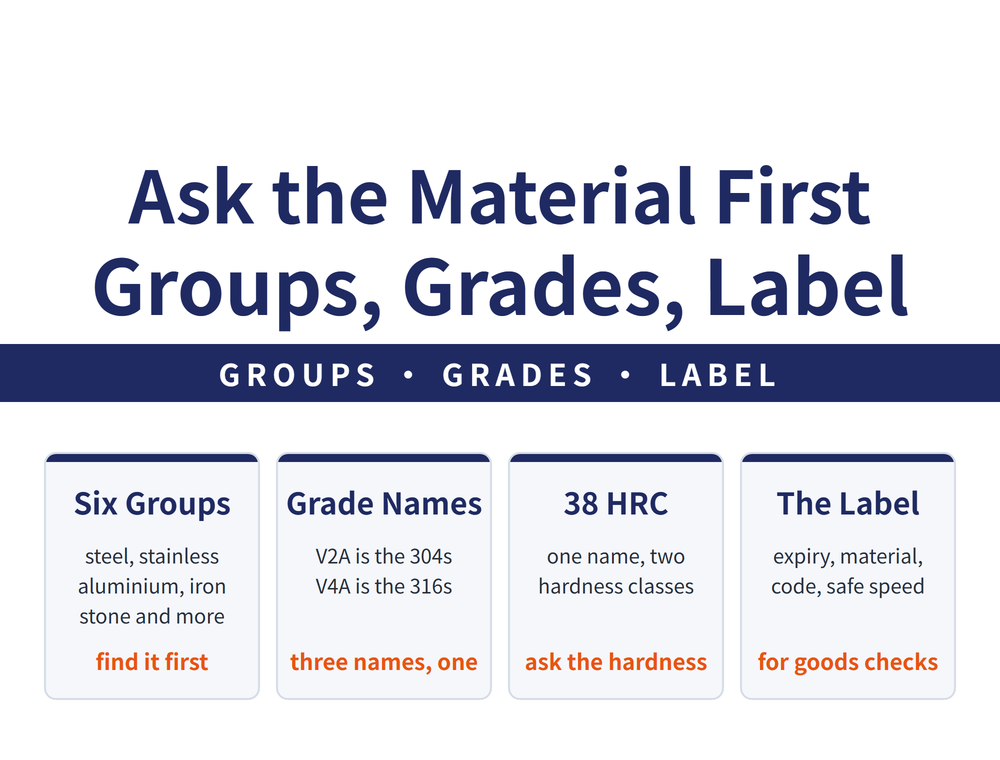
1. The Catalogue Asks the Material First, Not the Product
European abrasive catalogues share one structure: rows are applications, columns are materials, and the product only lives in the crossing cell. So the first step is never finding a product name - it is answering which group the workpiece belongs to.
| Material group | What it covers (as the catalogues divide it) |
|---|---|
| Steel, cast steel | Structural, carbon, tool, case-hardening and heat-treatable steels - split into two hardness classes (section 4) |
| Stainless steel | Rust- and acid-resistant steels, austenitic and ferritic (grades in section 3) |
| Aluminium | Wrought alloys and low- or no-silicon cast alloys |
| Other non-ferrous | Soft (brass, copper, zinc) / hard (bronze, titanium) / high-temperature (nickel-base) |
| Cast iron | Grey and nodular cast iron, malleable iron |
| Stone | Concrete, brick, tile, granite and the like |
Each group usually carries a fixed colour code repeated through the catalogue, so the header colour tells you the material column before you read a word. ⚠ The colour code is that one catalogue’s own navigation - other makers use other systems, and it means nothing outside that book. Remember the grouping logic, not the colours.
2. This Is Not the Same System as the Cutting-Tool ISO Groups
Anyone who reads cutting-tool catalogues will want to map P M K N S H onto this. The two look alike and do not interchange.
| ISO classes for cutting tools | Abrasive catalogue material groups | |
|---|---|---|
| Defined by | ISO 513, common across brands | Each maker’s own, valid inside that catalogue |
| How many | Six: P M K N S H | Commonly six, but cut differently |
| Example difference | Stainless is its own M group | Steel splits by hardness; non-ferrous splits soft/hard/high-temp |
For the ISO groups and tool selection, follow the workpiece-material line starting from Stainless Steel Grade Cross-Reference; inside an abrasive catalogue, follow its own groups. Carry group names from one system into the other and the recommendations will not fit. For how to compare cutting tools from two brands beyond the ISO groups, see Comparing Cutting Tool Brands: Which Spec Fields Line Up, and Which Only Count Within One Catalog.
3. Three Names for Stainless: V2A, EN Number, AISI
The cell that catches people most often: the drawing says SUS304, the German catalogue says V2A or 1.4301 - three names, one family of material.
| German trade name | EN number | AISI | Common name in Taiwan |
|---|---|---|---|
| V2A | 1.4301 | 304 | SUS304 |
| V2A | 1.4310 | 301 | SUS301 |
| V4A | 1.4401 | 316 | SUS316 |
| V4A | 1.4571 | 316Ti | SUS316Ti |
V2A and V4A are not standard numbers but German-speaking trade names: V2A roughly equals the 304 family (chrome-nickel), V4A the 316 family (with molybdenum, one class better against chlorides). A catalogue that says "für V4A" means the 316 family.
⚠ Two boundaries worth keeping: the Taiwan column is a matched correspondence - these four rows happen to share numbers between SUS and AISI, other grades are not guaranteed to, so do not extrapolate; for the full cross-reference see Stainless Steel Grade Cross-Reference. Also, the V4A class is more sensitive to iron contamination - abrasives and brushes that have touched carbon steel should not touch it; see Choosing a Wire Brush.
4. Why the Steel Group Splits in Two: The 38 HRC Line
Catalogues split steel at a tensile strength of roughly 1,200 N/mm² - about 38 HRC: below it, ordinary steels; above it, hardened and heat-treated ones.
The trap in this line: tool steel, heat-treatable steel and cast steel appear on both sides - the same material name sits in the lower class annealed and in the upper class after hardening. The name alone cannot place it; ask the actual hardness of the piece in front of you.
📌 The same 38 HRC line recurs through a catalogue - in some chapters even the bond type changes across it. For material near the boundary (around HRC 35-40), go by measured hardness, never by name.
5. Product-Line Stars and the Label: What to Check at Goods-In
Catalogues and packaging carry two layers of information, read separately: stars grade one maker’s own range; the label is one piece’s identity.
| Label field | What is printed | What it is for at goods-in |
|---|---|---|
| Expiry date and lot | e.g. EXP plus month/year, along the label edge | Resin-bonded abrasives expire - check on receipt (see Abrasives Have an Expiry Date) |
| Material info | Suitability banner plus the body code (shape-grain-grit-grade-bond) | Answers "may this touch stainless" |
| Size and safe speed | OD × thickness × bore, max peripheral speed and RPM | Check against the machine setting; what the limits mean: How Fast Abrasive Tools May Run |
| Safety marks | Safety-organisation mark and warning pictograms | Whether it sits inside a safety-monitoring scheme |
The star rule is one sentence: a relative grade within one maker’s range (general / performance / special line), never comparable across brands. Across brands, compare the fields defined the same way everywhere - grain, grit, speed, dimensions. ⚠ The body code’s letter system is not shared between the European system and others - the same letter means different things in different systems; for the grinding-wheel version in full, see Reading Grinding Wheel Markings.
6. Turning This Page Into a Procedure: Four Steps
| Step | Do what | Stuck? Read |
|---|---|---|
| 1 Place the material | Which of the six groups; for steel, ask the actual hardness | Sections 1 and 4 here |
| 2 Match the grade | Line up the drawing’s name with the catalogue’s name | Section 3, and Stainless Steel Grade Cross-Reference |
| 3 Pick grain and type | Choose grain and product type inside that material column | Choosing the Abrasive Grain |
| 4 Check the label | Expiry, speed and code, field by field | Abrasives Have an Expiry Date, How Fast Abrasive Tools May Run |
The order does not invert: workpiece first, product second. Ordering straight from the product page means the material column was guessed - which is exactly where burnt surfaces and rust spots on stainless begin; countermeasures in Deburring and Finishing by Material.
7. Frequently Asked Questions (FAQ)
Q: Are V2A and SUS304 the same material?
The same family. V2A is a German-speaking trade name for the 304-type chrome-nickel stainless family; the EN number is 1.4301, AISI calls it 304, and Taiwan commonly says SUS304. Four names, one family - but correspondence is not identity: the standards allow slightly different composition ranges, so before ordering or substituting material, confirm against a full cross-reference.
Q: Can I map the abrasive catalogue’s groups onto the cutting-tool P M K N S H?
No. ISO 513’s six classes are a cross-brand standard for cutting tools; an abrasive catalogue’s groups are that maker’s own navigation, and the cuts differ - abrasives split steel at about 38 HRC and split non-ferrous into soft, hard and high-temperature. The names look similar, the definitions are not, and swapping them fetches advice that does not fit.
Q: Which class does tool steel go in?
Ask the actual hardness, not the name. Tool steel, heat-treatable steel and cast steel appear in both classes - annealed they sit in the ordinary class, hardened and tempered they sit above the roughly 38 HRC line. The same mould core can sit in one class at roughing and the other at finishing. Near the boundary, go by measurement.
Q: Which label field should be checked first?
At goods-in, the expiry date and lot: resin-bonded abrasives carry a safety life, and out-of-date stock is a safety issue, not an efficiency one. Before mounting, the size and safe-speed field, against the machine setting. And the material banner decides whether the piece may touch your workpiece at all - especially stainless, which needs items marked suitable for it to avoid iron contamination.
This article is part of Deburring and Surface Finishing: The Complete Guide - Which Tool, Which Material, and What to Do in Volume; that guide shows how the whole topic fits together.
Published: 2026-09-25 | Last updated: 2026-10-28









