
Creep Feed Grinding: When to Take It All in One Pass, and What Happens When Cooling Cannot Keep Up
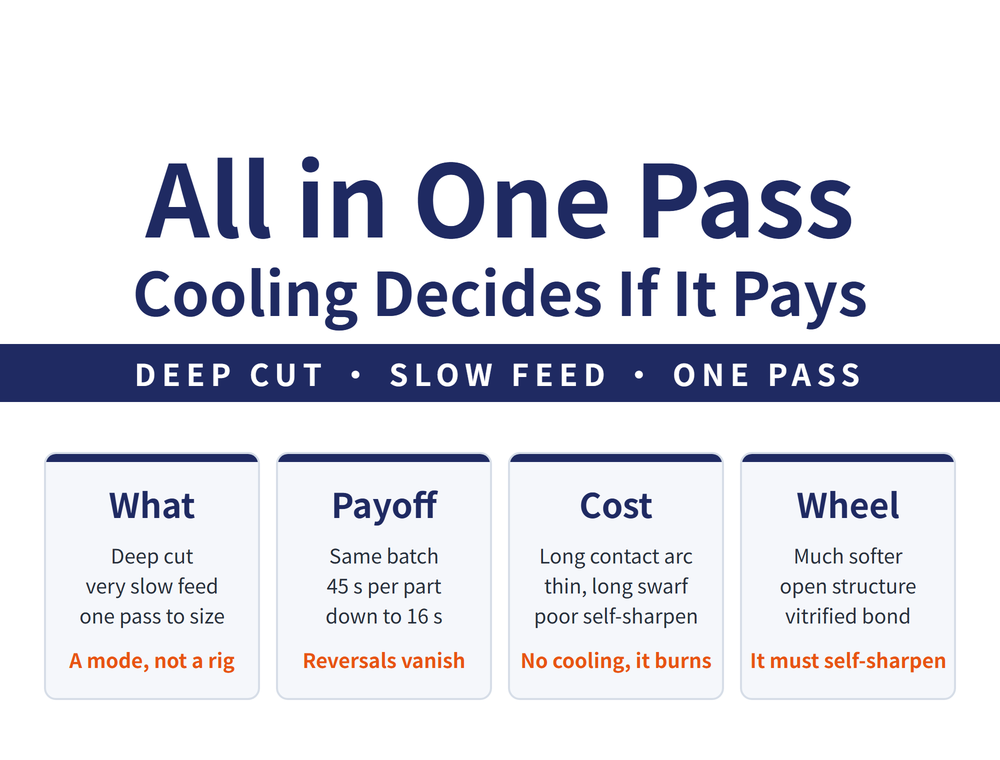
Creep feed grinding is a mode, not a machine: open up the depth of cut, slow the work right down, and reach size in one or a few passes. This covers what it buys you, when to use it, how the wheel has to be specified, and why cooling is the real bottleneck — force the mode without the cooling and what you get is burn, not throughput.
1. What creep feed grinding is: all the depth in one pass
Conventional grinding takes a small depth of cut with the work moving quickly, removing stock over many passes. How the wheel and the parameters are chosen at that small-depth, fast-work end is shown for high speed grinding in High Speed Grinding Wheels and Parameters: Five Selection Items, the k Value Chart and a Parameter Table. Creep feed reverses both:
| Item | Conventional reciprocating | Creep feed |
|---|---|---|
| Depth of cut | Very small, hundredths of a millimetre | 1–30mm, a hundred to a thousand times more |
| Work feed rate | Fast | 5–300 mm/min, very slow |
| Passes | Many | One, or a few, to finished size |
📌 It is a way of taking the cut, not a particular machine. Form grinding on a manual machine often works the same way: dress the wheel to shape, give it the full depth, and push the work through slowly. So the question is not "do we have that machine" but whether the cooling and the wheel can keep up.
It reaches roughly 2–5 μm accuracy and Ra 0.63–1.6 μm, with throughput about 1–5 times that of conventional grinding.
2. What it buys: the time difference on one batch
A measured comparison makes the difference concrete. Conventional and continuous-dress grinding take twelve parts at once; creep feed takes three at a time, four batches and 188 s in total, so its pass counts are per batch:
| Method | Passes | Cutting time per part | Total dressing |
|---|---|---|---|
| Conventional reciprocating | 120 rough, 26 finish, 4 spark-out | 45 s | 0.64mm |
| Creep feed | 1 rough, 1 finish | 16 s | 0.32mm |
| Continuous-dress creep feed | 1, full depth | 2.5 s | 0.28mm |
Reference values from one set of measured conditions, not a general rule. Continuous dressing means a diamond roll stays in contact with the wheel, dressing while grinding, so the wheel is always keen.
What is saved is mostly reversal and air-cutting time, not the cutting itself. Going from over a hundred passes to one or two removes all that accelerating and decelerating.
3. When to use it, and when not to
| Suits | Does not suit |
|---|---|
| Formed surfaces and slots, with the wheel dressed to shape | Anywhere cooling is inadequate — the main exclusion |
| Hard, tough, difficult materials: heat-resistant alloy steel, stainless, high-speed steel | One-offs with little stock, where there is no reversal time to save |
| Large stock with an accurate profile, replacing earlier turning or milling | Parts sensitive to heat, or with a poor path for heat to escape |
Three inherent advantages are worth knowing: (1) surface defects do not matter — scale and the chilled skin on castings grind straight off, so precision cast or forged blanks can be ground to shape directly; (2) the long contact arc damps vibration, so grinding cracks are less likely; (3) a blunt wheel only needs its periphery dressed, and with the spindle loaded mainly radially the slot ends are less prone to bell-mouthing.
4. 🔴 Cooling is the real bottleneck
Creep feed has a built-in contradiction: the contact area is large and the contact arc long, so:
| What happens | Result |
|---|---|
| Heat is high and fluid struggles to reach the grinding zone | The part burns easily |
| Swarf comes off thin and long | It loads and sticks to the wheel face |
| Force per grain is low, so self-sharpening is poor | The wheel does not keep itself keen, and a blunt wheel runs hotter still |
🔴 So the first question about whether a machine can do creep feed is not power, it is cooling. The mode needs high pressure and high flow, and not only onto the part — it also has to wash the wheel and carry away what has stuck to it. Standard coolant provision on an ordinary grinder is often not enough, and that is the usual way this goes wrong: no throughput gained, and a batch burnt first.
How to choose the fluid and whether to use EP additives is covered in Choosing a Grinding Fluid: Oil or Water Based, Five Types and EP Additives; if it does burn, work back from the defect in Grinding Defects: Tracing Chatter, Burn, Cracks and Size Errors.
5. Specifying the wheel: five points
The specification differs a lot from conventional grinding, and almost every choice goes the same way — softer and more open:
| Item | How to specify |
|---|---|
| Grain | White aluminium oxide (WA) or aluminium oxide (A) for ordinary alloy steel; WA mixed with green silicon carbide also works. CBN raises removal rate, cuts thermal damage and lasts longer |
| Grit | Usually 46–60; finer where the form has small radii and tight accuracy (one example used 80–100). As coarse as the requirement allows |
| Grade | 🔴 Much softer than usual — medium-soft to soft. The harder the material is to machine, the softer it goes; the most difficult materials take very soft grades. On accurate forms, go as hard as you can without burning |
| Bond | Vitrified, as a rule |
| Structure | Removal rate and heat are both high, so use an open or porous structure that gives swarf somewhere to go and lets fluid in |
How these five fields are read off the wheel marking is in Reading a Grinding Wheel Marking; general parameter ranges by material are in Grinding Parameters by Material: Stainless, Hardened Steel and Titanium.
⚠ The structure number is commonly in the 12–14 range; the chemical formula of a grain additive is unclear and unverified, so it is not given here. For large batches with complex, accurate forms, wheels are usually dressed with a diamond roll: the form holds better and dressing is quicker.
6. Finish down-grinding, and put the guide at the far end
| Direction | What happens |
|---|---|
| Up grinding | Fluid struggles to enter the zone; loose grains get pressed into the surface, scoring and tearing it, and the finish worsens |
| Down grinding | Cooling is better, fluid is carried into the zone, loose grains are washed away instead of scratching the finished face, and the finish is better |
⇒ Finish creep feed grinding on flat work should be down grinding, not up.
📌 The flow guide goes at the far end of the part, not the leading end. Down grinding starts with uncut material ahead of the wheel, which guides the fluid naturally, so the zone is well supplied at the start; it is at the far end that the fluid begins to divert. Fit a guide shaped to match the part hard against that end, or it will run short of fluid and burn. It is easy to fit this the wrong way round, and fitted backwards it does nothing.
7. Frequently Asked Questions (FAQ)
Q: Does creep feed grinding require a dedicated machine?
It is a way of taking the cut — deep, slow, one pass — not a particular machine. Form grinding on a manual machine frequently works this way. The real threshold is whether cooling is adequate and the wheel correctly specified.
Q: With a much deeper cut, why are cracks less likely?
Because the feed is so slow that chip thickness per grain is actually small and grinding force is low, while the long contact arc damps vibration. That does not make it safe — heat is still the issue, and burn remains the main risk.
Q: Why must the wheel be softer than usual?
Force per grain is low and self-sharpening is poor, so the wheel does not keep itself keen. A softer grade and a more open structure let blunt grains break away and expose fresh edges, instead of getting progressively hotter.
Q: Which end does the flow guide go on?
The far end. In down grinding the leading end has uncut material to guide the fluid, and it is at the far end that flow starts to divert, so a guide shaped to the part goes hard against that end to stop it running short and burning.
This article belongs to the line covered in Grinding Wheels and Machines: The Complete Guide - Reading the Wheel, Mounting It, Dressing It, and Tracing Defects, which shows where to start and where to go next.
Published: 2026-09-17|Updated: 2026-10-24









