
How to Use DLC Coating: Properties, Substrates and Tool Life Comparison
DLC is often treated as a budget version of diamond coating, and that reading leads to using it in the wrong place. It is an amorphous carbon film, less hard than diamond coating, but it offers two things diamond coating cannot: once doped it can machine ferrous materials, and it will deposit on almost any substrate. This article covers its performance limits, suitable substrates and the real magnitude of its tool life gains.
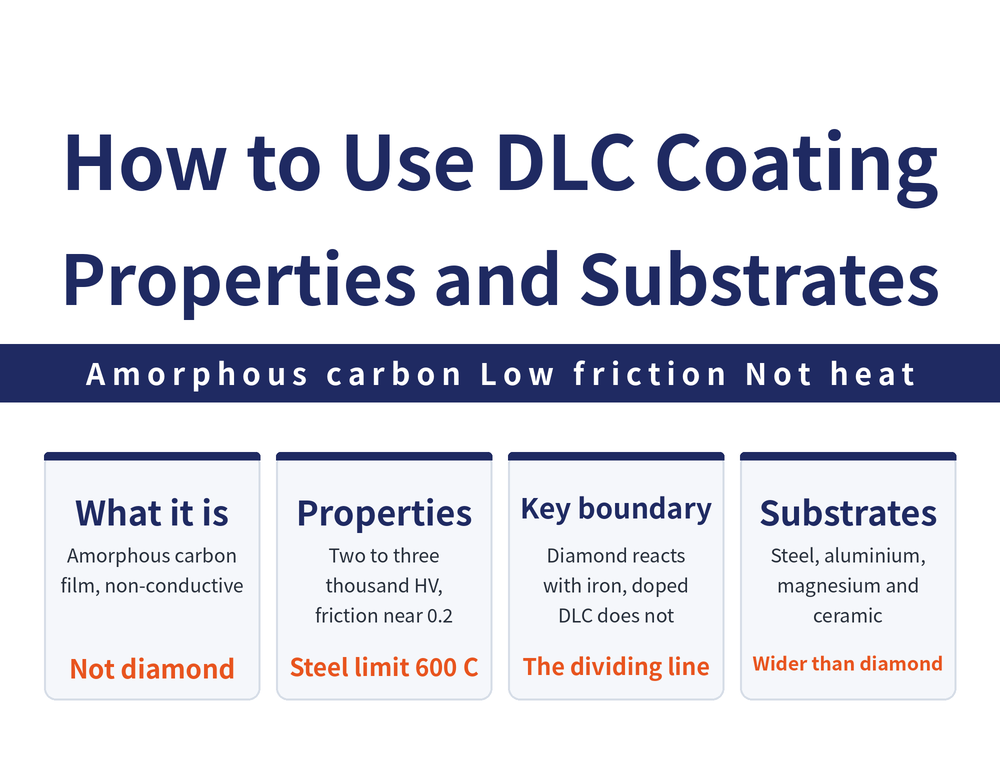
1. DLC is neither diamond nor graphite
DLC (diamond-like carbon) is an amorphous carbon film — it carries characteristics of both diamond and graphite bonding, yet belongs to neither crystal structure. It appears dark brown to dark grey and is non-conductive, which sets it apart from metallic coatings and can be the reason to select it where insulation matters.
Being amorphous, it does not reach the hardness of diamond coating — but it also escapes two of diamond coating's limits, and that is precisely where it belongs. For the scope of diamond coating and PCD, see PCD and diamond coating.
2. Six properties, and where the limits are
| Item | Value / characteristic | Practical meaning |
|---|---|---|
| Microhardness | About 2000–3000 HV | Above common nitride coatings, below diamond coating |
| Dry friction against metal | About 0.19 (at 50% relative humidity) | Low friction is its principal selling point |
| Adhesion tendency | Almost no welding to other materials | Directly addresses built-up edge |
| Maximum service temperature | Around 600°C on steel; above 800°C on ceramic | Watch the ceiling in high-speed heavy cutting |
| Suitable substrates | Steel, aluminium, magnesium, ceramic and more | Considerably wider than diamond coating |
| Electrical conductivity | Non-conductive | Useful in special cases, neutral in general cutting |
The table gives ranges; actual values vary considerably with process and doping recipe, so follow the coating house or tool catalogue specification. For comparison with other coatings see common tool coating materials.
The row to remember is service temperature. DLC's advantage is low friction rather than heat resistance, and the roughly six hundred degree ceiling on steel substrates means it does not belong in the high-temperature zone of high-speed heavy cutting — that is TiAlN territory.
3. The key boundary: diamond coating cannot touch iron, DLC can
Diamond coating is chemically active at high temperature and reacts readily with ferrous materials, producing chemical wear. It is therefore unsuitable for machining ferrous alloys, and is used mainly on aluminium-silicon and copper alloys, other non-ferrous metals and composites.
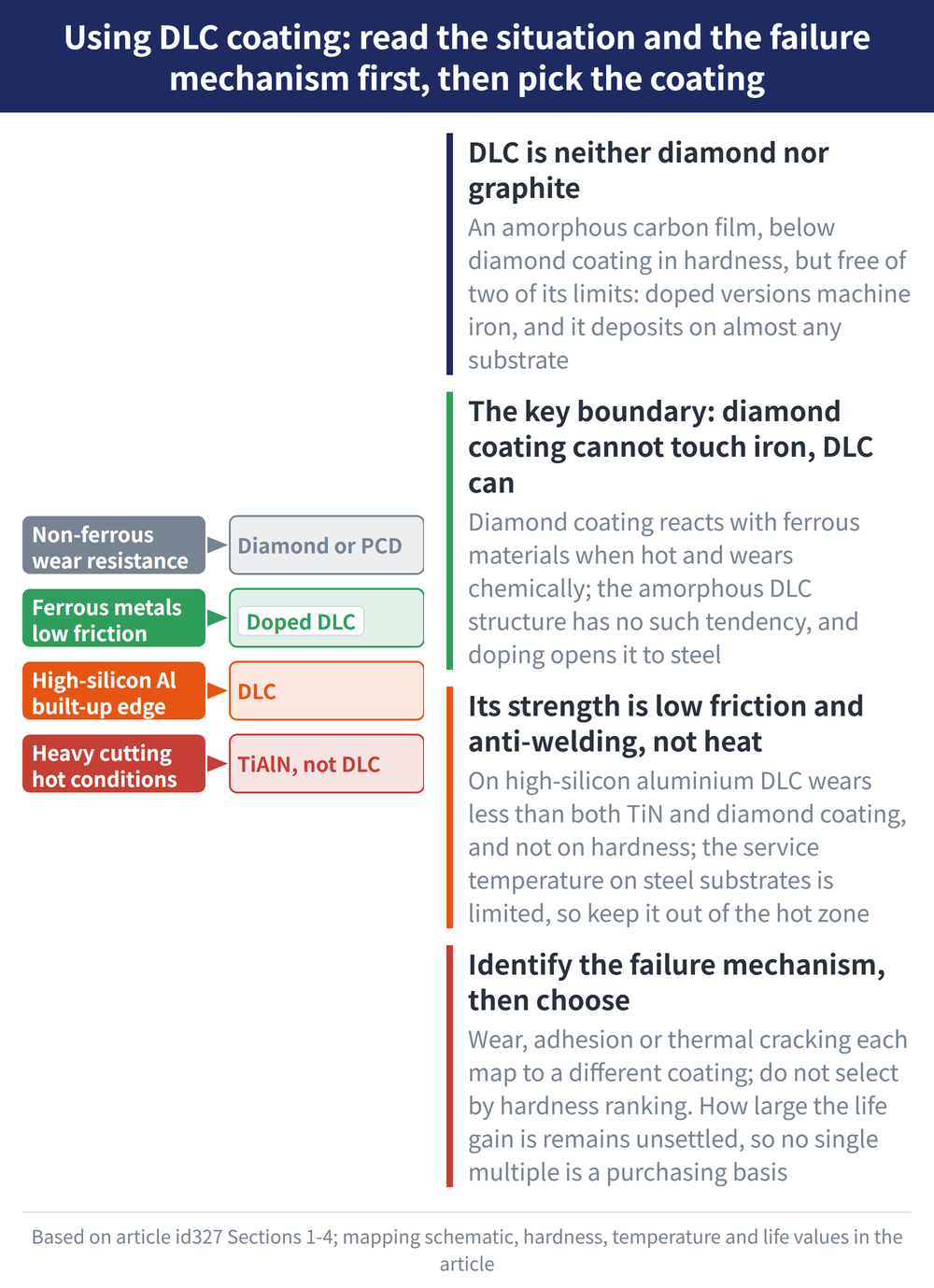
DLC has no such restriction. Carbon and iron would normally interact, but the amorphous structure of DLC does not show that tendency, and once doping atoms are added it can be used on steel and iron. That single property lifts it out of the non-ferrous-only category and defines its practical division of labour with diamond coating:
| Situation | First choice |
|---|---|
| Non-ferrous and composite finishing, maximum wear resistance | Diamond coating or PCD |
| Ferrous material needing low friction and anti-welding | Doped DLC |
| High-silicon aluminium where built-up edge dominates | DLC (see next section) |
| High-speed heavy cutting at high temperature | TiAlN family, not DLC |
4. The real magnitude of tool life gains
Three life comparisons are given, all single-source measurements, so only the orders of magnitude are quoted here:
First, under the same conditions DLC-coated tool life is about twice that of TiN coating. Second, in high-speed drilling and tapping its life is clearly longer than that of uncoated tools, but the multiple is not settled, so no single figure should be used as a purchasing basis.
The third is the one that best defines DLC. Machining high-silicon aluminium (for example a hypereutectic Al-Si alloy at around 18% silicon, where silicon segregation is severe and welding is extreme), DLC wears less than both TiN coating and diamond coating. Note that even diamond coating is beaten here — and not on hardness, but on resistance to welding. Where the failure mechanism is adhesion-dominated, a low friction coefficient is worth more than high hardness.
Which returns to the general rule for choosing coatings: identify whether the failure mechanism is wear, adhesion or thermal cracking, then pick the matching coating, rather than selecting by hardness ranking. For identifying wear modes see the tool wear analysis guide, and for grade cross-reference see the insert coating chart.
5. Frequently Asked Questions (FAQ)
Q: What is the difference between DLC and diamond coating?
Structure and scope. DLC is an amorphous carbon film, less hard, but doped versions machine ferrous materials and it deposits on many substrates; diamond coating is harder but reacts with iron at high temperature, limiting it to non-ferrous metals and composites.
Q: Can DLC be used in high-speed heavy cutting?
Not advisable. DLC's strength is low friction rather than heat resistance, and the maximum service temperature on steel substrates is around six hundred degrees; high-temperature work should favour TiAlN family coatings.
Q: Why does DLC beat diamond coating on high-silicon aluminium?
Because the failure mechanism there is adhesion rather than abrasion. DLC barely welds to other materials and has a low friction coefficient, which matches that mechanism; hardness is not the deciding factor.
Q: Can DLC tool life gain be estimated as a fixed multiple?
Not advisable. In high-speed drilling and tapping DLC clearly outlasts uncoated tools, but this rests on a single source's measurements and the multiple is not settled, so verify with a small trial batch under your actual conditions before purchasing.
This article is part of Tool Materials and Coatings: The Complete Guide - Separate Substrate From Coating, Then Work Back From the Workpiece; that guide shows how the whole topic fits together.
Published: 2026-08-26 | Last updated: 2026-10-21









