
Drill Performance Factors: Design, Cutting & Rigidity
Drill performance is affected by many factors: tool geometry, material, cutting conditions and machine rigidity. Helix angle, point angle and web thickness affect cutting force and chip evacuation, while cutting speed and feed determine efficiency and tool life; hole types such as blind, deep and cross holes also affect evacuation and stability. Integrating tool design and cutting conditions is the key to drilling quality and efficiency. For geometry details, see Drill Geometry and Function.
Three Main Factor Areas
Performance is determined by tool design, cutting conditions, and machine/workpiece conditions together.
| Area | Main content |
|---|---|
| Tool design | Geometry (helix, point angle, relief, chisel edge, back taper), structural rigidity, material and surface treatment |
| Cutting conditions | Cutting speed, feed, hole type, cooling and lubrication |
| Machine & workpiece | Machine rigidity and accuracy, feed mechanism, clamping force, workpiece material |
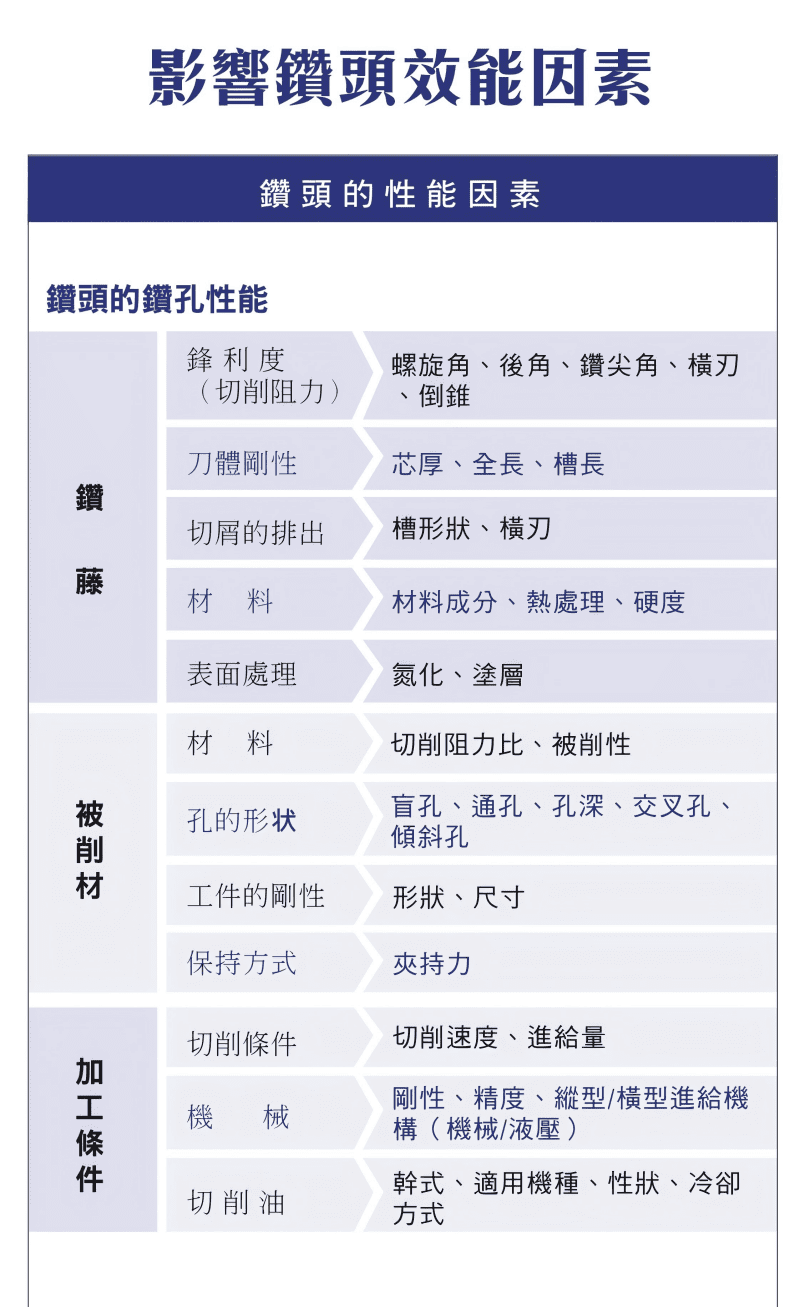
Tool Design and Cutting Conditions
| Factor | Content | Effect |
|---|---|---|
| Tool geometry | Helix, point angle, relief, chisel-edge design, back taper | Cutting force, evacuation, accuracy |
| Structure & rigidity | Web thickness, overall length, flute length | High rigidity→stable; low→vibration and deflection |
| Material & surface | Composition, heat treatment, hardness; nitriding, coating | Wear resistance, tool life, stability |
| Cutting conditions | Cutting speed vc, feed f | Efficiency, tool wear, quality |
| Cooling & lubrication | Cutting fluid (dry / wet) | Cooling, evacuation, tool life |
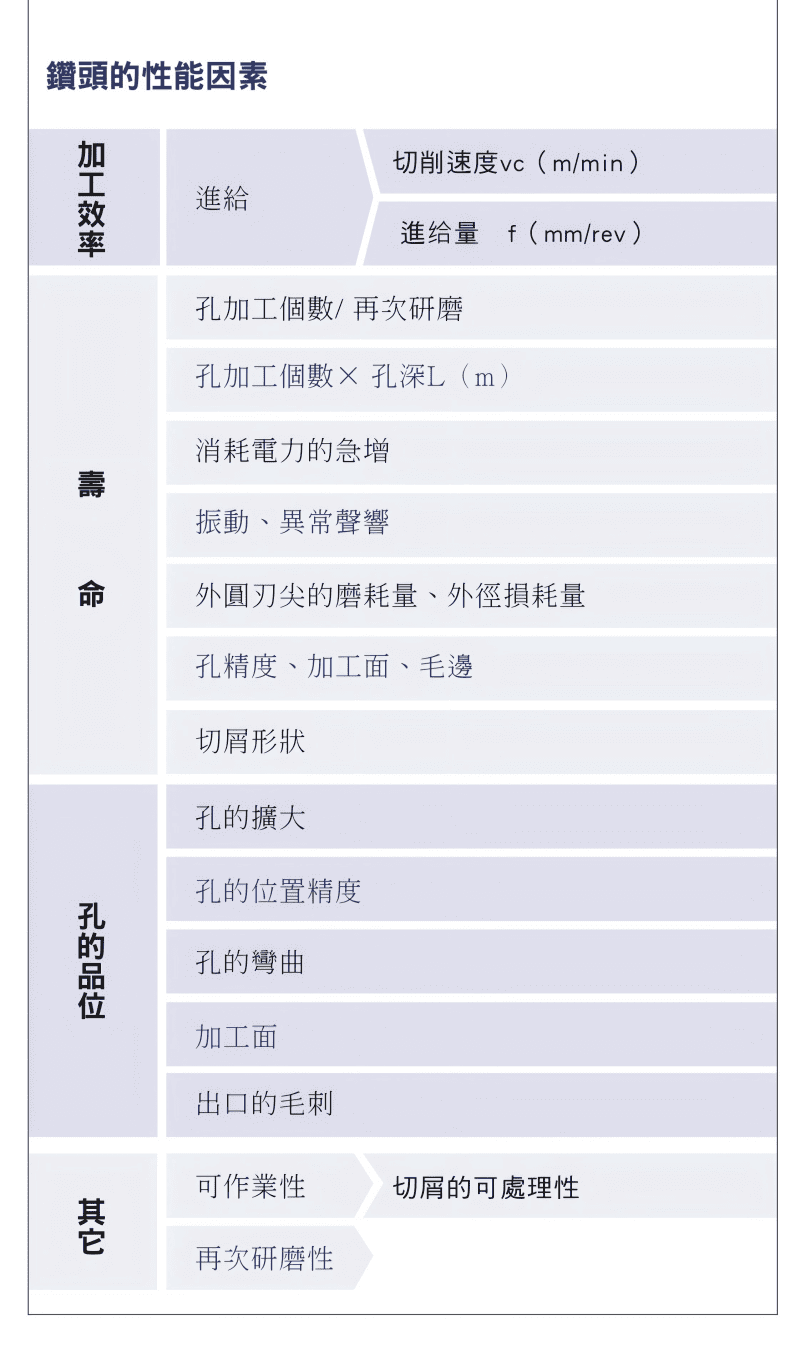
Hole Types and Machine/Clamping Conditions
| Hole type | Effect |
|---|---|
| Blind hole | Difficult chip evacuation |
| Deep hole | Prone to heat build-up |
| Cross hole | Unstable cutting |
| Inclined hole | Prone to deflection |
| Machine/clamping factor | Result |
|---|---|
| Machine rigidity & accuracy, feed mechanism (mechanical/hydraulic), clamping force | Insufficient rigidity → more vibration and error |
Quality Indicators, Abnormalities & Optimization
| Category | Items |
|---|---|
| Quality indicators | Hole-diameter accuracy, position accuracy, hole bow, burrs, surface roughness |
| Abnormal signs | Vibration, abnormal noise, rising power consumption |
| Optimization strategy | Balance cutting conditions and tool design, improve evacuation, strengthen machine rigidity, choose suitable material and coating |
For speed and feed, see Drilling Parameters Guide; for troubleshooting, see Drilling Troubleshooting Guide.
FAQ
What most affects drill performance?
Three areas — tool design (geometry, rigidity, material/coating), cutting conditions (speed, feed, cooling, hole type) and machine/workpiece conditions (machine rigidity, clamping, material) — which must be considered together.
Why are deep and blind holes harder to drill?
Blind holes evacuate chips poorly and clog; deep holes dissipate heat poorly and overheat. Both need stronger evacuation (high helix, through-coolant) and proper peck/retract cycles.
What happens with insufficient machine rigidity?
Low machine or clamping rigidity amplifies vibration, causing diameter error, position offset, poorer surface and shorter tool life; shorten overhang, increase clamping rigidity and use shorter drills. See Factors Affecting Drill Tool Life: Heat, Feed & Cooling for details.
Which signals indicate drilling problems?
Common signs include vibration, abnormal noise and rising spindle power; judge quality by hole-diameter accuracy, position, bow, burrs and surface roughness.
For the full reading guide on this topic, see Chip Control: A Complete Reading Guide.
This article is part of Drill Bits: The Complete Guide - Start From Depth-to-Diameter, Then Pick the Drill and Set the Conditions; that guide shows how the whole topic fits together.
Published: 2026-03-19 | Last updated: 2026-08-08









