
Drilling Formula Guide: vc, RPM, Feed & Time
Drilling formulas are the foundation of CNC drilling: cutting speed (vc), spindle speed (n), feed rate (vf) and cycle time (Tc). Calculating them correctly raises efficiency, controls tool wear and secures hole quality. This guide covers the four core formulas, the calculation workflow and optimization points, so you can turn material and tool conditions into usable machine settings quickly.
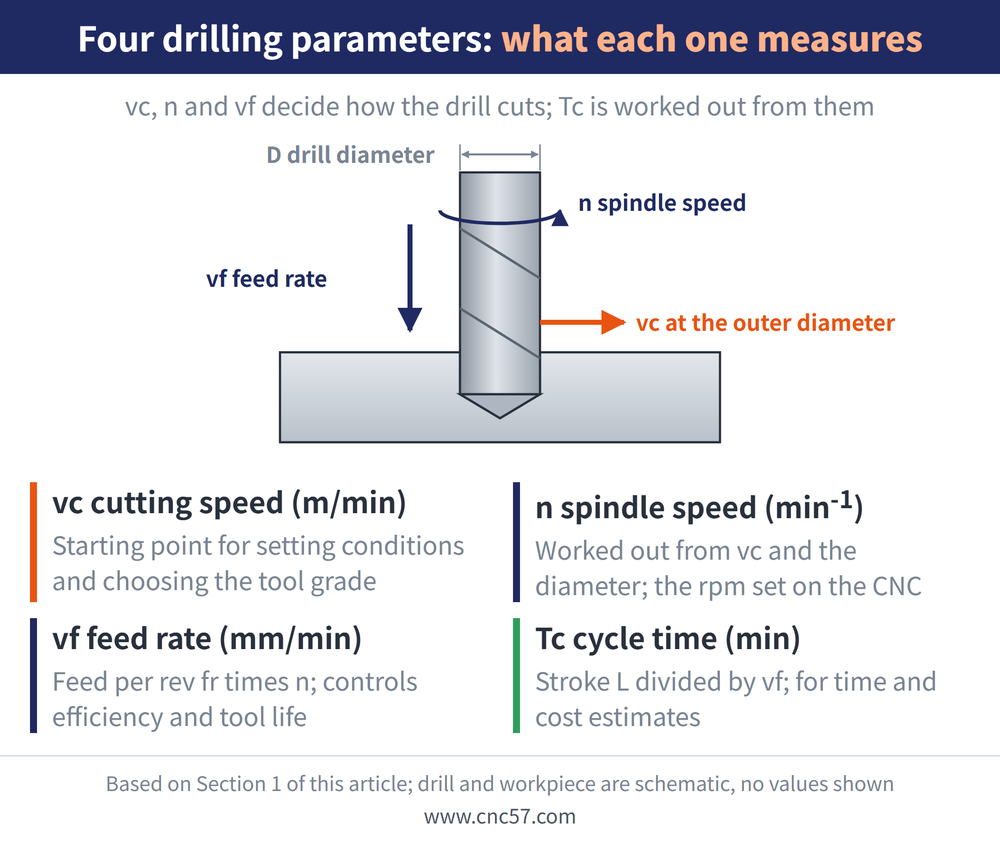
1. Core Parameters and Uses
| Parameter | Meaning | Use |
|---|---|---|
| vc | Cutting speed (m/min) | Set conditions, choose tool grade |
| n | Spindle speed (min⁻¹) | CNC rpm setting |
| fr / vf | Feed per rev (mm/rev) / feed rate (mm/min) | Control efficiency and tool life |
| Tc | Cycle time (min) | Time estimation, cost control |
2. The Three Basic Formulas
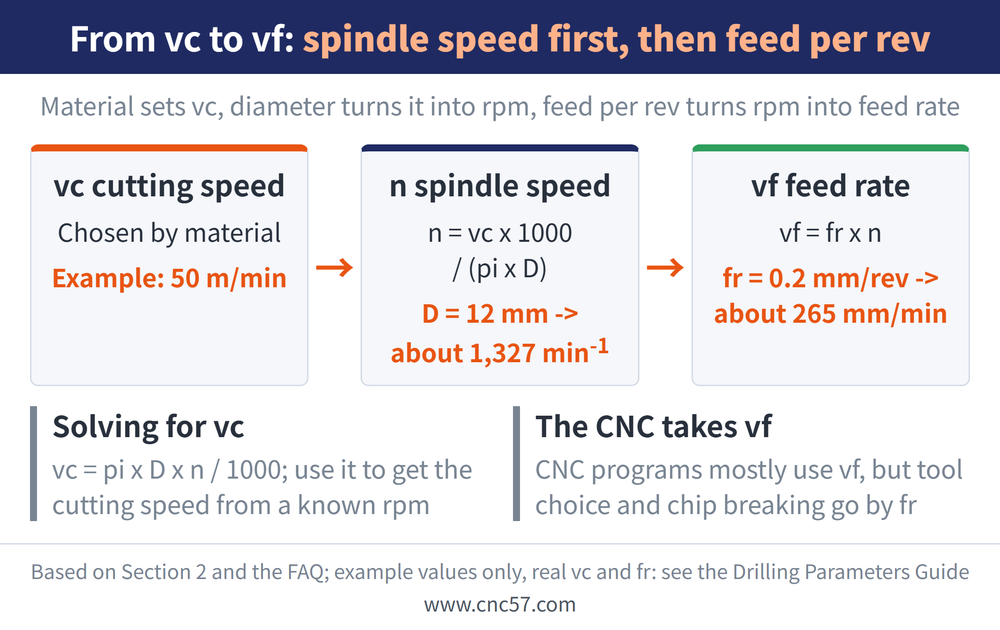
vc = π × D × n ÷ 1000 | n = (vc × 1000) ÷ (π × D) | vf = fr × n
D is drill diameter (mm), n is spindle speed (min⁻¹), fr is feed per revolution (mm/rev), vf is feed rate (mm/min), and π ≈ 3.14. For choosing vc and fr by material and checking clamping and spindle power, see the Drilling Parameters Guide; for converting between diameters, see Drilling Parameter Conversion. This article focuses on the next step: once the conditions are set, how long does one hole, or a batch of holes, take?
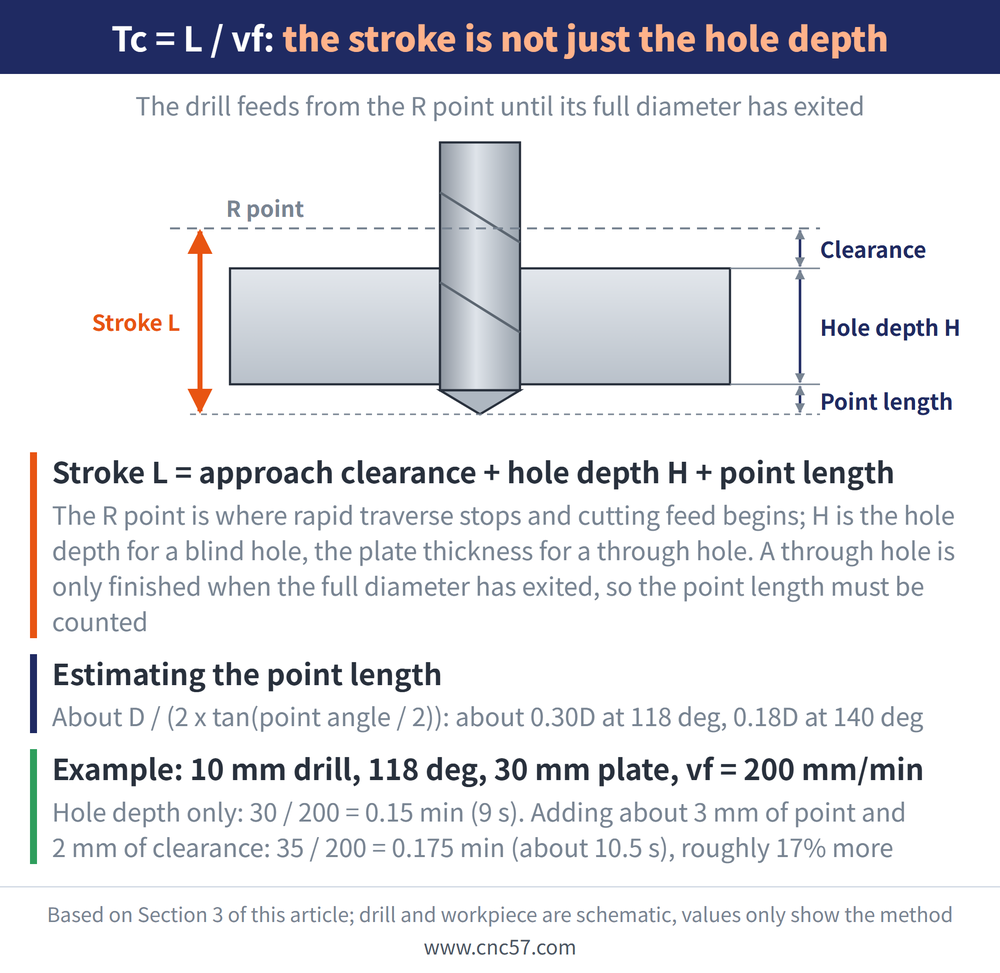
3. Cycle Time: The Stroke Is More Than the Hole Depth
Tc = L ÷ vf
The common shortcut takes L as the hole depth, but the distance the tool actually travels at cutting feed is longer:
| Part of the stroke | How to work it out |
|---|---|
| Hole depth H | Hole depth for a blind hole; plate thickness for a through hole |
| Point length | About D ÷ (2 × tan(point angle ÷ 2)): about 0.30D at 118°, 0.18D at 140° |
| Approach clearance | Distance from the R point (where rapid traverse stops and cutting feed begins) to the workpiece surface |
A through hole is only finished when the full diameter has exited, so the point length must be counted.
Illustrative calculation (figures only show the method): φ10 drill, 118° point, through a 30 mm plate, assuming vf = 200 mm/min. Hole depth only: 30 ÷ 200 = 0.15 min (9 s). Adding about 3 mm of point and 2 mm of approach clearance: 35 ÷ 200 = 0.175 min (about 10.5 s), roughly 17% more.
4. Multiple Holes: Do Not Forget the Non-Cutting Moves
Total time for a multi-hole part = the sum of each hole's cutting time + rapid moves between holes + the return to the R point at every hole. The more holes and the shallower they are, the larger the share of non-cutting time; with peck drilling, every retract and re-entry adds distance too — see Peck Drilling for the settings.
For quoting and scheduling, CAM simulation or the machine's measured cycle time is the most accurate; if you must calculate by hand, at least estimate the non-cutting moves rather than multiplying a single-hole Tc by the hole count.
5. Calculation Workflow
| Step | Action |
|---|---|
| 1 | Choose cutting speed vc (by material) |
| 2 | Compute spindle speed n from diameter |
| 3 | Set feed per rev fr |
| 4 | Compute feed rate vf |
| 5 | Work out the stroke L (point and approach included), then the cycle time Tc |
6. Optimization Tips
| Aspect | Direction |
|---|---|
| Speed & feed | Higher feed raises efficiency; lower speed reduces wear |
| Tool choice | HSS for medium speed; carbide (tungsten) for high speed |
| Coolant | Internal coolant raises efficiency and cuts heat effects |
Calculated values still need tuning for material, diameter and depth; use chip form as a live indicator — see Drill Chip Formation Guide.
FAQ
Q: How do I calculate cutting speed vc?
vc = π × D × n ÷ 1000, where D is drill diameter (mm) and n is spindle speed (min⁻¹). To solve for rpm instead, use n = (vc × 1000) ÷ (π × D).
Q: What is the difference between vf and fr?
fr is feed per revolution (mm/rev); vf is feed per minute (mm/min); they relate by vf = fr × n. CNC usually sets vf, but tool selection and chip breaking often reference fr.
Q: How do I estimate drilling cycle time?
Tc = L ÷ vf, where L is the distance travelled at cutting feed: hole depth plus point length (about 0.30D at 118°) and approach clearance. For multiple holes, add the rapid moves and retracts between holes before using it for quoting and scheduling.
Q: Can I use the calculated values directly?
They are a starting point. Tune for material, diameter, depth and machine rigidity, and adjust by observing chips and tool wear rather than copying values verbatim.
For the full reading guide on this topic, see Machining Calculation Reading Guide.
This article is part of Drill Bits: The Complete Guide - Start From Depth-to-Diameter, Then Pick the Drill and Set the Conditions; that guide shows how the whole topic fits together.
Published: 2026-03-25 | Last updated: 2026-10-12









