
Engineering Ceramics in Four Types: Alumina, Zirconia, Silicon Nitride and Ferrite Compared
When a customer brings in a ceramic part and asks whether it can be machined, the first step is identifying which type it is. This article compares alumina, zirconia, silicon nitride and ferrite by composition, properties and use, and explains why all four are difficult for the same underlying reason.
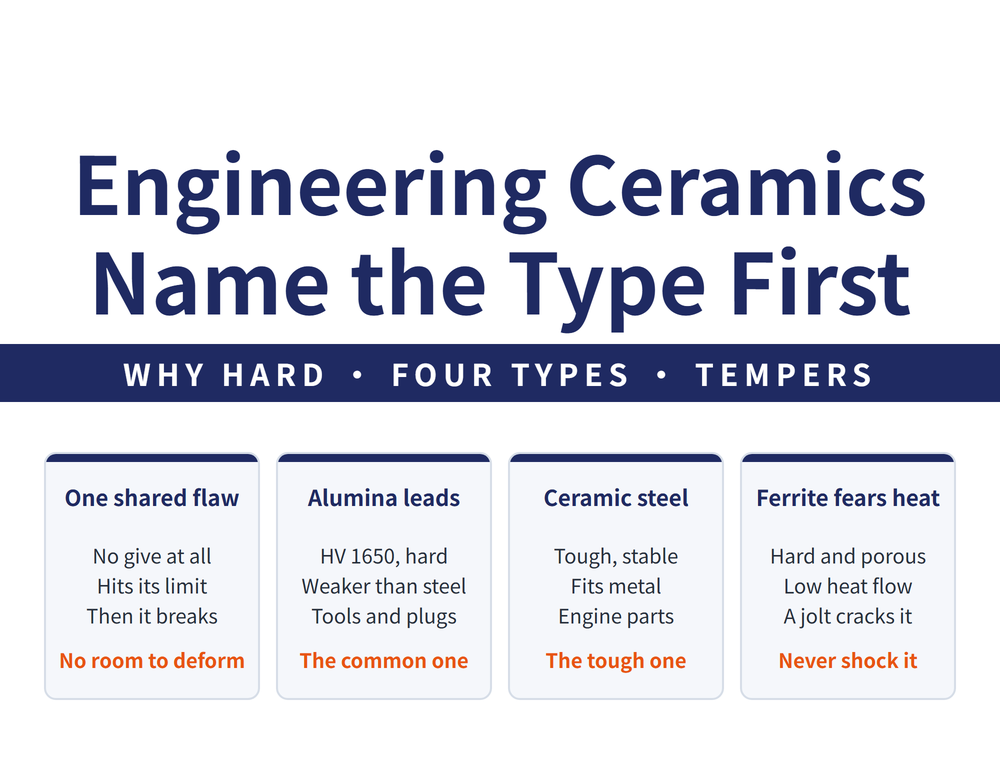
1. First, this ceramic is the workpiece, not the tool
🔴 "Ceramic" means two completely different things in machining. One is a tool material — a ceramic insert used to cut other things. The other is a workpiece material — a ceramic part, the thing being cut.
This article is about the second: when a customer brings a ceramic part and asks whether it can be machined, you first need to know which type it is. For choosing ceramic cutting tools, a separate subject, see Ceramic Cutting Tool Guide: Choosing Between Alumina, SiAlON and Whisker-Reinforced.
📌 The chemistry can even overlap — both may be alumina — but the question asked is the opposite: of a tool you ask how long it lasts, of a workpiece you ask how it will fail.
2. All four are difficult for the same reason
The advantages come as a list: high strength, high hardness, low density, low expansion, wear and corrosion resistance, thermal insulation and chemical stability — hence their use in aerospace, petrochemicals, marine, electronics and automotive.
🔑 But the forming route and the crystal structure impose three shared traits, and those three are the root of the machining difficulty:
| Trait | What it means in the cut |
|---|---|
| High brittleness | It never yields, it only cracks |
| Low fracture toughness | Once a crack starts it is not stopped |
| Elastic limit close to strength | 🔴 No plastic buffer — reaching the limit means fracture |
⚠ The third is where metal-cutting instinct misleads. Metal yields past its elastic limit and gives you warning; ceramic has no such stage, which is why its machinability differs so far from metals.
Monocrystalline silicon is the same kind of hard, brittle material that cracks rather than deforms at room temperature; its grinding characteristics and fixed cleavage directions are covered in Grinding Monocrystalline Silicon.
3. Porosity cuts both ways
Structurally, engineering ceramics consist of grains, a glassy phase and a gas phase. The glassy phase runs 20–40% by volume, bonding the grains, filling voids and raising density.
Pores are a by-product of production: 5–10% porosity in ordinary ceramics, under 5% in specialist and functional grades.
⚠ Their effect runs in both directions: porosity lowers strength, raises dielectric loss and reduces insulation, while improving thermal insulation and shock resistance. High porosity is therefore not automatically poor quality — it depends what the part is for.
4. The four types at a glance
| Type | Position | Typical uses |
|---|---|---|
| Alumina Al₂O₃ | Widest use, largest volume | Cutting tools, blast nozzles, spark plugs, wire dies, IC substrates, furnace tubes |
| Zirconia ZrO₂ | Toughest, known as "ceramic steel" | Engine cylinder liners and pistons, unlubricated bearings, press and extrusion dies, pump parts |
| Silicon nitride Si₃N₄ | Heat resistant, lowest expansion | Diesel glow plugs, cutting tools, high temperature bearings, turbine rotors, crucibles |
| Ferrite | Magnetic ceramic, least tolerant of temperature change | Transformer cores, magnetrons, microwave devices, memory elements, ultrasonic devices |
🔑 Establish the type before quoting. Hardness, toughness and heat sensitivity differ widely across the four, and applying zirconia experience to ferrite will crack the part in front of you.
📌 Once you know the type, where to look for how to machine it: for grinding, how to choose between diamond and CBN wheels and which one suits ceramics is covered in Diamond or CBN Wheels; for single-crystal silicon, which likewise cracks rather than deforms, see Grinding Monocrystalline Silicon; and for materials such as silicon nitride, where a tool breaks down quickly in direct turning, laser assist preheats the work to soften it locally, see section 5 of Two Assisted Routes for Difficult Materials.
5. Alumina, alongside steel and aluminium
Alumina occurs mainly as the α and γ forms, sintered above 1600 °C, usually with MgO, CaO or SiO₂ as sintering aids. Its figures mean little alone, so set them beside steel and aluminium:
| Material | Hardness HV | Strength MPa | Modulus GPa | Conductivity W/(m·K) |
|---|---|---|---|---|
| Al₂O₃ (pressureless) | 1650 | 350 (flexural) | 330–390 | 17 |
| Al₂O₃ (99%) | 1600 | 280–310 (flexural) | 330 | 34 |
| Steel | 450–650 | 586 (tensile) | 100–120 | 50.2 |
| Aluminium | 100–150 | 150 (tensile) | 71 | 155 |
🔴 Around three times the hardness of steel, yet lower strength — that pair of figures is "hard and brittle" put into numbers. ⚠ The ceramic rows are flexural and the metal rows tensile, different tests, so compare orders of magnitude rather than subtracting.
📌 Alumina measures 97 HRA, and still 80 HRA at 1200 °C; adding TiC, TiN, TiB₂ or SiC raises impact toughness, flexural strength and thermal shock resistance.
6. Zirconia: where "ceramic steel" comes from
Zirconia has three forms that interchange with temperature: monoclinic (below 1150 °C) → tetragonal (950–2370 °C) → cubic (above 2370 °C).
🔴 The monoclinic to tetragonal transition changes volume abruptly, expanding by as much as 7% — which is why pure zirconia often cracks itself after firing.
The answer is a stabiliser (MgO, CaO or Y₂O₃): enough of it gives stabilised zirconia (SZ), holding the high temperature cubic form at room temperature; deliberately too little gives partially stabilised zirconia (PSZ), with excellent strength and fracture toughness — the origin of the "ceramic steel" name.
| Form | Properties and use |
|---|---|
| Stabilised, SZ | Low heat capacity and conductivity, an ideal high temperature insulator; resists acids and neutrals but not alkalis; a good electrical insulator |
| Partially stabilised, PSZ | Flexural strength 430–800 MPa, hardness HV1500, expansion 9.2×10⁻⁶/°C, modulus 210 GPa |
🔑 The larger expansion coefficient of PSZ is an advantage — it matches metal more readily, which is what makes ceramic-metal composite engine parts possible.
7. Silicon nitride and ferrite: their own tempers
Silicon nitride is covalently bonded and has no melting point (it decomposes and sublimes around 1900 °C). Its high temperature mechanical properties are stable, its expansion coefficient is the lowest among non-oxide ceramics, and its fracture toughness is markedly above silicon carbide. A SiO₂ layer forms at high temperature, giving good oxidation resistance; friction is low, and it neither wets nor corrodes in molten metal.
⚠ It is hard to sinter to density, requiring sintering aids even under hot pressing, so price and lead time both need checking. Properties vary widely with route: reaction bonded gives 340 MPa flexural, HRA 83–85, while pressureless sintered reaches 800–850 MPa, HRA 87.
🔴 Ferrite is the one to watch: iron oxide based, with strontium or barium oxides added. It is hard, brittle, porous, low in thermal conductivity and sensitive to heat, so a sudden temperature change cracks it — a textbook difficult hard, brittle material.
📌 Ferrites divide into five groups by application: soft magnetic (transformer cores, recording heads), hard magnetic (magnetrons, lifting magnets, automotive motors), gyromagnetic (microwave devices), square loop (memory, switching and logic elements) and magnetostrictive (ultrasonic and underwater acoustic devices, pressure sensors). For the wider material selection picture, see Workpiece Materials: The Complete Guide - Name the Metal First, Then Match the Tool.
8. Frequently Asked Questions (FAQ)
Q: Is the ceramic here the same thing as a ceramic insert?
No. Ceramic has two identities in machining: a tool material, the ceramic insert used to cut other things, and a workpiece material, the ceramic part being cut. This article covers the second. The chemistry may even overlap, since both can be alumina, but the question is reversed — of a tool you ask how long it lasts, of a workpiece you ask how it will fail.
Q: Why are engineering ceramics so difficult to machine?
Three shared traits: high brittleness, low fracture toughness, and an elastic limit sitting very close to the strength. The third matters most — metal yields past its elastic limit and gives warning, while ceramic has no such stage and fractures at the limit. That is why ceramic machinability differs so far from metal, and why metal-cutting experience carried straight across leads to misjudgement.
Q: Why is zirconia called "ceramic steel"?
Because partially stabilised zirconia has excellent strength and fracture toughness. Pure zirconia changes volume abruptly at the monoclinic to tetragonal transition, expanding as much as 7%, so it often cracks itself after firing; adding MgO, CaO or Y₂O₃ as a stabiliser solves that, and deliberately under-dosing the stabiliser produces the partially stabilised form. Its larger expansion coefficient is an advantage, matching metal more readily, which enables ceramic-metal composite engine parts.
Q: Which of the four causes the most trouble in process?
Ferrite. It is hard, brittle and porous, and on top of that its thermal conductivity is low and it is sensitive to heat, so a sudden temperature change will crack it. In other words it carries the usual hard, brittle material problems plus a thermal shock risk. Confirm which ceramic the customer's part actually is before quoting or planning the process, rather than carrying zirconia experience straight across.
Published: 2026-09-21 | Last updated: 2026-10-26









