
Face mills (shell mills) don't have a shank you can grip like an end mill - instead they're centered and locked to a shell mill arbor, with torque carried through a face drive key. This guide explains the arbor's structural components, how it mates with the spindle, and what to check during selection and assembly.
1. What Problem the Shell Mill Arbor Solves
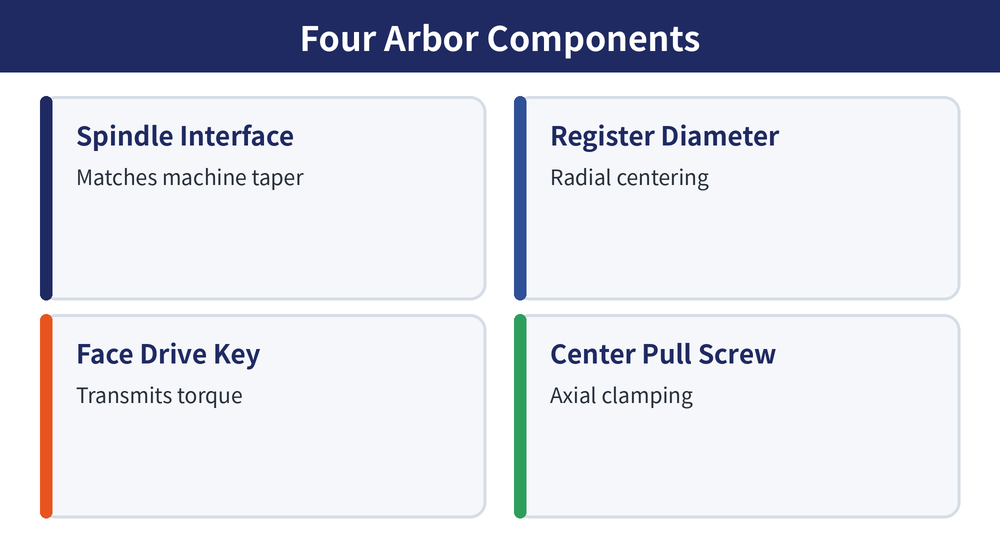
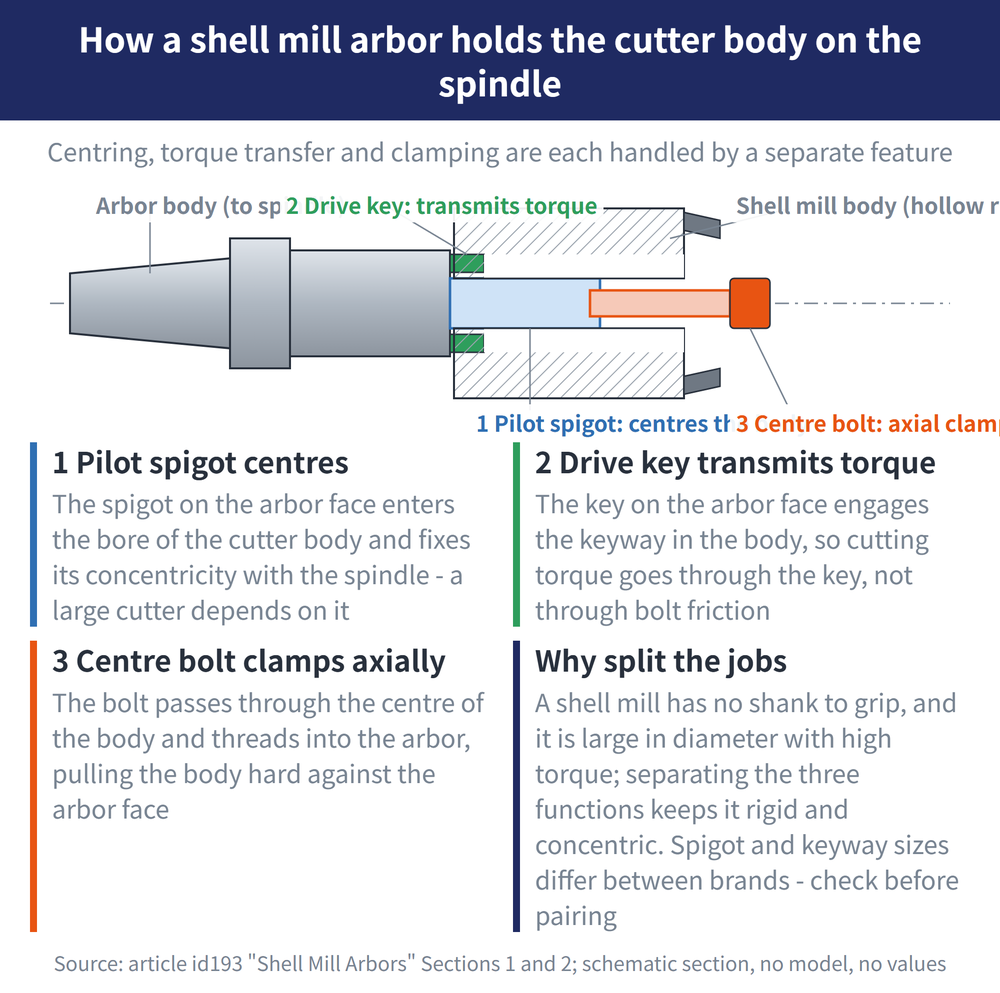
A face mill (shell mill) body is a hollow, ring-shaped cutter - unlike an end mill, it has no full-length shank that a collet or chuck can grip directly. Instead, the cutter body must be centered by a shell mill arbor passing through its bore, with a register and drive key on the arbor's face transmitting torque, and a center pull screw (center bolt) clamping the cutter body against the arbor's face. In effect, the shell mill arbor bridges the "spindle interface" and the "face mill body."
The full taper picture: see Spindle Taper Systems Overview.
2. Structural Components of a Shell Mill Arbor
| Component | Function |
|---|---|
| Spindle interface end | Machined to the machine's spindle taper (BT, ISO, HSK, etc.), just like any other holder - must match the machine spec |
| Register diameter | A locating fit between the arbor's front face and the face mill body's bore, responsible for radial centering |
| Drive key / face key | Engages a keyway in the cutter body's face, transmitting cutting torque and preventing the cutter body from slipping |
| Center pull screw | Passes through the arbor's center to axially clamp the cutter body against the arbor's face |
This combination - register-diameter centering, face-key torque transfer, and center-screw axial clamping - is the general design logic behind shell mill arbors, intended to hold a large-diameter, high-torque face mill body securely on the spindle while maintaining good concentricity.
Balance at high rpm: see Tool Holder Balance Grade (G Value).
3. Selection and Assembly Checklist
| Item | Notes |
|---|---|
| Spindle interface spec | Must exactly match the machine's spindle taper type (BT, ISO, HSK, etc.) - see Spindle Taper Systems Overview |
| Register diameter vs. cutter bore | The arbor's register diameter must match the face mill body's bore for correct concentricity |
| Face key engagement | Confirm the drive key is fully seated in the cutter body's keyway during assembly, so no play remains after clamping |
| Pull screw torque | Tighten to the manufacturer's specified torque - under-tightening risks loosening during machining, over-tightening can damage the threads |
| Cleanliness and rust prevention | Keep the register face and mating contact surfaces clean; rust or contamination degrades seating accuracy - see Tool Holder Maintenance Guide |
Exact tolerances and keyway dimensions for shell mill arbors and cutter bodies vary by manufacturer. Always match against the OEM specification for the specific face mill body and arbor - arbors and cutter bodies from different brands are not necessarily interchangeable, so confirm the register diameter and keyway dimensions match before assembly.
Holder care and life: see Tool Holder Maintenance Guide.
FAQ
Q1: How is a shell mill arbor different from a regular end mill holder?
A regular end mill holder (such as an ER collet chuck or side-lock holder) grips a cylindrical shank directly. A shell mill arbor instead mates with a face mill that has no full shank - a hollow, ring-shaped body - centering it via a register diameter, transmitting torque through a face key, and clamping it with a center pull screw. It's a fundamentally different clamping mechanism, and the two are not interchangeable.
Q2: Can shell mill arbors and cutter bodies from different brands be mixed?
Not recommended. Register diameters, face keyway dimensions, and pull screw specs can differ between brands - even if parts look similar, correct centering and clamping aren't guaranteed. Mixing brands risks poor concentricity or an incomplete keyway engagement. Confirm compatibility against both manufacturers' specifications before assembly.
Q3: Why does the face mill body wobble after mounting on the arbor?
Common causes include contamination or rust on the register face or cutter bore preventing proper seating, the face drive key not fully engaging the keyway, insufficient pull screw torque, or a register diameter that doesn't actually match the cutter body's bore (for example, from mixing brands). Check cleanliness, key engagement, and torque in that order; if the problem persists, verify that the arbor and cutter body specs are actually compatible.
Q4: Does a shell mill arbor need a balance grade too?
Yes, especially for high-speed applications. Once assembled, the arbor and face mill body together form a rotating assembly, and balance grade (e.g. G2.5/G6.3) affects both cutting stability at high speed and spindle life, just as with any other holder - see Tool Holder Balance Grade G2.5/G6.3 and High-Speed Spindles for the underlying principles. The actual required grade should follow the machine's spindle speed and the manufacturer's recommendation.









