
How to Write a Cutting Tool RFQ (Request for Quotation): Part Number, Specs, Work Material, Quantity and Lead Time in One Go
Fill in three areas of a cutting tool RFQ (request for quotation) in one go and the supplier will not need to come back with questions: the tool itself (the full part number copied exactly, or the specs if there is no part number, and whether "standard" means conforming to a standard or the maker's stock item), where it will be used (work material and hardness, machine and holder, operation), and how many and by when (quantity, required date, whether substitutes are acceptable). If the catalog does not have it, first ask whether a semi-standard tool will do; when quotes come back, compare cost per part, not unit price.
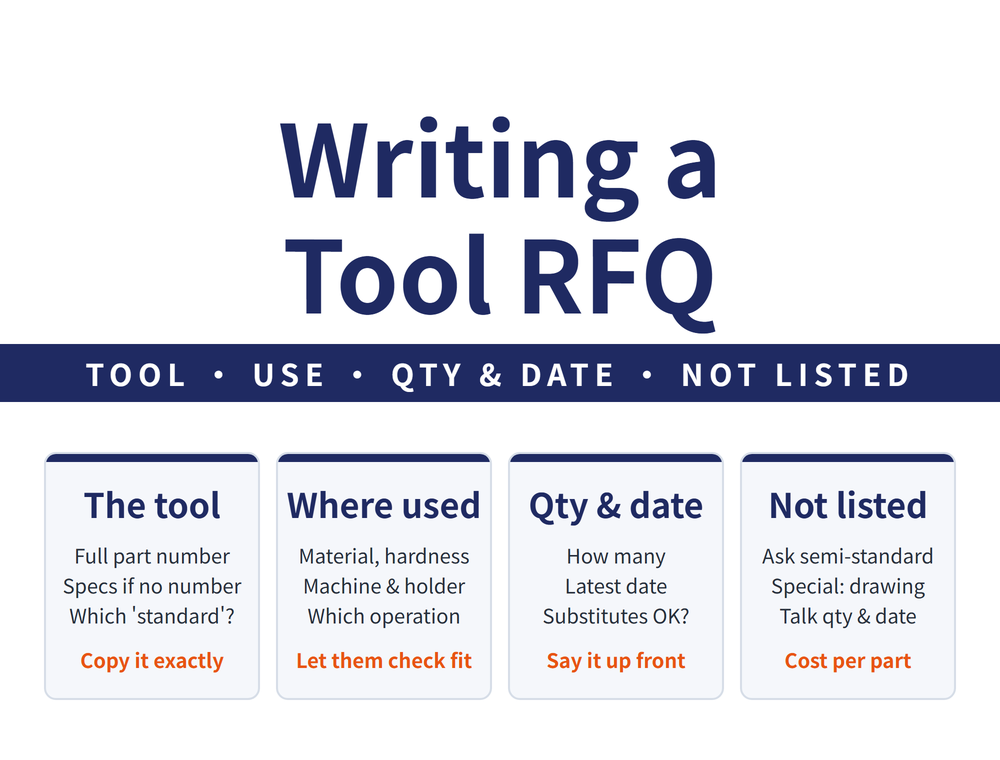
1. Split the RFQ into three areas: the tool, where it is used, how many and by when
Split it into the three areas below and fill in every box before you send it:
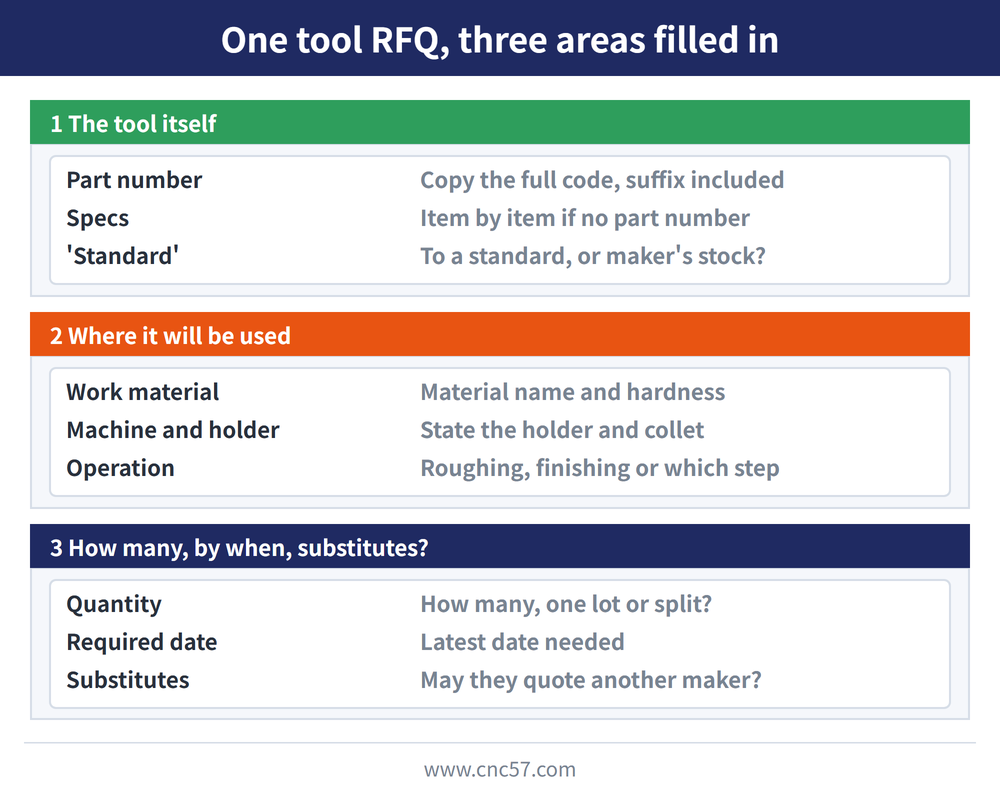
Reamers have seven classification axes to fill in on top of this; see Choosing a Reamer: Seven Classification Axes, 15 Types, Flutes and Angles. This article is the general version for any cutting tool. If you are outsourcing the machining of a part rather than buying a tool, you need to prepare different things; see From Quote to Delivery: The Stages a Part Passes Through.
2. Field checklist: what the supplier may ask when a box is left empty
The third column shows what the supplier may ask if that box is left empty:
| Field | Why it matters | What they may ask if it is missing |
|---|---|---|
| 1 The tool itself | ||
| Part number (full code) | Grade and suffix codes are defined by each maker | Which grade, which chipbreaker? |
| Specs (if no part number) | Lets the supplier find a matching item from the specs | What type of tool, what dimensions? |
| Which "standard" | Conforming to a standard and a maker's stock item are not always the same | To a standard, or from stock? |
| 2 Where it will be used | ||
| Work material and hardness | Lets the supplier judge whether the tool fits | What material, how hard? |
| Machine and holder | Whether a collet can hold the tool depends on its marked clamping range | Which holder, which collet? |
| Operation | Tells the supplier what the tool has to do | Roughing, finishing, or which step? |
| 3 How many, by when, substitutes? | ||
| Quantity | Lets the supplier judge whether stock is enough | How many? One lot or split? |
| Required date | Lets the supplier judge whether they can make it | What is the latest date? |
| Substitutes accepted? | If the part number is out of stock, can they quote another maker? | Is another maker's equivalent OK? |
3. Area 1: copy the full part number, and say which "standard" you mean
Copy the whole part number, suffix included. The grade, chipbreaker and suffix codes at the end of a part number are defined by each maker; with only the front part, the supplier may not be able to tell which tool you mean. Which spec fields line up across makers is covered in Comparing Cutting Tool Brands: Which Spec Fields Line Up, and Which Only Count Within One Catalog.
If there is no part number, write the specs instead: the tool type and its dimensions, item by item; if you have the old tool or a drawing, send it along.
⚠ When you write "standard item", say which kind you mean: "standard" may mean conforming to a national or international standard, or it may only mean the maker's own stock range. The two are not always the same; a stock item may also conform to a standard, but you cannot assume that a stock item equals a standard specification.
For high-speed steel tools, the same grade comes in a conventionally melted and a powder metallurgy version, so state which one you need; see HSS Grades Decoded: SK, SKH, M/T Series, Cobalt and Powder Metallurgy.
4. Area 2: work material, machine and holder, operation
Taking mold milling as an example, tool selection goes in this order: application conditions first, then cutting geometry, and the grade last; if the material, hardness, machine or holding changes, it is worth going through the steps again. See Three Steps for Mold Milling Tool Selection: Application, Geometry, Grade, In That Order. This area gives the supplier the conditions to judge whether the tool fits.
For machine and holding, go down to the holder and the collet. Whether a φ11.8 tool can go in a φ12 collet depends on the clamping range marked on that collet, not just its nominal diameter; state the holder and collet you have, or send a photo.
Also be clear whether you are buying something that holds the tool or something that holds the workpiece. Even when both use hydraulic pressure, a hydraulic tool holder clamps the tool and a hydraulic fixture clamps the workpiece; specs, selection logic and suppliers all differ. See Hydraulic Workholding Basics: Pascal's Principle, System Layout, Air vs Hydraulic.
For the operation, say which step the tool is for: roughing, finishing, or drilling, tapping and so on.
5. Area 3: quantity, required date, substitutes
For quantity, write how many you need this time and whether you buy in one lot or in batches; for the date, write the latest date you need it, not "as soon as possible".
State clearly whether substitutes are acceptable: only the specified part number, or another maker's equivalent may be quoted. If substitutes are fine, how to run a trial cut and what to compare before switching is covered in Switching Cutting Tool Brands: What to Check First, How to Run the Trial Cut, and Deciding on Cost per Part.
6. Not in the catalog: what extra to give for standard, semi-standard and special tools
If the tool you need is not in the catalog, first be clear which kind you are asking for:
| Type | What it is | What else to give in the RFQ |
|---|---|---|
| Standard | A toolmaker's mass-produced item; versatile, with dependable lead time | Fill in the three areas above |
| Semi-standard | A simple modification of a standard tool, such as a different corner radius or tool length | Which standard tool to start from, and what to change |
| Special | Designed for a specific operation on a specific part | Send the part drawing; discuss quantity and lead time together |
📌 First ask whether a semi-standard tool will do: it can be made relatively quickly, although the modification range is limited.
A special tool goes through design and coordination with the customer before production, its lead time is long, and it no longer fits once the part changes; it is mainly used in mass production, so quantity and lead time have to be discussed together. For the three types seen from the inventory side, see Too Many Items in the Tool Crib? Trimming Cutting Tool Inventory with Standardization, Dead-Stock Checks and Safety Stock.
7. When the quotes come back: compare cost per part, not unit price
The first thing to look at when choosing a tool is the cost of that operation and its effect on the cost per unit of the whole part. Tool cost is a small share of the cost per unit, but its indirect effect can be large, because the tool is often what keeps the machine from running faster.
Purchase price is not the cost of use; a low unit price does not guarantee savings, and a high one is not necessarily worth it, so let figures from actual testing decide. How to work out tool cost per part and run the trial cut is covered in Switching Cutting Tool Brands: What to Check First, How to Run the Trial Cut, and Deciding on Cost per Part.
Recommended cutting conditions attached to a quote only count within that maker's catalog; for the conversion, see End Mill Cutting Conditions Guide | Speed, Feed Rate and Calculation Explained.
8. Frequently Asked Questions (FAQ)
Q: Which fields must a cutting tool RFQ include?
Three areas: the tool itself (full part number or specs), where it will be used (work material and hardness, machine and holder, operation), and how many and by when (quantity, required date, whether substitutes are acceptable).
Q: I wrote "standard item" in the RFQ. Why does the supplier still ask?
"Standard" may mean conforming to a national or international standard, or it may mean the maker's own stock item, and the two are not always the same; say which one you mean.
Q: The tool I need is not in the catalog. How do I ask for a quote?
First ask whether a semi-standard tool will do, that is, a simple modification of a standard tool such as a different corner radius or tool length, which can be made relatively quickly. If you really need a special tool, send the part drawing and discuss quantity and lead time together.
Q: I have quotes from two suppliers. How do I compare them?
Compare cost per part, not unit price. Purchase price is not the cost of use; a low unit price does not guarantee savings, and a high one is not necessarily worth it.
When you put this into practice, the full cutting tool range filters by requirement; for spec questions, ask us on LINE.
Published: 2026-10-28 | Last updated: 2026-10-28









