
How to Choose Tool Material by Tool Type: Milling, Drilling, Tapping, Reaming
The same HSS or carbide lands on different recommendations depending on whether it is a milling cutter, a drill, a tap or a reamer. This guide helps you decide what the tool in your hand should be made of: work out how that tool type is loaded, then map it to a material. A practical selection matrix for the four tool types is included, so you can pick straight from the tool type.
1. The two material camps: how HSS and tungsten carbide divide the work
In practice you pick from two camps: HSS (high-speed steel) and tungsten carbide. HSS is tough, regrindable and cheap, and holds its hardness up to about 600°C (typical value); use it on large sizes, low-rigidity machines or where budget matters. Tungsten carbide is hard, wear-resistant and runs fast, but is pricier and more brittle, and dislikes vibration and interrupted cuts.
| Material camp | Strengths | Weaknesses | When to use |
|---|---|---|---|
| HSS (high-speed steel) | Tough, regrindable, cheap; holds hardness to about 600°C (typical value) | Lower hardness and wear resistance, lower usable cutting speed | Large sizes, low-rigidity machines, budget-driven jobs |
| Tungsten carbide | Hard, wear-resistant, high-speed capable | Pricier and brittle, dislikes vibration and interrupted cuts | High speed, hard-to-cut work, high accuracy and tool life demands |
For the full picture of materials see the Cutting Tool Materials Guide; for carbide grades and grain size see Carbide Grades Decoded; if you are stuck choosing between the two for an end mill, read Carbide vs HSS End Mills.
2. Why the material orientation differs by tool type
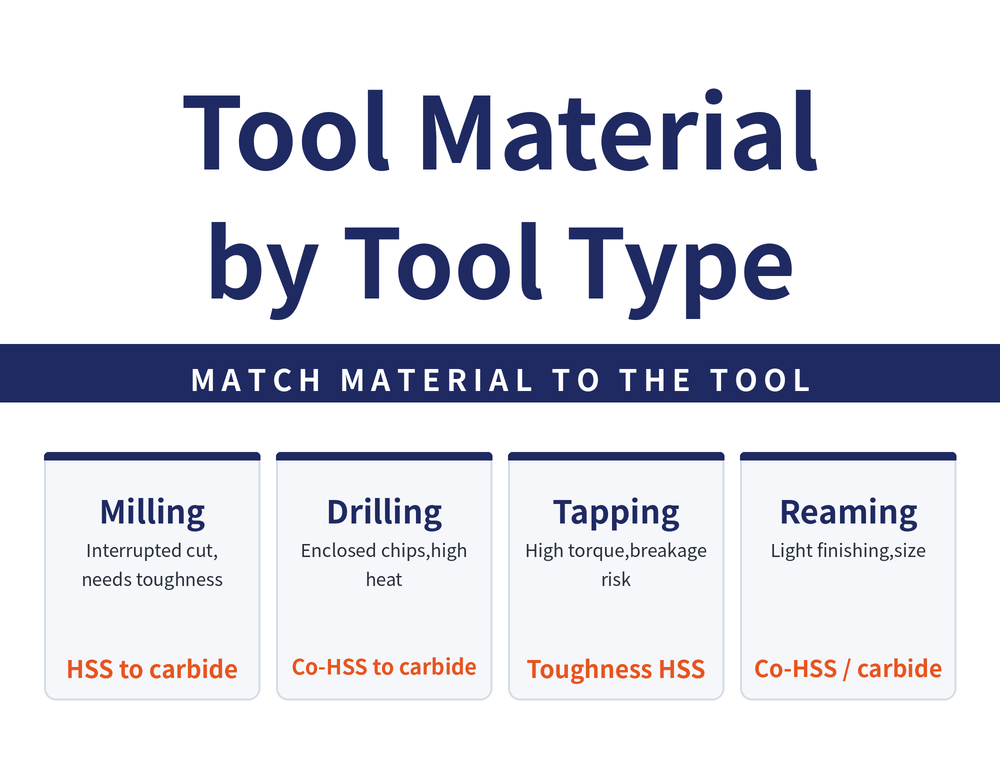
With the same two camps, different tool types get different recommendations, and the key is the load pattern. Milling cuts intermittently, drilling traps chips and heat, tapping carries high torque and risks snapping, and reaming is a light finishing cut — each cares about a different property.
| Tool type | Main load / risk | Material orientation |
|---|---|---|
| Milling cutter | Interrupted cut, edge repeatedly entering and exiting | Toughness against chipping |
| Drill | Enclosed chip evacuation, high heat build-up | Heat resistance |
| Tap | High torque, risk of snapping inside the hole | Toughness above all |
| Reamer | Light finishing cut | Dimensional stability and wear resistance |
3. Tool type × material selection matrix
Mapping the two camps onto four tool types, split by difficulty into entry, advanced and top tiers, gives the practical selection matrix below.
| Tool type | Entry / general | Advanced / hard-to-cut | Top / high-speed | Note |
|---|---|---|---|---|
| Milling cutter | HSS SKH51 | Cobalt HSS or powder HSS | Solid tungsten carbide (ultra-fine to extra-ultra-fine grain) + PVD coating | Go back to HSS only for large sizes or low rigidity |
| Drill | HSS SKH51 | Cobalt HSS (stainless, hard-to-cut) | Solid tungsten carbide (deep holes, hard-to-cut) | Brazed-tip or exchangeable-head are the cost and large-diameter options |
| Tap | HSS | Cobalt HSS or powder HSS | Carbide tap (special, brittle; needs rigidity and stable tapping) | Toughness matters most; carbon tool steel (e.g. SK2, softens at about 200°C, not high-speed steel) appears only on cheap hand taps |
| Reamer | HSS SKH51 | Cobalt HSS or powder HSS | Solid or brazed-tip tungsten carbide, CBN/PCD | Dimensional stability and wear resistance matter most |
SKH51 corresponds to US M2 (typical cross-reference, follow the catalogue); temperatures are typical values, follow the catalogue or standard. For grade decoding see Carbide Grades Decoded.
4. When to move up a tier
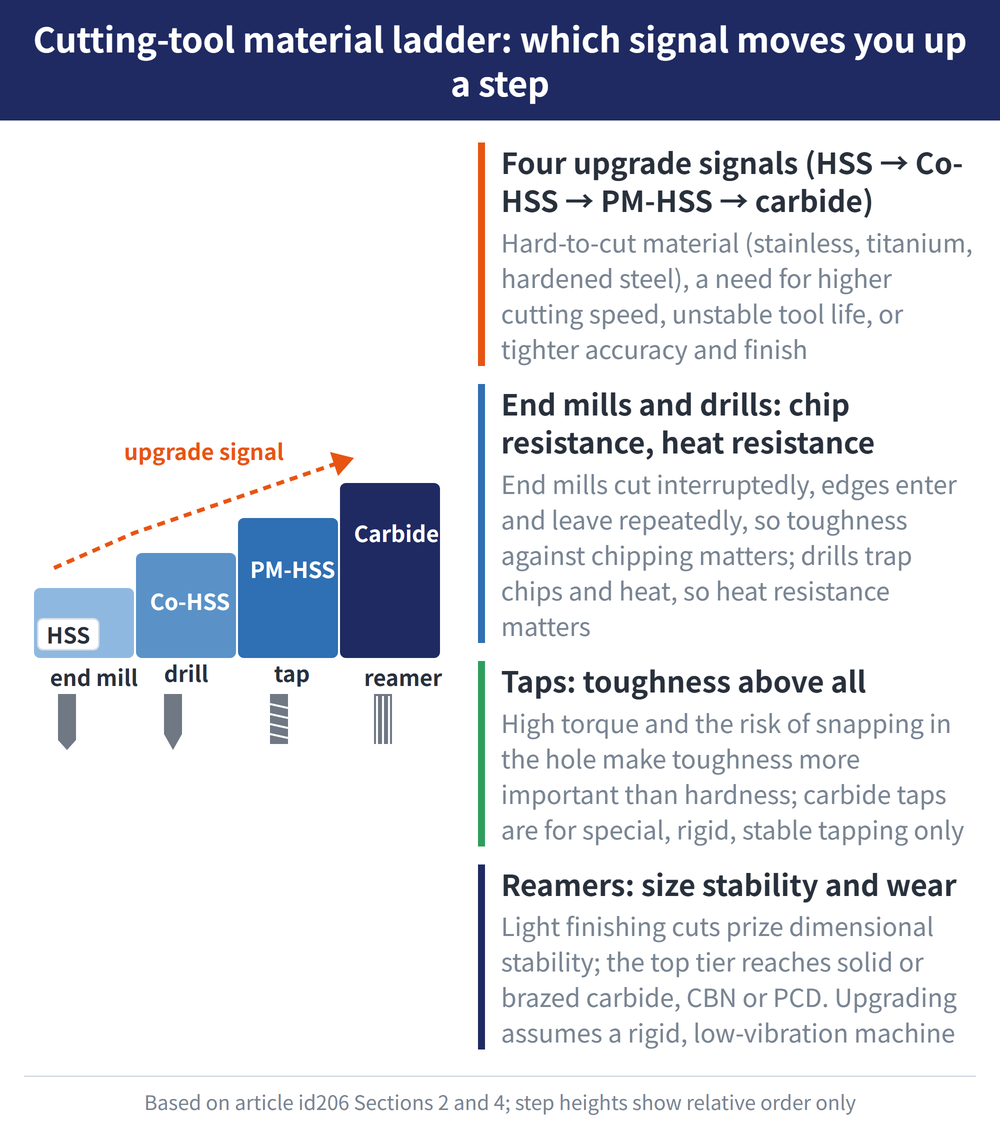
Material is not a one-step jump but a climb along HSS → cobalt HSS → powder HSS → tungsten carbide. When the signals below appear, move to the next tier.
| Upgrade signal | Which direction to move |
|---|---|
| Hard-to-cut material (stainless, titanium, high hardness) | HSS → cobalt HSS → powder HSS → tungsten carbide |
| Need to raise cutting speed | Toward cobalt HSS, powder HSS, tungsten carbide |
| Tool life is unstable | Upgrade the material or switch to solid tungsten carbide |
| Higher accuracy / surface requirement | Toward powder HSS, tungsten carbide |
First sort out which class the workpiece belongs to and what material orientation it calls for; for classification see the ISO workpiece material classification. After upgrading, do not guess cutting speed and feed — convert them with the end mill cutting conditions guide.
Last updated: 2026-10-21
5. Frequently Asked Questions (FAQ)
Q: Why does the same material get different recommendations for different tool types?
Because the load pattern differs: milling needs toughness against chipping, drilling needs heat resistance, tapping needs toughness to avoid snapping, and reaming needs dimensional stability. The same HSS or carbide therefore lands on a different orientation and tier per tool type.
Q: Are SK2 and SKH the same thing?
No. SK2 is a carbon tool steel that softens at about 200°C (typical value) and appears only on cheap hand taps, while SKH is high-speed steel with far higher heat resistance and usable cutting speed. They should not be treated as interchangeable.
Q: When is it worth switching from HSS to tungsten carbide?
When you hit hard-to-cut material, need higher cutting speed, see unstable tool life, or face tighter accuracy and surface demands, climb HSS → cobalt HSS → powder HSS → tungsten carbide. The precondition is a rigid, low-vibration machine, or carbide chips easily.
Q: Why don't taps chase the hardest possible material?
Because a tap carries high torque and its worst failure is snapping inside the hole, so toughness matters more than hardness. Too hard and brittle breaks more easily, so taps are mostly HSS, cobalt or powder HSS, with carbide taps reserved for special cases needing rigidity and stable tapping.
This article is part of Tool Materials and Coatings: The Complete Guide - Separate Substrate From Coating, Then Work Back From the Workpiece; that guide shows how the whole topic fits together.









